


More news on this day
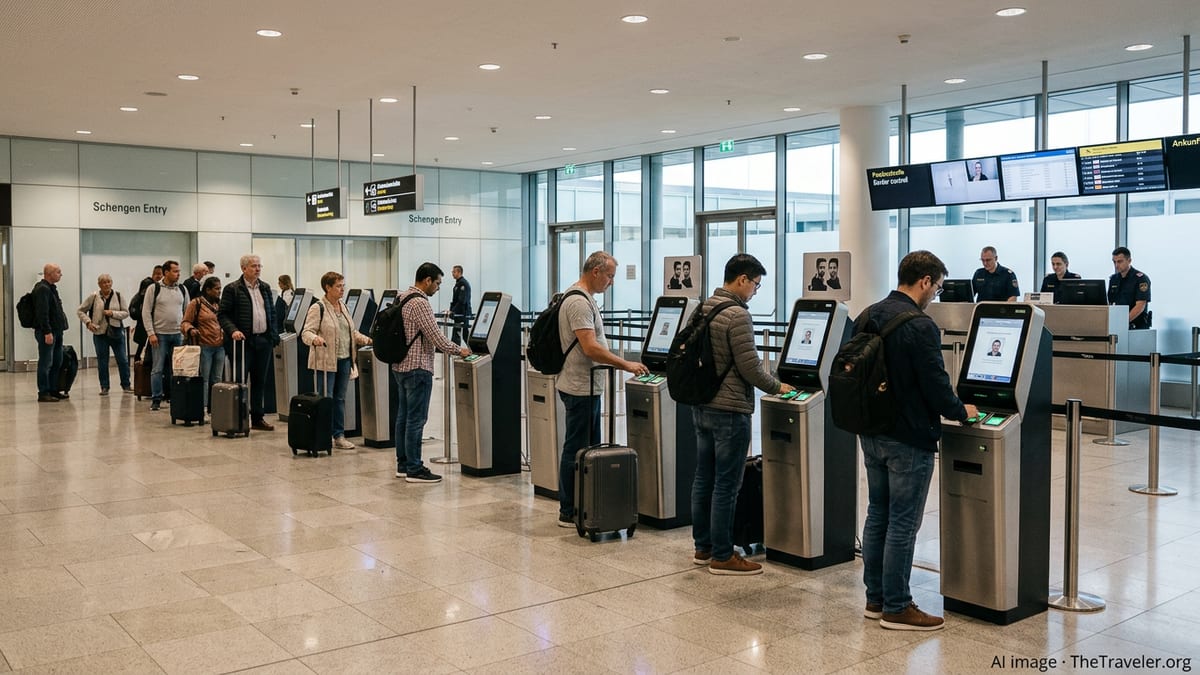
Airports serving the European Union’s external borders are grappling with longer queues and missed flights as the bloc’s new biometric Entry/Exit System reaches full deployment, transforming how non-EU travelers are checked in and out of the Schengen area.
Get the latest news straight to your inbox!
From delayed launch to full deployment
The Entry/Exit System, known as EES, is the European Union’s new digital border database for non-EU nationals crossing the external frontiers of the Schengen area. After several postponements, the system entered service in October 2025 and has since been rolled out at land, sea and air crossing points in 29 participating European countries.
Publicly available information from EU institutions describes EES as a replacement for manual passport stamping. Instead of ink stamps, the system records each traveler’s personal details, the time and place of entry and exit, and biometric identifiers such as facial images and fingerprints. The aim is to tighten security, automate overstay calculations and speed up future border crossings for returning visitors.
An official launch date in October 2025 was followed by a phased introduction, with member states allowed to bring individual border posts online in stages. An EU infographic on the scheme describes this as a gradual process leading to full operational status by spring 2026, with some flexibility built in for busy travel periods.
Background documents from the European Parliament and the European Data Protection Supervisor indicate that eu-LISA, the EU agency responsible for large-scale IT systems, oversees the technical operation, while national border services handle data collection at airports and other crossings.
Queues and missed flights as first-time biometrics bite
As the biometric component of EES becomes mandatory at more airports, travelers arriving from non-EU countries are increasingly encountering longer waits at passport control. Reports from consumer travel outlets and national media point to bottlenecks at popular hubs handling high volumes of UK, US and other third-country passengers.
Travel coverage in early 2026 highlighted waits of up to two hours at some Schengen airports during busy periods, particularly for passengers who had never enrolled in EES before and therefore had to provide a full set of fingerprints and facial scans. Commentators note that once this initial registration is complete, subsequent crossings should be faster, as repeat travelers need to provide fewer biometrics.
Industry-focused reporting describes how, during the phased rollout, manual passport stamping continues alongside digital registration in some locations, effectively duplicating checks. Aviation analysts warn that this combination can slow processing, with border officers switching between new kiosks, legacy booths and separate IT systems.
Accounts shared by travelers on social media and forums echo these concerns, describing extended queues at passport control and, in some cases, passengers missing onward connections after bottlenecks at arrival checkpoints. The experiences vary widely between airports, depending on staffing levels, physical layout and how far the local EES deployment has progressed.
Airlines and airports warn of summer strain
European aviation bodies have repeatedly raised alarms about the impact of EES on peak-season travel. According to coverage in European newspapers and broadcast interviews, airline and airport associations have warned of the risk of queues stretching to several hours at major hubs if full biometric registration is enforced for all eligible passengers during the height of summer.
In public statements reported by outlets such as The Independent, industry groups argue that border control staffing and infrastructure have not kept pace with the added complexity of biometric checks. They point to technology glitches, limited numbers of functioning kiosks and the continued need for manual intervention for families, elderly travelers and those unfamiliar with self-service systems.
Travel industry reporting indicates that carriers and airports have urged the European Commission and national governments to use the system’s built-in flexibility to pause or scale back biometric capture when waiting times become excessive. A briefing note from the European Parliament mentions such mechanisms, including allowing member states to reduce the proportion of travelers fully enrolled at times of acute congestion.
Some tourism boards and travel trade bodies are also expressing concern that persistent delays could dent Europe’s competitiveness as a destination for long-haul visitors, particularly from markets where e-visas and rapid electronic gates are already the norm.
Examples at land borders highlight wider challenges
While aviation has drawn most of the attention, recent reporting from news agencies illustrates how EES-related congestion is affecting land crossings too. In late July and early August, motorists at the Croatia–Serbia border faced queues several kilometers long and waits of many hours as traffic peaked during the holiday exodus.
Coverage from Associated Press linked these scenes not only to seasonal demand but also to the extra time needed to process non-EU travelers through the new digital system. Border posts handling both EU-bound tourists and residents returning home from non-Schengen countries are particularly exposed, as officers must process a mix of EES registrations, passport checks and customs controls.
Observers note that land crossings pose distinct logistical problems. Cars, coaches and lorries arrive in unpredictable waves, making it harder to meter passenger flows into biometric kiosks. Infrastructure upgrades, such as covered waiting areas, expanded inspection zones and additional lanes dedicated to coaches, are still in progress at several major road borders.
Transport analysts suggest that lessons learned at land frontiers, where EES is already being stress-tested under high volumes, could inform how airports refine their own passenger-handling strategies as the system beds in.
Info campaigns and workarounds aim to ease the transition
In response to rising concern, governments and travel organizations are increasingly turning to communication campaigns and practical guidance to help passengers prepare. Official travel advice from several European and non-European states now urges visitors to arrive at airports earlier than usual, check terminal-specific guidance and expect additional time at border control when entering or leaving the Schengen area.
Some carriers are updating pre-departure emails and apps with reminders about biometric checks, while airports publish maps showing the location of EES kiosks and automated gates. Travel media recommend that families decide in advance who will manage passports and explain the process to children to reduce confusion at the front of the line.
EU documentation stresses that the system is designed to speed up repeat visits once travelers are enrolled, and that self-service options should gradually replace manual booths as familiarity grows. European Parliament briefings also note that national authorities have the option, in case of very long queues, to temporarily limit biometric collection and prioritize keeping lines moving.
For now, however, the early months of full-scale EES implementation are proving to be a demanding test for Europe’s airports. With the summer peak approaching, how effectively border agencies, airlines and airport operators coordinate their response is likely to determine whether biometric borders become a byword for smoother travel or a source of ongoing disruption.