


John F. Kennedy International Airport can feel overwhelming on a first visit. It is one of the busiest international gateways in the United States, spread across multiple terminals, connected by an elevated train, and surrounded by a tangle of highways and rail links into New York City. With a little advance knowledge, though, JFK becomes manageable. This guide walks first-time travelers through how the airport is laid out, what to expect at security and immigration, how to move between terminals, and how to reach Manhattan or other boroughs without unnecessary stress.
Get the latest updates straight to your inbox!
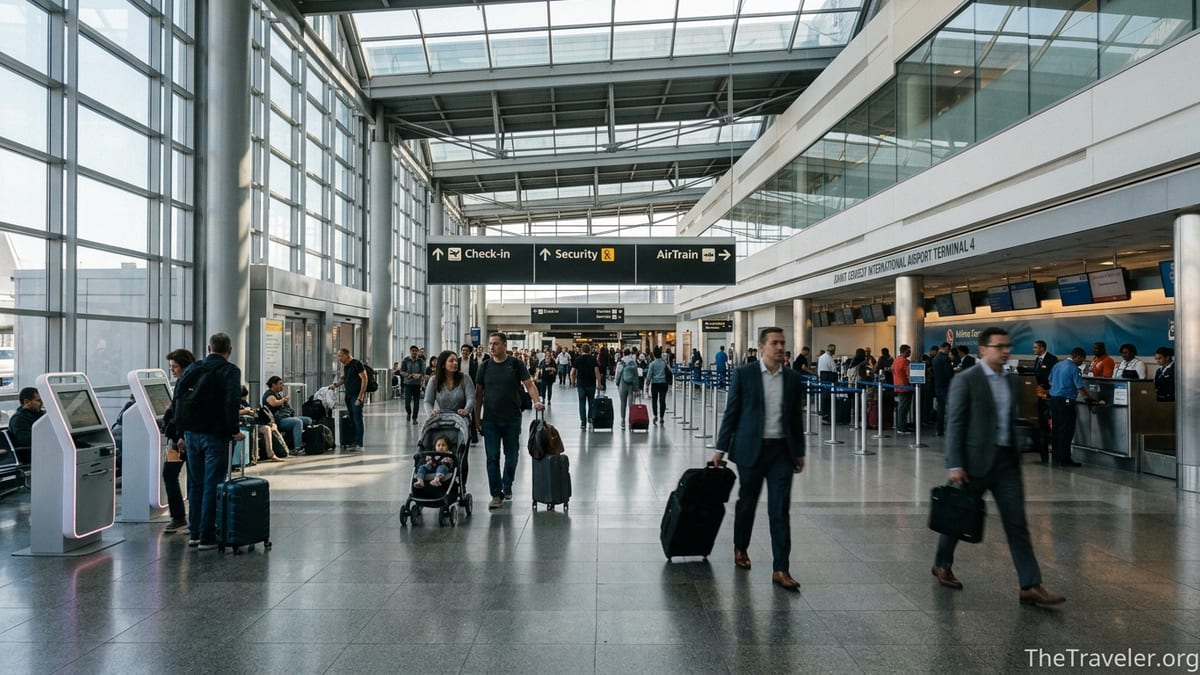
Understanding JFK’s Terminals and Layout
JFK currently operates six passenger terminals in a broad U-shaped loop: Terminals 1, 4, 5, 7, and 8 are in use for most travelers, with a new Terminal 6 rising between Terminals 5 and 7 as part of a long-term redevelopment. Terminals sit along a central ring road, with parking garages and the elevated AirTrain running just behind them. If you imagine driving into the airport, you enter the loop and then peel off right toward your assigned terminal, which is clearly signed on overhead boards well before each turnoff.
Each terminal at JFK is effectively its own mini airport, with check-in, security, departure gates, and baggage claim. For example, many major international carriers and Delta operate from Terminal 4, JetBlue uses Terminal 5 for most flights, and American Airlines and several of its partners use Terminal 8. That means you cannot simply check in at one building and walk airside to another. If you accidentally arrive at Terminal 4 when your ticket shows Terminal 8, you will need to use the AirTrain or a shuttle to move landside between terminals and then pass through security again at the correct building.
Construction is very visible across JFK in 2026 as the Port Authority modernizes aging terminals and roadways. Travelers may see cranes, temporary walkways, or traffic cones near Terminal 1 and the future New Terminal One site, or between Terminals 5, 6, and 7 where the new Terminal 6 is under way. Allow extra time when driving, since construction can temporarily close certain entrances or shift traffic. If you are taking a rideshare, it is common for drivers to mention detours around the southern side of the loop, which can add 10 to 20 minutes at busy periods.
First-time travelers should check their airline’s terminal a day or two before departure in case of temporary changes caused by construction or seasonal schedule shifts. For instance, some European airlines that once shared older facilities have moved to Terminal 4 during redevelopment, changing where passengers check in or clear security. Your confirmation email usually lists the terminal, and the JFK airport website also shows which carriers are based in each building.
Getting To and From JFK: Trains, Taxis, and Rideshares
Most visitors reach JFK using a mix of AirTrain and city transit or by road in a taxi or rideshare. The elevated AirTrain runs 24 hours and links every terminal to two key transfer points: Jamaica Station for the Long Island Rail Road and subway lines, and Howard Beach for the A subway line. As of mid-2026, the AirTrain fare collected when you exit or enter at Jamaica or Howard Beach is typically a few dollars per person, and the subway or commuter rail into Manhattan adds its own fare on top. For a solo traveler off-peak, using AirTrain and subway can be significantly cheaper than a taxi, though travel time often ranges from 50 to 75 minutes from Midtown.
At Jamaica Station, many locals now use contactless tap-to-pay or the OMNY system at subway turnstiles and commuter rail gates instead of older MetroCards. A common route is AirTrain to Jamaica, then the Long Island Rail Road to New York Penn Station or Grand Central Madison. During weekday rush hours, the LIRR ride can be as little as 20 to 25 minutes. A first-time visitor with one suitcase might tap into AirTrain at JFK Terminal 4, ride 10 minutes to Jamaica, transfer to an LIRR train, and be in Midtown in under an hour door to door.
Taxis from JFK to Manhattan operate on a regulated flat fare structure plus tolls and tip. While exact amounts can change, travelers should expect a set base price from JFK to anywhere in Manhattan, plus surcharges during peak times. For example, a typical late afternoon taxi ride to a Midtown hotel can often total in the ballpark of 80 to 100 US dollars once tolls and tip are included. Yellow cabs line up at official taxi stands directly outside baggage claim at each terminal; dispatchers help match passengers to vehicles, and you should always join the queue instead of accepting rides from individuals who approach you inside the terminal.
Rideshare services such as Uber and Lyft also operate at JFK, but pickups are concentrated at designated areas. At some terminals, drivers meet passengers on the upper departures level, while at others they use a centralized rideshare lot or a marked curb zone. The app will give exact instructions. Prices can fluctuate widely due to surge pricing; a late-night ride to Brooklyn might be under 50 dollars, while an early-evening rush-hour ride to Manhattan can be similar to or even above the taxi flat fare. If cost is a major concern, new visitors often compare the estimated rideshare fare in the app against the predictable taxi flat rate before leaving baggage claim.
Navigating Check-In, Security, and Boarding
For flights departing JFK, airlines open check-in counters several hours before departure, typically 3 hours for domestic and 3 to 4 hours for long-haul international flights. At Terminal 4, for example, Delta and major foreign carriers have large check-in halls with separate lanes for economy, premium cabins, and elite members. Digital kiosks can often print boarding passes and bag tags, but most first-timers still check in online and arrive with a mobile boarding pass, heading directly to the bag-drop lanes.
Security lines at JFK vary dramatically by time of day and terminal. Historical and live tracking services show that standard security waits can average around 25 to 45 minutes during peak morning and evening banks, with occasional surges beyond an hour on busy holiday weekends. Many terminals now display estimated wait times on monitors at the entrance, and third-party sites as well as the MyTSA app provide live ranges, although frequent flyers report that these digital estimates can sometimes be considerably lower than real-world queues. This means a traveler flying from Terminal 8 at 6 a.m. might see a posted 20-minute estimate but experience a longer actual wait, so building in an extra buffer is wise.
TSA PreCheck and CLEAR are both available at JFK and can substantially reduce your time in line when lanes are fully staffed. Travelers with PreCheck typically keep shoes and light jackets on and leave laptops and small liquids in their bags. When these lanes are open and not overloaded, people report getting through in about 10 to 20 minutes, even on busier mornings. CLEAR members can verify their identity with a kiosk and then use a dedicated lane to reach the front of security, though they still go through standard or PreCheck screening depending on their boarding pass. However, travelers have shared examples of PreCheck and CLEAR lines stretching over an hour during early morning rushes, so these programs are useful but not a guarantee of a short wait.
Boarding usually begins 30 to 50 minutes before scheduled departure for domestic flights and up to an hour for larger international aircraft. At Terminal 5, JetBlue commonly uses group numbers printed on boarding passes, with priority and Mosaic members boarding first, followed by back-of-plane groups. In Terminal 4, many international airlines call boarding by zones or cabin class. First-time travelers should pay close attention to gate screens, as last-minute gate changes do happen at JFK, especially among nearby gates within the same pier. Walking time from the central security area to a far-end gate can easily be 10 to 15 minutes in larger terminals such as Terminal 4 or 8.
Arriving at JFK: Immigration, Customs, and Baggage Claim
International arrivals at JFK can involve multiple steps: deplaning, immigration, baggage claim, and customs. Terminals 1, 4, 7, and 8 all handle significant long-haul traffic, and each has its own federal inspection area. US citizens and some foreign travelers enrolled in Global Entry can use automated kiosks or e-gates that typically shorten the passport control process when working smoothly. Others join traditional lines sorted by citizenship or visa type. At busy times, such as early morning banks of transatlantic flights into Terminal 4, it can take close to an hour or more to clear immigration, while off-peak arrivals may be through in 20 to 30 minutes.
After passport control, passengers move to baggage claim, where carousels are labeled by flight number and origin city. At JFK, baggage delivery times can vary; some travelers report seeing the first bags within 20 minutes of arrival, while others, especially on heavily loaded long-haul flights, may wait 40 minutes or longer. Airlines typically aim to deliver priority-tagged bags first. For example, a business-class passenger on a European carrier arriving in Terminal 1 might see their suitcase appear among the earliest, while economy passengers from the same flight watch the belt for a bit longer.
Customs inspections usually follow baggage claim. Many arriving passengers simply hand their customs declaration or confirmation from the mobile app to an officer and exit into the arrivals hall. Random secondary screening is always possible, particularly for travelers carrying large amounts of luggage or certain food items. Once you exit customs, you cannot return inside, so it is important to double-check that you have collected all checked bags and carry-ons before walking through the final doors into the public arrivals area.
For domestic arrivals or passengers who have already pre-cleared US immigration abroad, arrival at JFK is simpler. You step off the aircraft directly into the terminal, walk to baggage claim, and then exit to ground transportation. In Terminals 5 and 8, signs lead you quickly toward AirTrain stations, taxi stands, and rideshare pickup zones. First-timers should pause for a moment in the public arrivals area to locate clear overhead signs for “AirTrain,” “Taxi,” or “Ground Transportation,” which help you avoid wandering down the wrong corridor after a long flight.
Food, Shopping, and Services in the Terminals
Each JFK terminal offers a mix of dining and retail options, though quality and selection vary. Terminal 5, JetBlue’s base, is popular among frequent flyers for its casual, traveler-friendly options such as coffee bars, burger chains, and sit-down restaurants near the central rotunda. Terminal 4 has the widest variety overall, with everything from quick-serve pizza and salads to full-service bars and branded outlets. It is possible, for instance, to land in Terminal 4 mid-afternoon, clear security for a connecting flight, and sit down for a proper meal with table service before boarding.
Many terminals now feature recognizable national brands alongside New York–focused concepts. You might find a New York bagel stand serving fresh bagels and coffee at breakfast, a slice counter selling classic thin-crust pizza, or a deli offering sandwiches piled high with pastrami. For travelers with longer layovers, Terminal 8’s post-security concourses include bars, cafes, and a mix of midrange and upscale shops selling cosmetics, electronics, and fashion. Prices generally reflect airport markups: a simple sit-down meal with a drink can easily cost 25 to 40 US dollars per person, while a grab-and-go sandwich and bottled water may run 15 to 20 dollars.
Beyond food and shopping, JFK terminals provide essential services that first-time visitors often need. ATMs are widely available, though fees can be higher than in town. Currency exchange counters operate near arrivals in major international terminals, but exchange rates are usually less favorable than those offered by banks or ATMs in the city. Free Wi-Fi is offered airport-wide, with a simple sign-in process; speeds are generally adequate for email and messaging, though streaming video can be inconsistent in crowded gate areas.
Families and travelers with special needs can find dedicated facilities in most terminals. Many restrooms have changing tables, and some terminals include nursing rooms or family restrooms. Wheelchair assistance is provided by airlines and should be requested in advance; on arrival, agents often meet passengers at the aircraft door. In certain terminals, small children’s play areas or quiet zones allow families to decompress. If you are unsure where to find these, ask at an information desk near the main departures hall.
Connecting Flights and Terminal Transfers
Making a connection at JFK can be straightforward or stressful depending on whether you change terminals and whether you have to recheck baggage. If both flights are on the same ticket and same airline family, such as an American Airlines domestic arrival connecting to an American international departure in Terminal 8, your bags are usually checked through and you may only need to change gates within the same building. Even so, give yourself at least 90 minutes between flights to navigate potential delays, long taxi times on the runway, and security queues should you be forced landside.
When connections involve a terminal change, the AirTrain is usually the fastest way to move between buildings. Inside the terminal, signs direct you up escalators or elevators to the AirTrain platforms, which run in a loop around the airport. Trains arrive every few minutes, and the ride from, say, Terminal 1 to Terminal 5 is typically under 10 minutes not counting walking time. Importantly, the AirTrain is free for trips between terminals; fares are charged only when you exit or enter at the outlying transit stations such as Jamaica or Howard Beach.
Travelers arriving on an international flight who connect to a domestic one must often clear US immigration, collect checked bags, pass customs, and then recheck luggage with their connecting airline. For example, a first-time traveler flying from London into Terminal 4 and then on to a domestic flight from Terminal 5 with a separate ticket might spend 45 minutes to an hour clearing passport control and customs, another 20 minutes queuing to recheck their suitcase, and then additional time riding the AirTrain around to Terminal 5 and passing security again. In such cases, aiming for a connection time of 3 hours or more is prudent.
Some airlines operate inter-terminal buses on the secure side for passengers holding through tickets, especially for international-to-international connections. These can save time by allowing travelers to avoid clearing US immigration on certain itineraries, but availability changes as construction and airline partnerships evolve. If your itinerary suggests a secure-side bus, follow the airline’s signs or ask a transfer desk agent for directions as soon as you land. For all other transfers, assume you will exit to landside and follow the standard AirTrain loop.
Practical Tips for First-Time Visitors
Planning your timing is one of the most important steps for a smooth first experience at JFK. For domestic departures, many airlines recommend arriving at least 2 hours before your flight, and 3 hours for international. In practice, frequent travelers often aim for 2.5 to 3 hours in busy terminals like 4 and 5 during early morning and evening rushes, especially if they need to check bags or do not have PreCheck. Around major holidays, giving yourself even more margin can prevent last-minute panic if you encounter a traffic jam on the Van Wyck Expressway or an unexpectedly long security line.
When packing, remember that TSA carries standard restrictions on liquids, gels, and aerosols in carry-on luggage. Toiletries should fit in containers of 3.4 ounces or less and be grouped in a clear, quart-size bag if you are using standard security lanes. Laptops and full-size tablets usually need to be removed from bags and placed in separate bins unless you are in a PreCheck lane where different rules apply. Having your boarding pass and ID ready before you reach the front of the line speeds the process for everyone.
First-time visitors are often unsure about tipping and basic airport etiquette. In the arrivals hall, it is customary to tip porters or skycaps a few dollars per bag when they help with luggage. Taxi drivers normally receive a gratuity of around 15 to 20 percent of the metered or flat fare, while rideshare passengers can tip through the app at similar levels. At cafes and bars inside the terminals, tipping practices mirror those in the rest of New York: counter-service spots may suggest 10 to 18 percent, while table-service restaurants often show options starting at 18 or 20 percent.
Language and signage at JFK are primarily in English, but key directions such as “Baggage Claim” or “Ground Transportation” often appear with icons and sometimes additional languages to help international visitors. Staff at information desks can generally answer questions about terminal layout, flight status boards, and the quickest way to reach the AirTrain. If you become turned around, do not hesitate to ask security officers or airline employees for directions; they are used to helping confused first-timers, especially around construction zones that temporarily change normal walking paths.
The Takeaway
JFK’s scale, crowds, and constant construction can intimidate anyone visiting for the first time, but understanding a few core principles makes a big difference. Know which terminal your airline uses, and double-check it a day or two before departure. Build in generous time for traffic, check-in, and security, especially in the early morning and evening peaks. Learn the basics of the AirTrain, including that inter-terminal travel is free and that Jamaica Station is the key link to the subway and commuter rail.
Once inside the terminal, watch gate screens for late changes, give yourself enough time to walk to distant gates, and take advantage of dining and services when you have a longer wait. On arrival, move calmly through immigration, baggage claim, and customs, then follow clear signs to your chosen ground transport, whether that is an affordable AirTrain-and-subway combo or a straightforward yellow cab to Manhattan. With realistic expectations and a bit of planning, even a sprawling hub like JFK becomes manageable, setting a confident tone for the rest of your journey.
FAQ
Q1. How early should I arrive at JFK before my flight?
For most travelers, aim for at least 2 hours before domestic flights and 3 hours before international flights, adding extra time during holidays or peak morning and evening periods.
Q2. How do I know which terminal my flight uses at JFK?
Check your booking confirmation or airline app, which typically lists the terminal. You can also verify on the airport’s website the day before travel in case of last-minute changes.
Q3. Is the AirTrain free at JFK?
The AirTrain is free for travel between terminals and certain on-airport stops. A separate fare is charged only when entering or exiting at Jamaica Station or Howard Beach to connect with subway or rail services.
Q4. How long does it take to reach Manhattan from JFK?
Typical travel times range from about 50 to 75 minutes using AirTrain plus subway or commuter rail, and roughly 45 minutes to over an hour by taxi or rideshare depending on traffic.
Q5. Are TSA PreCheck and CLEAR available at JFK?
Yes, JFK offers TSA PreCheck and CLEAR lanes in several terminals. They can shorten security time when fully staffed, but waits can still be significant during busy peaks.
Q6. What should I expect for immigration and customs when arriving internationally?
After deplaning you will pass through passport control, then collect your checked luggage and proceed through customs. The process can take from around 30 minutes to an hour or more at peak times.
Q7. Is JFK a good airport for tight connections?
Because of long taxi times, possible delays, and terminal transfers, very tight connections are risky. First-time travelers should allow at least 90 minutes for same-terminal connections and around 3 hours when changing terminals or clearing immigration.
Q8. Can I walk between JFK terminals instead of taking the AirTrain?
Sidewalks between some terminals exist but are not designed for convenient transfers with luggage. The free AirTrain loop is generally faster, safer, and clearly signposted for moving between terminals.
Q9. Are there places to store luggage at JFK if I have a long layover?
Luggage storage services have historically operated in certain terminals, but availability can change. Check with your airline or the airport information desk on arrival for the latest options and locations.
Q10. What payment methods work best for transport from JFK?
Credit and debit cards are widely accepted for taxis, rideshares, and ticket machines. Contactless tap-to-pay and major digital wallets usually work on the AirTrain, subway, and commuter rail at Jamaica and Howard Beach.