


John F. Kennedy International Airport is in the middle of a massive, years-long redevelopment, and that means the terminal layout in 2026 can feel confusing even for seasoned travelers. Several terminals have been demolished, new ones are under construction, and airlines have shifted around. The good news: once you understand which airlines use which buildings and how to move between them, JFK becomes far more manageable. This guide explains every operating passenger terminal at JFK today, how they differ, and how to decide which one is right for your flight.
Get the latest updates straight to your inbox!
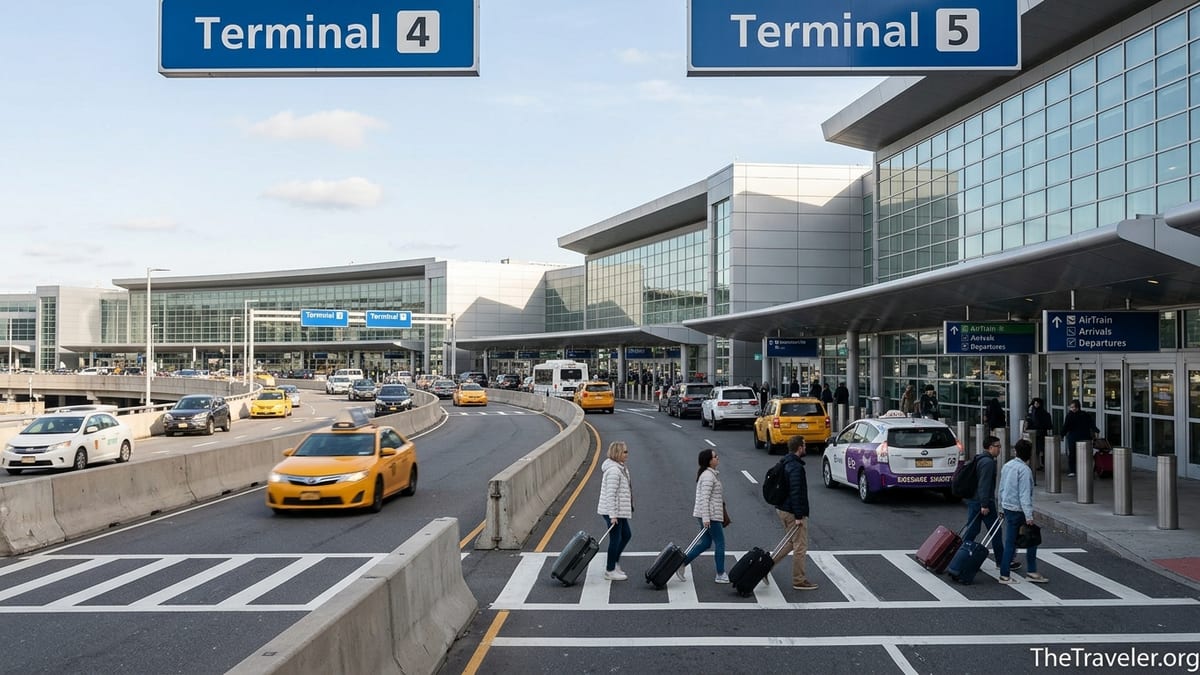
How JFK Is Laid Out in 2026
JFK currently operates five passenger terminals for commercial flights: Terminals 1, 4, 5, 7 and 8. They sit around a central loop of roads and parking lots, all connected by the free AirTrain, which links the terminals to the Jamaica and Howard Beach stations for subway and Long Island Rail Road connections. Terminals 2 and 3 were demolished years ago, and Terminal 6 is being rebuilt as a brand-new facility that begins opening in phases from 2026 onward.
The airport is run by the Port Authority of New York and New Jersey, which publishes a live list of the more than 70 airlines at JFK and the terminal where each operates. In 2026, international carriers such as Air France, Lufthansa, Turkish Airlines and Korean Air are grouped mainly in Terminal 1 and Terminal 4, while American Airlines and British Airways anchor Terminal 8 and JetBlue concentrates its operations in Terminal 5. This clustering matters when you book, because your terminal determines not just where you check in, but what kind of food, lounges and connection options you will have.
Road construction and terminal building works are constant around JFK through at least 2030, so travel times between terminals can be unpredictable by road. The AirTrain remains the most reliable way to move between terminals, because it runs 24 hours a day and is free within the airport. If you are connecting between, for example, a JetBlue flight arriving at Terminal 5 and an American Airlines flight leaving from Terminal 8, plan at least 60 to 90 minutes total to account for taxi-in, deplaning, walking, security and the AirTrain ride.
Because the airport is changing so quickly, it is wise to recheck your terminal closer to departure, especially if you booked months in advance. Airlines sometimes adjust which terminal they use as more renovated gates open, particularly around the new Terminal 6 and the expanded Terminals 4 and 8.
Terminal 1: New International Gateway
Terminal 1 is being rebuilt as part of the New Terminal One project, a multi-billion-dollar development that will gradually replace the old Terminal 1 structure with a modern international hub. In 2026, parts of the new facility are already open, providing gates and lounges for a cluster of long-haul carriers. Airlines using Terminal 1 include Air France, Lufthansa, Korean Air, and Turkish Airlines, along with several other transatlantic and transpacific carriers serving Europe, the Middle East and Asia.
For a practical example, if you are flying Air France from New York to Paris in economy, you will check in at Terminal 1 on the departures level, clear security, then walk through a modern departures concourse with duty-free shops and a handful of French and international dining options before reaching your gate. Premium passengers with SkyTeam or Star Alliance status may have access to newly opened lounges operated by participating airlines or third-party providers.
Terminal 1 is primarily an international terminal. That means if you arrive here from overseas and connect to a domestic U.S. flight, you will normally clear immigration and customs at JFK, reclaim your bags, recheck them with your onward airline if on separate tickets, and likely change terminals. For example, a traveler on a Lufthansa flight from Frankfurt arriving in Terminal 1 who then connects to a JetBlue flight to Orlando from Terminal 5 will pass through passport control and customs, exit the secure area, take the AirTrain to Terminal 5, and then clear security again. Building at least three hours into that connection is sensible.
Because of ongoing construction, curbside traffic around Terminal 1 can be congested, especially during evening departure banks when many flights to Europe and the Middle East leave within a few hours of each other. Arriving at the airport at least three hours before departure is strongly recommended for long-haul flights from this terminal, and longer if you need to check bags or travel at peak times such as Friday evenings.
Terminal 4: Delta and a Global Mix of Airlines
Terminal 4 is the largest and one of the most modern terminals at JFK, with a long concourse of more than 40 gates and an extensive selection of restaurants, bars, and shops. It serves as the primary hub for Delta Air Lines at JFK, especially for international flights, and also hosts a wide mix of foreign carriers including Emirates, Virgin Atlantic, LATAM, Etihad, Swiss and Air Canada, among many others. This terminal often feels like a small city, especially in the late afternoon and night when both Delta and the major international carriers are busy.
As an example, a traveler flying Delta from Los Angeles to JFK and then connecting to a Delta-operated flight to Amsterdam may stay entirely within Terminal 4. They would arrive at one concourse, follow the overhead signs for International Connections, and walk to their next gate without having to change terminals or re-clear security, since both flights are on Delta and use the same terminal complex. By contrast, a traveler arriving on an Emirates flight from Dubai and connecting to a JetBlue flight to Boston will land in Terminal 4, clear U.S. immigration and customs, then follow signs to the AirTrain to reach Terminal 5 for their domestic leg.
Terminal 4 offers some of the airport’s better-known dining options, including sit-down restaurants, quick-service chains and bars near the main security area and along the concourses. It also houses several airline lounges: Delta Sky Clubs, the Emirates lounge, Virgin Atlantic Clubhouse and others, depending on airline and ticket class. If lounge access matters, checking which lounges are in Terminal 4 and what hours they operate can help you decide whether to book a flight from here instead of another JFK terminal.
Given the size and busyness of Terminal 4, walking times can be significant. Gates at the far ends of the concourse can be a 10 to 15 minute walk from the central security area at a moderate pace, longer if the concourse is crowded or if you are traveling with children or heavy carry-on bags. Travelers with connections inside Terminal 4 should avoid extremely tight layovers; a 50-minute connection might be possible if both flights are on time and use nearby gates, but planning at least 90 minutes allows a much more comfortable margin.
Terminal 5: JetBlue’s Home Base
Terminal 5 is the dedicated home of JetBlue, with some additional operations by smaller partners such as Cape Air and Sun Country Airlines. If you are flying JetBlue, whether on a quick shuttle to Boston or a transatlantic flight to London, you will almost always be using Terminal 5. The building is known for a clean, relatively bright layout, decent food options, and plenty of seating, especially compared with some of the older facilities elsewhere at JFK.
Consider a traveler flying JetBlue from New York to San Juan, Puerto Rico. They check in at the Terminal 5 departures level, often using self-service kiosks or the JetBlue app before dropping bags at a staffed counter. After security, they find a central hall with fast-casual food brands, a few local New York options, and coffee bars. Boarding gates ring the terminal, and most domestic JetBlue flights depart from nearby concourses, so walking distances are manageable.
Terminal 5 also handles many of JetBlue’s international flights, including routes to the Caribbean, Latin America and select European cities. On return, passengers clear U.S. immigration and customs in the terminal’s arrivals area before exiting to ground transportation. Travelers connecting from a JetBlue international arrival in Terminal 5 to a domestic JetBlue departure also in Terminal 5 may use in-terminal connection corridors and do not usually need to change terminals, though they will still pass through passport control and sometimes re-clear security depending on how the connection is structured.
Because Terminal 5 is compact and primarily devoted to a single airline, it can be a good choice for nervous or first-time flyers who prefer a simpler experience. If you are deciding between a JetBlue flight from JFK Terminal 5 and another airline from a different terminal for a similar price, the straightforward layout, consistent signage and app integration at Terminal 5 are significant advantages, especially if you are traveling with children or have a tight schedule in New York.
Terminal 7 and Terminal 8: OneWorld and Other Carriers
Terminal 7 is in transition as JFK is redeveloped. Historically it has hosted carriers such as Alaska Airlines, Aer Lingus, Scandinavian Airlines and some British Airways services, but as of 2026 several of those airlines have shifted or announced plans to move as new facilities open. When you book a flight that might use Terminal 7, such as a regional connection or a partner code-share, double-check your terminal in the days leading up to departure, since operations here are more likely to change than in the larger core terminals.
Terminal 8, by contrast, is a major and growing hub at JFK. It is the primary base for American Airlines at the airport and also a key facility for oneworld alliance partners such as British Airways, Iberia, Finnair and Qatar Airways. Recent expansion projects have added gates and improved the shared American and British Airways facilities, including an enlarged security area and additional lounge space for premium travelers and oneworld elites.
For a real-world scenario, a traveler flying American Airlines from Dallas to New York and then connecting to British Airways for a London flight will generally stay within Terminal 8. The domestic American flight from Dallas arrives at one concourse, and the traveler follows clearly marked signs for international connections and British Airways departures, often with the ability to access joint American-British Airways lounges if their ticket or status allows. This kind of same-terminal, same-alliance connection is one of the smoothest ways to transfer at JFK.
If, however, you arrive on an Alaska Airlines flight that still uses Terminal 7 and connect to an American Airlines long-haul flight out of Terminal 8, you will need to move between the two by AirTrain. Although the terminals look close on the map, walking is not practical due to roadways and restricted areas, so you will exit Terminal 7, follow signs to the AirTrain, ride one stop, and then enter Terminal 8 and clear security there. For such inter-terminal connections, it is prudent to allow at least two hours, more in bad weather or during peak travel seasons.
Getting Between Terminals: AirTrain, Buses and Walking
Within JFK, the AirTrain is the backbone of terminal-to-terminal travel. It runs in a loop around the airport, stopping at each passenger terminal as well as parking lots, car rental areas and the Jamaica and Howard Beach stations. Travel between terminals on the AirTrain is free, and trains run frequently throughout the day and night, though late-night headways can be longer. The ride between adjacent terminals generally takes only a few minutes, but you should factor extra time for walking from the platform into the terminal itself.
A typical connection might involve arriving at Terminal 4, following signs for the AirTrain up an escalator to the platform, boarding a train marked for all terminals, and then getting off at Terminal 5 or Terminal 8 depending on your onward flight. Announcements and station signage identify each stop. If you are continuing into Manhattan, you will stay on the AirTrain to the Jamaica or Howard Beach station and transfer to the subway or Long Island Rail Road there, which requires paying a separate fare.
JFK has occasionally used shuttle buses to supplement the AirTrain, particularly during construction that affects certain stations or when parts of the loop are temporarily out of service. If that is the case during your travel dates, terminal signs and staff will direct you to the appropriate bus stops. These buses are free for airside transfers. Construction can also temporarily close direct walking routes between some terminal areas, so relying on older printed maps is less reliable than following current signage inside the airport.
Walking outside between terminals is generally discouraged for passengers, both because of distance and the complexity of the road network. In some cases, especially between Terminals 5 and 7 or 7 and 8, it might look short on a map, but sidewalks can be incomplete or routed through busy vehicle zones. For safety and convenience, travelers should plan to use the AirTrain or any officially marked shuttle service to change terminals, even for seemingly short hops.
Choosing the Right Terminal for Your Trip
For most travelers, the airline you book will effectively choose your JFK terminal for you. American Airlines and its oneworld partners are based in Terminal 8, Delta uses Terminal 4, JetBlue uses Terminal 5, and many foreign carriers are grouped in Terminals 1 and 4. However, understanding the character of each terminal can help inform choices when you have flexibility, such as when fares are similar on multiple airlines or when you are booking a multi-city itinerary.
If you value a straightforward experience with minimal terminal changes, it often makes sense to choose a single airline or alliance where both your domestic and international legs use the same terminal. For example, a traveler from Raleigh to Rome might pick American Airlines through JFK specifically because both flights use Terminal 8, avoiding a terminal change and re-screening. Similarly, a traveler from Denver to Tel Aviv might choose a Delta itinerary that keeps them entirely within Terminal 4 instead of one that requires a connection to another terminal.
Travelers who prioritize in-terminal experience may also weigh the age and amenities of each facility. Terminal 4 and Terminal 5 are generally regarded as more modern and spacious, with a broader selection of dining and shopping, compared with older or transitional facilities like Terminal 7. If you have a long layover of several hours, booking through an airline that uses Terminal 4, 5, or the newer sections of Terminal 1 or Terminal 8 can make the wait more comfortable, especially if you have access to airline or independent lounges.
Another practical consideration is your ground transportation. If you are arriving in New York late at night and heading to Manhattan by train, for instance, it may not matter much which terminal you use, since all connect to the AirTrain. But if you are meeting a car service or rideshare, make sure the driver knows your exact terminal and the appropriate pickup zone. Telling a driver you are “at JFK” without specifying Terminal 1, 4, 5, 7 or 8 can easily lead to delays of 20 minutes or more as they circle the loop looking for you amid construction-detour traffic.
The Takeaway
JFK in 2026 is a work in progress, with big construction projects reshaping the airport for the next decade. That can make the terminal layout feel complicated, but the fundamentals remain clear once you break them down. Terminal 1 serves many long-haul international airlines, Terminal 4 is Delta’s main base and a global hub, Terminal 5 is essentially JetBlue’s home, Terminal 7 is transitional, and Terminal 8 is dominated by American Airlines and oneworld partners. All of them are tied together by the free AirTrain loop.
When choosing flights, think about more than just price. Consider whether your connections keep you within a single terminal, which can save stress and time. Factor in the character of each terminal, from the amenities of Terminal 4 and 5 to the alliance-focused layout of Terminal 8. Build generous time buffers for any inter-terminal connection, especially when traveling internationally or checking bags.
Most importantly, revisit your booking details shortly before travel. With new gates and terminals opening in phases, airlines may shift operations on relatively short notice. A quick check of your airline’s app or boarding pass for the latest terminal information can prevent last-minute confusion, reduce the risk of missed flights, and help you navigate JFK with confidence despite the construction cranes on the horizon.
FAQ
Q1. Which terminal is best if I am flying Delta from JFK?
For most Delta flights in 2026, including many international routes, you will use Terminal 4, which serves as Delta’s primary hub at JFK and offers the widest range of Delta gates and services.
Q2. I am flying JetBlue. Which JFK terminal should I go to?
JetBlue operates almost all of its flights from Terminal 5, so if your boarding pass shows JetBlue and JFK, assume Terminal 5 unless your airline app or itinerary explicitly lists a different terminal.
Q3. How early should I arrive at JFK for an international flight?
Plan to arrive at least three hours before departure for international flights from JFK, and consider adding extra time if you are departing from busy terminals such as Terminal 1 or 4 during evening peak hours.
Q4. Is the AirTrain between JFK terminals free?
Yes, travel between terminals on the AirTrain is free. You only pay a fare when you exit or enter the system at stations like Jamaica or Howard Beach to connect with subways or commuter rail.
Q5. Can I walk between terminals instead of taking the AirTrain?
Walking between most terminals is not practical due to distance, road layouts and construction. The recommended way to change terminals is to use the AirTrain or any official shuttle that may be running.
Q6. Which terminal does American Airlines use at JFK?
American Airlines is based in Terminal 8 at JFK. Many of its oneworld partners, such as British Airways, Iberia and Finnair, also operate from this terminal for easier connections.
Q7. What happens if my international flight arrives at Terminal 1 and my connection leaves from another terminal?
You will clear U.S. immigration and customs at Terminal 1, collect and recheck any checked baggage if necessary, exit to the arrivals hall, then take the AirTrain to your departure terminal and pass through security again.
Q8. Is there good food and shopping at JFK, or should I eat before I arrive?
Terminals 4 and 5 in particular have a broad mix of sit-down restaurants, fast-casual spots and shops, while Terminals 1 and 8 also offer growing options as renovations expand. You can comfortably plan to eat after security in those terminals.
Q9. How do I know which terminal my airline uses on the day of travel?
Check your airline’s app or your electronic boarding pass on the day of departure. These sources are usually updated with any last-minute changes to terminal or gate assignments at JFK.
Q10. Is JFK still under construction in 2026, and will that affect my trip?
Yes, major redevelopment projects continue through at least the late 2020s, including new terminals and roadway work. You may encounter detours, scaffolding and temporary layouts, so allow extra travel time and follow current airport signage.