


More news on this day
Flight operations at Omaha’s Eppley Airfield came under strain as 14 delayed departures and five cancellations disrupted key domestic routes for major United States carriers, complicating travel plans at the height of the summer season.
Get the latest news straight to your inbox!
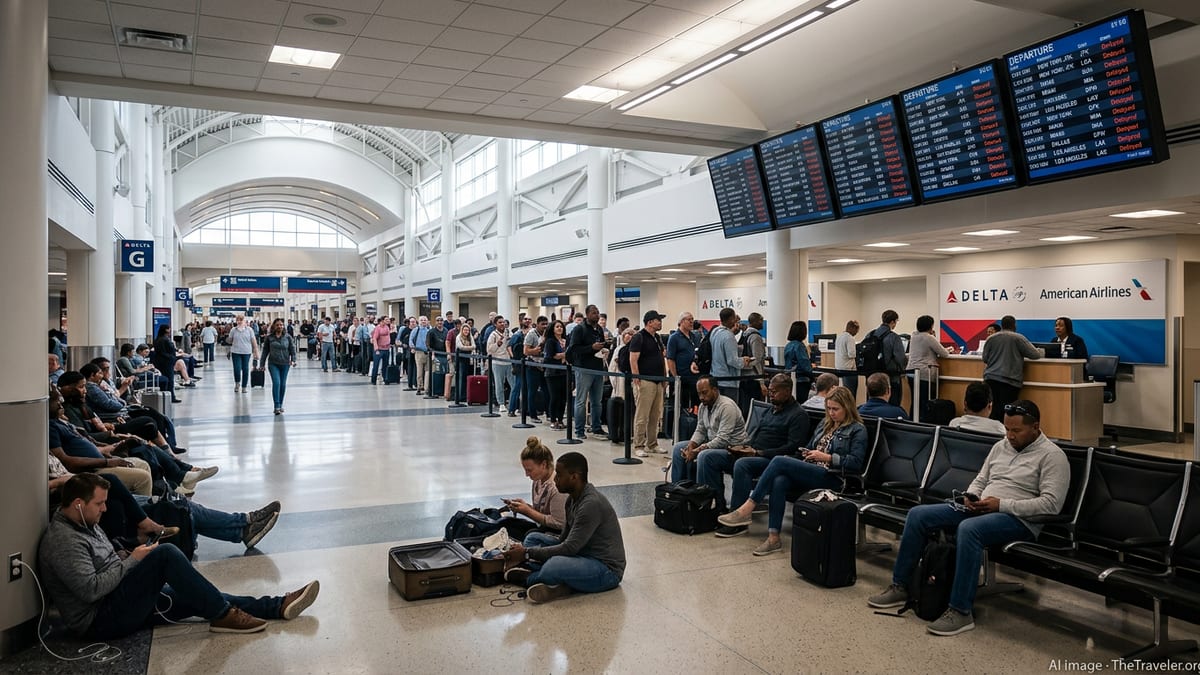
Disruptions Concentrated on Busy Domestic Corridors
Publicly available flight-tracking data for Omaha Eppley Airfield on July 8 indicates that a cluster of delays and cancellations hit some of the airport’s most heavily used domestic corridors. Routes feeding large hub airports such as Chicago O’Hare, Denver, Dallas Fort Worth, Atlanta, Phoenix, Las Vegas, Seattle and Washington National were among those most affected, according to published coverage that aggregated the day’s operations.
Reports indicate that a total of 14 flights departed significantly behind schedule while five were cancelled outright, a notable disruption for an airport that typically sees steady but modest levels of daily traffic compared with major coastal hubs. The impact was magnified because many of the affected services were first or second legs in multi‑segment itineraries, forcing passengers to scramble for alternative connections across the national network.
Operational summaries show that the irregularities were scattered across the day, rather than confined to a single storm cell or ground stop window. However, the knock‑on effect was most visible during peak connection banks at large hubs, when even modest schedule changes in Omaha created gaps in onward options for travelers heading to secondary markets.
Although overall numbers of disrupted flights remained small in absolute terms when set against nationwide totals, the concentration on a handful of high‑demand domestic corridors meant that hundreds of passengers were directly affected, with many more seeing arrival times pushed back as delays cascaded through the system.
Major U.S. Carriers Among Those Affected
According to operational snapshots compiled from flight‑tracking platforms and industry reports, the disruptions at Eppley involved a cross‑section of major U.S. airlines. American Airlines, Delta Air Lines, Southwest Airlines and United Airlines all registered delayed operations, while regional affiliates operating under big‑carrier brands were also present in the list of affected flights.
The mix reflected Eppley’s role as a spoke airport connected primarily to large domestic hubs. American typically links Omaha to Dallas Fort Worth, Charlotte and other key gateways, while Delta focuses on connections through Atlanta, Minneapolis and Detroit. United’s network from Omaha is built largely around Chicago O’Hare, Denver and Houston, and Southwest concentrates on point‑to‑point service to destinations such as Denver, Las Vegas and Phoenix. When irregular operations occur simultaneously across several of these routings, recovery options narrow quickly for passengers.
Industry performance data for recent months shows that these carriers, while generally operating within federal on‑time benchmarks, continue to face pressure from tight schedules, full aircraft and limited spare capacity at secondary airports like Omaha. Analysts note that even a small number of delayed inbound aircraft or short‑notice crew reassignments can spill over into missed departure slots, particularly during high‑season travel periods.
The presence of multiple major brands in the disruption tally may also influence how travelers perceive reliability at Eppley in the short term, even though the root causes often lie outside the airport itself, in weather or congestion at large hub airports that feed Omaha’s arrivals and departures.
Weather, Congestion and Network Knock‑On Effects
Operational records for early July show that convective weather and scattered storms across parts of the central and eastern United States have periodically tightened airspace capacity and slowed traffic flows through key hubs. On days when those constraints align with heavy summer schedules, regional nodes like Omaha can experience disproportionate fallout, as carriers juggle aircraft and crews to keep their most critical trunk routes moving.
Aviation analysts frequently point to “late arriving aircraft” as one of the main drivers of delays at spoke airports. When an inbound flight from a weather‑affected hub departs late, the aircraft may reach Omaha behind schedule, compressing turnaround times or forcing a departure to slip into a later time block. If crew duty limits are also approached, carriers sometimes opt to cancel rather than risk regulatory exceedances, adding to the disruption tally.
Published industry research on nationwide delay patterns suggests that afternoon and evening departure banks are more vulnerable to compounding disruptions, as small hiccups from early in the day accumulate. The experience at Eppley appears to track with this broader trend, with some of the longest delays occurring on later departures that relied on aircraft and crew cycling through already stressed parts of the national network.
Despite these challenges, overall traffic volumes at Omaha have grown steadily in recent years, supported by the airport’s role as Nebraska’s principal commercial aviation gateway. That expansion, while beneficial for connectivity, also means the margin for error shrinks during peak periods, since more flights are competing for finite runway, gate and airspace capacity when weather or congestion narrows the window for on‑time operations.
Passenger Impact and Rebooking Challenges
The 14 delays and five cancellations translated into a broad mix of passenger experiences, from relatively minor schedule slips to missed long‑haul connections. Because many Omaha departures feed major domestic hubs, travelers bound for international flights or last‑bank departures to smaller cities were particularly exposed when their first legs out of Eppley left late or did not operate.
Publicly available information from airline customer channels and travel forums shows that some passengers were rebooked on same‑day alternatives through different hubs, while others received hotel and meal support when onward options were no longer available. In cases where cancellations occurred on evening departures, travelers often had to wait until the following morning to secure new seats, reflecting the tight capacity typical of midsummer schedules.
Industry observers note that secondary airports such as Omaha tend to have fewer spare aircraft or reserve crews positioned on the ground, limiting the ability to mount quick replacement services when irregular operations occur. As a result, carriers frequently prioritize stabilizing operations at their hubs and then work to fill gaps in spoke markets, which can delay resolution for travelers starting their journeys at airports like Eppley.
For passengers, the disruptions have reinforced common advice to build additional connection time into itineraries that rely on evening departures or single daily frequencies. Travel planners often recommend at least a two‑hour buffer for domestic connections and longer for international links, particularly during summer and winter periods when weather‑related volatility is more likely.
What the Disruptions Mean for Summer Travel Through Omaha
The latest wave of irregular operations at Eppley Airfield arrives as airlines across the United States navigate one of the busiest summer travel seasons since before the pandemic. Strong demand, fuller aircraft and high utilization of fleets and crews have combined to leave less slack in the system when weather or air traffic constraints emerge.
For Omaha, the episode underscores the airport’s importance as a regional connector and the vulnerability that comes with relying on a limited number of daily departures on key routes. While 14 delays and five cancellations represent only a small share of Eppley’s daily movements, the concentration on routes to national hubs amplifies the practical consequences for travelers who depend on those flights to reach broader domestic and international networks.
Airport planning documents and industry commentary suggest that ongoing investments in terminal, ramp and technology upgrades are aimed at supporting growing passenger numbers and improving operational resilience. Even so, aviation analysts caution that the most effective tools for reducing passenger disruption remain improved scheduling discipline, greater use of buffer times on vulnerable routes and better integration of real‑time weather and air traffic data into day‑of‑operation decision making.
In the near term, passengers using Omaha Eppley Airfield are likely to see continued emphasis on early‑morning departures and hub‑focused connectivity as airlines seek to balance reliability with growing demand. The latest disruption figures provide a reminder that, in a tightly coupled national air network, even a modest spike in delays and cancellations at a single regional airport can reverberate widely across domestic routes.