


More news on this day
Rail travel north of London was thrown into chaos on Friday after two passenger trains collided near Bedford, leaving one person dead, multiple people injured and prompting the declaration of a major incident on one of the United Kingdom’s busiest intercity corridors.
Get the latest news straight to your inbox!
Major incident on Midland Main Line near Bedford
The collision occurred on the Midland Main Line between Bedford and Luton on the afternoon of 19 June, when two southbound services heading toward London St Pancras came into contact near a signal gantry a few miles south of Bedford. Publicly available rail-tracking data cited in media coverage indicates that the trains were East Midlands Railway services, understood to include the 16:40 departure from Corby and a service from Nottingham bound for the capital.
Reports indicate that one train appears to have struck the rear of another that was ahead on the same line, resulting in a forceful impact that threw some passengers from their seats. Initial imagery from the scene shows at least one carriage visibly damaged and slightly off alignment, with emergency crews clustered around the leading vehicles.
According to information released by the British Transport Police and summarised in news reports, one person has died and a number of others have been injured. The incident is being treated as a major emergency, with a large multi-agency response deployed to the railway corridor south of Bedford.
Witness accounts gathered by broadcasters describe passengers experiencing a sudden jolt, followed by confusion and a rapid response from rail staff and emergency services. Some passengers on board reported broken glass, minor derailment of equipment within carriages and fellow travellers with visible injuries.
Emergency response and disruption for travellers
Emergency services, including local fire and rescue teams, ambulance crews and air ambulances, were dispatched to the scene, with public images and social media posts showing multiple emergency vehicles lining nearby roads and at trackside access points. The collision site lies on a busy stretch of main line that cuts through open countryside, accessible only through rail or service tracks, which has complicated the logistics of the response.
Publicly available information from rail operators shows that services on the Midland Main Line have been severely disrupted, with trains to and from London St Pancras suspended or heavily delayed through the Bedford corridor. East Midlands Railway and other operators have advised passengers to check live travel updates and to avoid attempting journeys on the affected section while the emergency response and subsequent investigations continue.
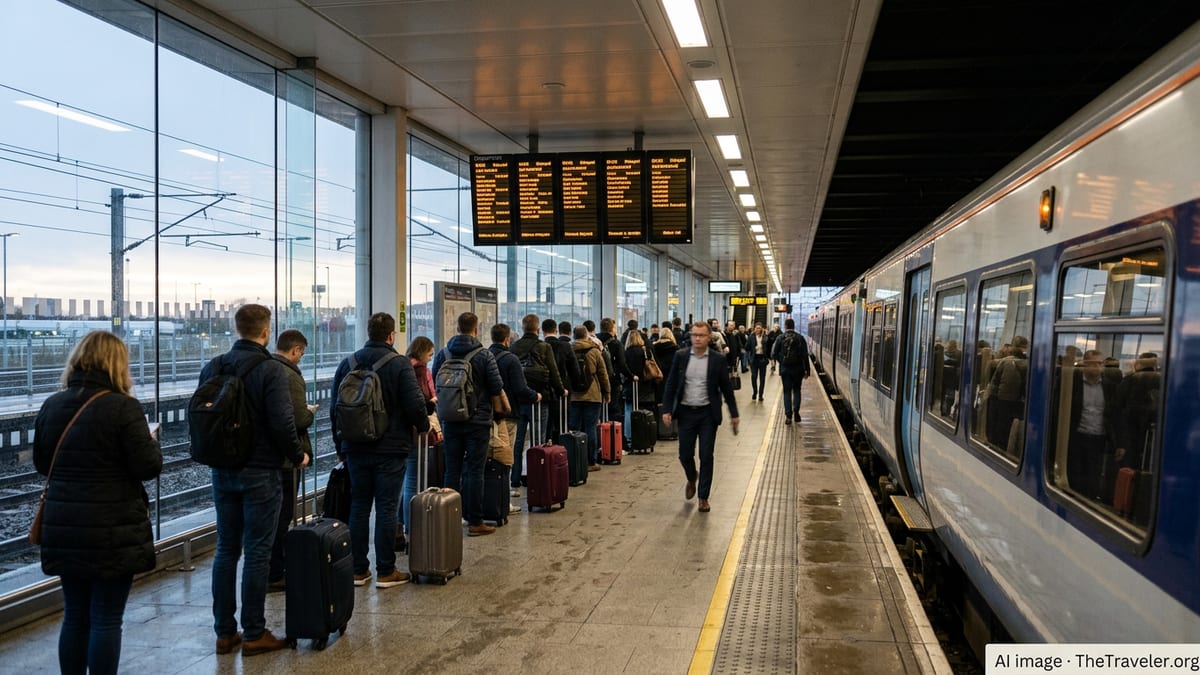
Images shared from nearby stations depict crowded concourses, passengers waiting for replacement transport and long queues for information desks. Travellers bound for northern cities such as Nottingham, Sheffield and Derby, as well as those commuting into London from Bedfordshire and the East Midlands, are among those affected by the cascading delays.
Rail industry updates suggest that services will remain disrupted into the evening, with the potential for knock-on impacts into the weekend as damaged rolling stock is recovered and the infrastructure is assessed for safety before reopening.
Safety record under scrutiny after recent UK rail collisions
The Bedford collision comes shortly after the publication of official findings into the 2024 Talerddig collision in mid-Wales, where two passenger trains also collided and one person died. Investigators described that incident as the first fatal train-to-train collision on the UK network in more than 25 years, underscoring the rarity of such events on a system that generally records strong safety performance.
In this latest case, early unverified commentary within the rail community has speculated about a possible signal overrun by the rear train, sometimes referred to as a signal passed at danger, or SPAD. At this stage, no formal cause has been established, and specialists from the Rail Accident Investigation Branch are expected to play a central role in gathering data from signalling systems, on-board recorders and staff interviews before reaching any conclusions.
Publicly available data on previous rear-end collisions on Britain’s railways, such as historic crashes at Marden and Watford, show that signalling design, driver workload, braking performance and visibility can all come under close examination following such incidents. Modern mainline routes are typically equipped with layers of protection intended to prevent trains from entering occupied sections of track, but investigators routinely examine whether those protections operated as intended.
For regular rail users and the wider public, the Bedford incident will likely renew attention on how high-frequency operations are managed on busy intercity routes that share tracks between express and regional services, particularly at peak travel times into and out of London.
Impact on passengers and local communities
Passengers on board the affected services have described a chaotic scene immediately after the collision, with some carriages left in darkness and luggage thrown from racks. People were guided along the track to safe areas once it was considered secure to evacuate, according to accounts shared in local and national media.
The collision has also brought disruption to nearby communities along the Bedford corridor, as helicopters and emergency vehicles converged on the rural stretch of line. Roads used as access points for rescue operations have experienced congestion, and noise from aircraft and sirens has been reported by residents throughout the afternoon and early evening.
Local businesses reliant on commuter and leisure traffic are expected to see an immediate short-term impact, particularly those near Bedford station that serve passengers transferring between regional and intercity services. Hotels in London and in the East Midlands may also receive last-minute bookings from stranded travellers seeking overnight accommodation while they await restored rail links.
Travel insurers and rail operators are advising passengers to retain tickets and documentation related to disrupted journeys. Standard industry practice typically includes compensation schemes for significant delays, although individual entitlements vary depending on the ticket type and operator policies.
What travellers need to know in the coming days
For travellers planning to use the Midland Main Line over the coming days, publicly available journey planners are already reflecting large-scale cancellations and diversions through Bedford. Rail operators are encouraging passengers with flexible plans to postpone non-essential travel and to consider alternative routes using other main lines where feasible.
Those who must travel are being advised to allow considerable extra time, monitor operator announcements closely and prepare for replacement buses or rerouted services that may involve additional changes. Travellers connecting to international services, including flights from London airports, are being urged to leave wider margins than usual between rail and onward connections.
In the medium term, the line south of Bedford may be subject to temporary speed restrictions or altered timetables while infrastructure inspections and any necessary repairs are carried out. Such measures are common after significant incidents and are designed to maintain safety while full technical assessments are completed.
As the investigation progresses, more detail is expected to emerge about the precise sequence of events leading to the collision and any recommendations that may be made for the wider rail network. For now, the incident stands as a stark reminder of the potential consequences when something goes wrong on a busy passenger railway, and of the importance of transparent, rapid safety learning for operators and travellers alike.