


More news on this day
A rush-hour collision between two London-bound passenger trains near Bedford, north of London, has left one person dead and dozens injured, sharply disrupting travel on one of the main rail corridors into the British capital.
Get the latest news straight to your inbox!
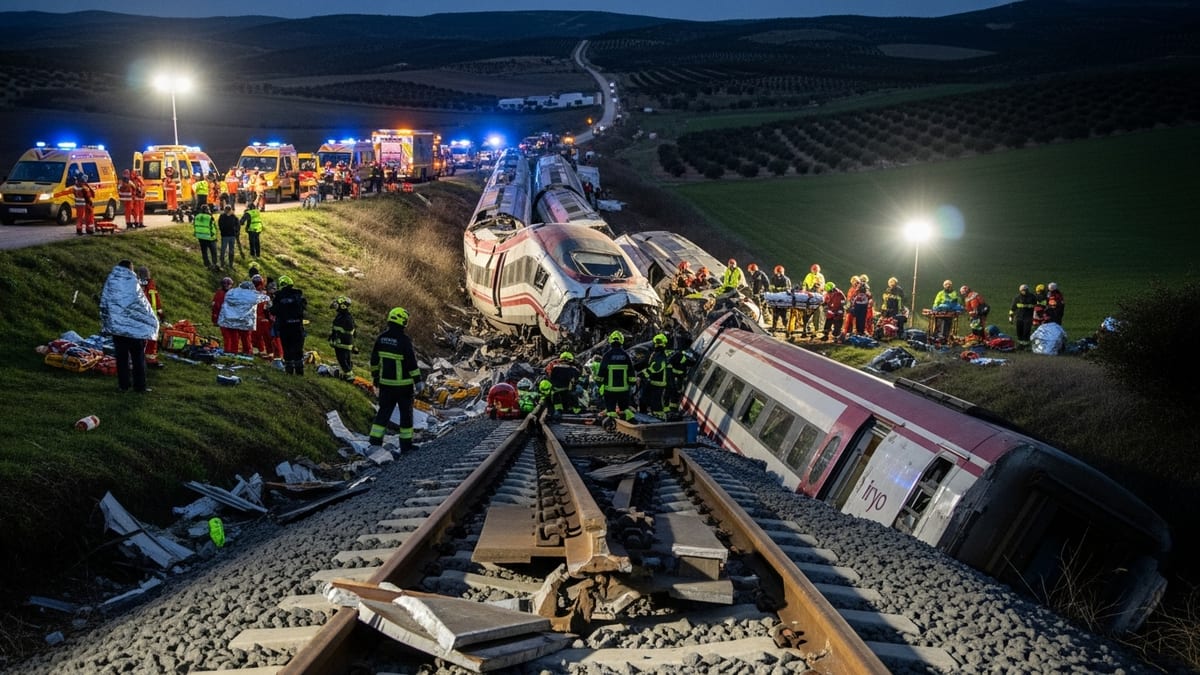
Rush-hour crash on key route into London
Publicly available information indicates that the collision occurred on Friday 19 June in the early evening south of Bedford, a town roughly 90 kilometers north of central London. Two East Midlands Railway services traveling toward London St Pancras International were involved, both heading south when they came into contact on the busy Midland Main Line.
According to published coverage, the incident took place at the height of the evening commute, with many passengers on board both trains. Images shared on social media show carriages still upright on the tracks but visibly damaged, while travelers are seen standing or sitting in adjacent fields and alongside a parallel roadway as emergency vehicles crowd the scene.
Rail tracking data cited in news reports places the collision shortly after 5 p.m. local time, just as commuters were returning to London from towns in the East Midlands and beyond. The affected services are reported to have been operating between Nottingham and Corby and the capital.
Casualties and emergency response
Reports indicate that one person, believed to be a train driver, was killed in the collision. Updated figures from regional ambulance services cited in media coverage suggest that more than 80 people sustained injuries of varying severity, with a significant number classed as serious or very serious.
Publicly available information shows that multiple ambulance units, an air ambulance and specialized hazardous incident teams were dispatched to the site, alongside fire and rescue crews. Nearby hospitals were placed on alert as emergency planners prepared for a major influx of patients from the scene.
Photographs from the area show emergency personnel treating passengers on a roadside and in open ground near the line. Some travelers appear to be wearing bandages to the head and limbs, while others wait wrapped in foil blankets or sitting on the ground as triage operations continue.
Passenger accounts from inside the trains
Accounts carried by British and international outlets describe a sudden, violent impact that threw passengers forward in their seats. One traveler spoke of a sensation comparable to an explosion, with smoke visible soon after the collision and people in the carriage screaming and crying as they tried to understand what had happened.
Several passengers described struggling to exit the damaged carriages, with some using partially open doors or gaps between cars to climb down to the trackside. Others recounted seeing fellow travelers with suspected broken limbs and serious cuts, while some passengers appeared unable to speak in the immediate aftermath because of shock.
Social media posts from those caught up in the incident refer to long waits at the scene while emergency teams worked methodically through each carriage. As the evening progressed, rail replacement buses and private vehicles began carrying uninjured or lightly injured passengers away from the area.
Severe disruption for rail travelers
The collision has caused major disruption along one of the principal rail arteries linking London with the East Midlands and parts of northern England. East Midlands Railway announced the suspension of services into and out of London St Pancras for the remainder of Friday, with trains canceled or terminating short of the affected section of track.
Passenger information systems show knock-on delays and cancellations spreading across the wider network as rolling stock and crews are displaced. Travelers heading to and from destinations including Nottingham, Derby, Sheffield and Corby have been urged to check revised schedules and consider alternative routes where possible.
Industry statements cited in media reports indicate that it may take time to fully assess damage to infrastructure and rolling stock, raising the prospect of continued disruption into the weekend. Rail operators have advised that tickets may be accepted on other routes while the line remains partially closed.
Early questions over cause and safety systems
As investigators begin to examine the circumstances of the Bedford collision, attention is turning to how two modern passenger services came into contact on a signaled, busy main line. Early reporting emphasizes that it remains too soon to determine an exact cause, and no official investigative findings have yet been released.
Specialist rail accident investigators are expected to review onboard data recorders, signaling information and track conditions, as well as to interview staff and passengers. Published commentary has highlighted the role of automatic train protection and other modern safety systems, which may have limited the severity of the crash even as one life was lost and many people were injured.
Rail unions and passenger groups are calling for a thorough review of the incident, particularly in light of the heavy commuter use of the Bedford corridor and recent growth in rail travel into London. For international visitors and domestic travelers alike, the crash is a stark reminder that, although rail remains one of the safest modes of transport in the United Kingdom, rare but serious incidents can have profound human and logistical consequences.