


More news on this day
One person has died and at least 89 people have been injured after two passenger trains collided near Bedford, north of London, on Friday afternoon, disrupting a major route into the capital and prompting a large emergency response.
Get the latest news straight to your inbox!
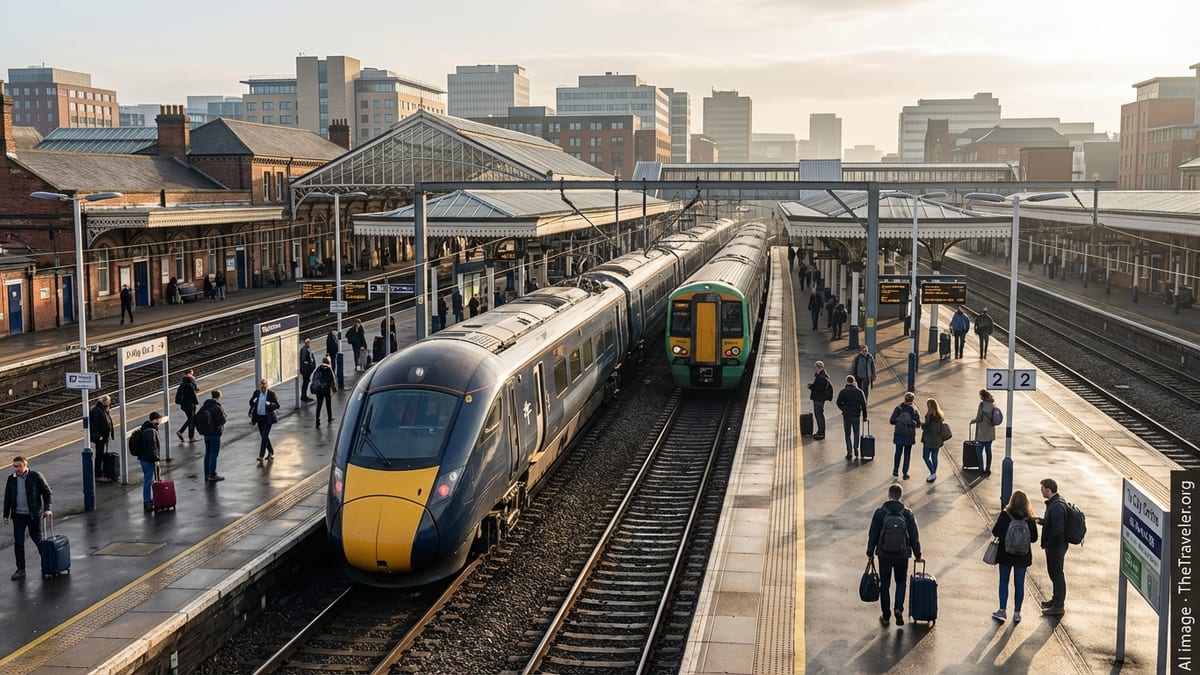
Major incident on key route into London
Reports indicate that the collision occurred on the busy Midland Main Line between Bedford and Luton, when two southbound services bound for London St Pancras came into contact. Early information from rail tracking data and published coverage suggests that the impact happened in the late afternoon, at around the height of the commuter period.
According to multiple news and rail community reports, the crash involved two East Midlands Railway services travelling in the same direction. One train is reported to have been stationary or moving slowly when it was struck from behind by the following service, creating a violent jolt that threw passengers from their seats and caused significant damage to the leading cab of the rear train.
A major incident was declared locally, with regional police, fire and ambulance services attending alongside specialist hazardous area and air ambulance teams. Publicly available information indicates that dozens of people required treatment at the scene, with a number transferred to hospitals in the region for serious and very serious injuries.
Rail operators suspended services through the area for several hours as responders worked in and around the damaged carriages. The line is a critical corridor linking the East Midlands with central London, and the disruption quickly spread across the regional and intercity network.
Casualty figures and condition of the injured
Figures emerging from published coverage and rail industry reports indicate that one person has died and 89 people have been recorded as injured in the Bedford collision. Of those, more than 30 are understood to have sustained serious or very serious injuries, with the remainder assessed as having minor injuries.
Initial accounts circulating in rail forums and local media suggest that the person who died was in the front cab of the moving train at the moment of impact. Photographs from the scene show the leading cab crushed back into the first passenger carriage, a pattern consistent with earlier descriptions from passengers who reported a sudden, forceful stop followed by confusion and smoke inside the train.
Hospitals across Bedfordshire and surrounding counties are reported to be treating patients for fractures, head injuries and other trauma consistent with a high-energy deceleration event. Passenger descriptions referenced by media outlets speak of individuals being thrown against seats, tables and internal fittings as the trains collided.
Emergency planners in the region activated mass-casualty protocols, with triage areas reportedly established near the tracks. Rail staff and passengers assisted the injured before specialist teams arrived, guiding people along the ballast and embankments to safer areas away from the damaged rolling stock.
Early focus on signalling and train protection systems
Although the precise cause of the Bedford collision has not yet been formally established, early discussion in rail industry circles has focused on signalling, braking performance and train protection technology. Some well-followed rail commentators, summarising what they describe as informed background briefings, have suggested that a train protection system fault on the leading train may have prompted it to stop on the main line.
Unconfirmed but widely shared accounts indicate that the following train may have passed a signal at danger or failed to slow in time, resulting in a rear-end impact with the stationary or slow-moving service. Comparisons are already being drawn with past rear-end collisions in the United Kingdom in which a signal passed at danger was a central factor, including historic accidents at Purley and Dagenham East.
Publicly available information shows that the British rail network is equipped with several layers of protection intended to prevent such scenarios, including the Train Protection and Warning System and, on some routes, more advanced in-cab signalling. The Bedford section of the Midland Main Line is not yet widely reported as operating with the newest digital systems, and discussion among rail professionals is focusing on how existing technology performed at the time of the crash.
The Rail Accident Investigation Branch has confirmed through public statements that inspectors are at the scene to gather evidence. That process typically includes downloading data from on-train recorders, analysing signal aspects and train movements, and examining the condition of braking and protection equipment. A preliminary report is usually issued within weeks, followed by a full report containing safety recommendations.
Disruption for passengers and impact on operators
The collision near Bedford has caused significant disruption for rail passengers across a wide area, as all lines through the site were initially closed. According to publicly available journey planners and operator updates, long-distance services between London, the East Midlands and northern England were suspended, diverted or heavily delayed.
Passengers already on trains north and south of the incident reported extended waits in the countryside and overcrowding at alternative stations as services were terminated short of their destinations. Replacement road transport has been limited, reflecting both the scale of the disruption and the evening timing of the crash.
Rail experts note that the Midland Main Line is a strategic artery for both commuter and intercity traffic. Even after one or more tracks reopen, speeds through the affected section are likely to be restricted while damaged infrastructure is repaired and investigators complete their on-site work. As a result, passengers are being advised via operator channels and journey planners to check services carefully and expect residual delays.
For East Midlands Railway and the wider rail industry, the collision presents both immediate operational challenges and wider reputational questions. The operator is expected to work closely with investigators, infrastructure managers and unions to review working practices, driver training, fleet condition and contingency planning on the route.
Rail safety record and questions raised
The Bedford crash comes at a time when the United Kingdom’s mainline rail network is generally regarded as having a strong safety record in comparison with many countries. Fatal train-to-train collisions are now relatively rare events, in large part due to decades of investment in signalling, train protection and crashworthiness.
Nevertheless, the scale of the injuries and the loss of life near Bedford are already prompting renewed scrutiny of how risk is managed on busy mixed-traffic corridors. Commentators are drawing attention to the concentration of services on a limited number of tracks, the age and design of some rolling stock, and the pace at which advanced digital signalling is being rolled out.
Rail unions and safety campaigners, in previous incidents, have often highlighted the importance of learning from near misses and technical faults before they escalate into serious accidents. The Bedford collision is likely to become a new reference point in these debates, particularly if early suggestions about signalling risk, braking performance or protection equipment are borne out by the formal investigation.
In the coming weeks, the publication of preliminary findings is expected to set out the sequence of events leading to the crash. For travellers, communities along the route and the families of those affected, attention will focus on whether the lessons drawn from Bedford lead to tangible, system-wide improvements intended to reduce the chance of a similar event on one of the country’s busiest rail corridors.