


More news on this day
A collision between two London-bound passenger trains near Bedford in central England has left one person dead and close to 90 injured, according to figures reported by emergency and transport agencies, in one of the most serious rail incidents the United Kingdom has seen in years.
Get the latest news straight to your inbox!
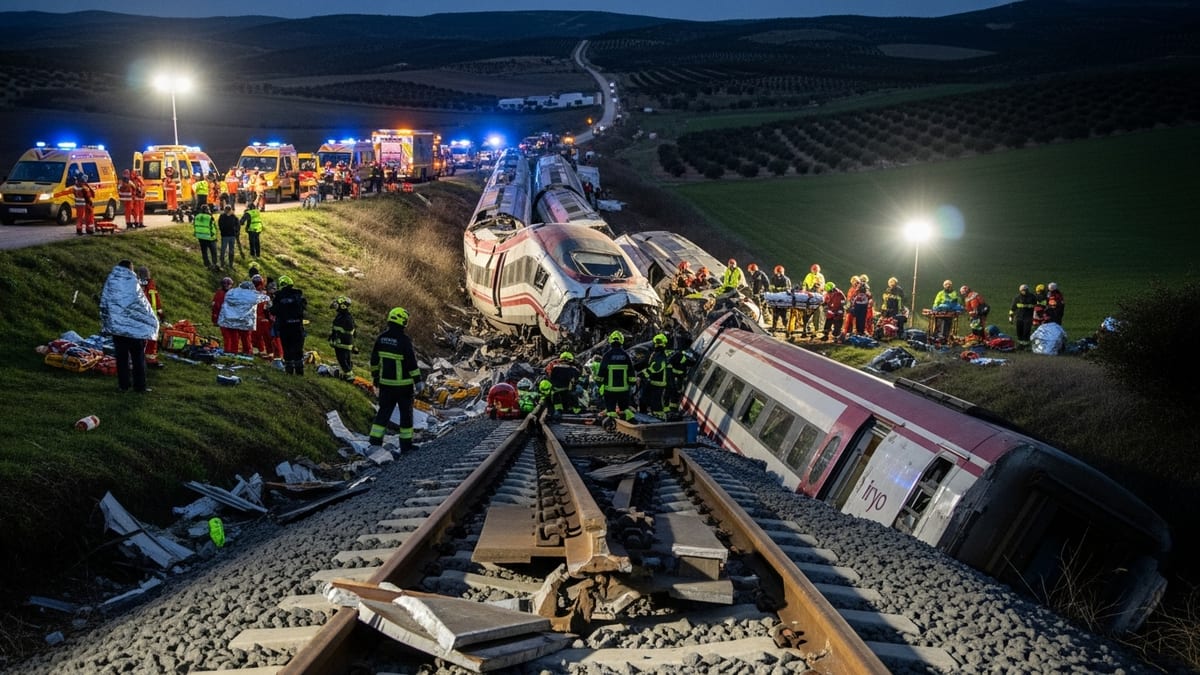
Crash Near Bedford Shocks Evening Commuters
The collision occurred on the afternoon of 19 June 2026 on a busy section of the main line linking the English Midlands with London St Pancras. Published coverage indicates that two East Midlands Railway services heading toward the capital made contact just south of Bedford, around 90 kilometers north of London, at the height of the evening rush period.
Reports from national and regional outlets describe one train running into the rear of another London-bound service on the same line. Initial accounts suggest that one train had come to a halt or was moving slowly when it was struck from behind by the following service, triggering a violent jolt that threw passengers from their seats.
Images and video shared across news reports show both trains upright on the tracks but with visible damage to carriages, shattered windows, and debris scattered along the line. Passengers can be seen standing on the ballast between tracks and waiting beside emergency vehicles that filled an access road running parallel to the railway.
Rail tracking data cited in media coverage place the collision shortly after 5 p.m. local time, at a point when trains from Corby and Nottingham were converging on the same corridor toward London. The line is a key artery for intercity and commuter traffic serving the East Midlands and north of England.
Casualty Toll: One Fatality and Dozens Seriously Hurt
Publicly available figures compiled overnight into 20 June indicate that a train driver was killed in the collision. Emergency service updates summarized in multiple outlets state that close to 90 people were treated for injuries of varying severity.
Among those, more than 30 people were initially described as seriously hurt, with several in critical condition. Many others sustained fractures, head wounds, and soft tissue injuries consistent with the sudden deceleration and impact inside crowded carriages. Some passengers walked away with relatively minor cuts and shock, but accounts from the scene describe multiple individuals unable to stand or move without assistance.
Ambulance crews from across the region, supported by an air ambulance and specialist hazardous incident teams, transported the injured to hospitals in Bedford and surrounding areas. Reports indicate that dozens were admitted for observation and treatment, while others were assessed on site and later released.
Rail worker unions and passenger groups have highlighted reports of injuries among both staff and travelers, emphasizing the human toll of an event that unfolded in seconds on what is ordinarily a routine commuter journey into London.
Major Incident Response and Disrupted Rail Services
Emergency responders rapidly declared a major incident at the site, triggering a large-scale deployment of police, fire, and medical resources. Public information statements on Friday evening described a complex rescue environment, with responders working through damaged interiors to reach passengers at both ends of the trains.
Rail services on the affected section were halted as the rescue operation unfolded. According to rail industry updates cited in media coverage, services between Bedford and London St Pancras were suspended or severely curtailed for several hours, with knock-on disruption continuing into Saturday as investigators and recovery teams remained on scene.
Passengers traveling on East Midlands Railway and other operators on the corridor were advised to expect cancellations, diversions, and extended journey times. Some intercity services were turned back short of London or rerouted where alternative paths were available, while replacement road transport was arranged for stranded travelers.
Rail infrastructure managers and operators used public channels to discourage nonessential travel through the area while tracks were being cleared and safety inspections carried out. Overnight, engineering teams began the complex process of removing the damaged rolling stock and examining track, signaling, and overhead line equipment.
Early Focus on Safety Systems and Signaling
Specialist rail accident investigators have begun examining why two trains traveling in the same direction on a well equipped main line ended up in a collision. Published analysis and expert commentary note that modern British main lines are designed with multiple layers of protection intended to prevent rear end impacts, including signaling controls and automatic braking systems on many routes.
Some early reporting has centered on whether the lead train stopped unexpectedly after passing a signal and whether the following train approached at a speed that left little margin for braking once the obstruction became apparent. Observers have also pointed to the configuration of train protection systems on this stretch, which is not universally fitted with the most advanced automatic stop technology in use elsewhere on the network.
Rail industry commentators have stressed that any discussion of causes remains preliminary until formal investigations are complete. However, the incident is already prompting comparisons with previous rare but serious collisions in the United Kingdom, where inquiry findings have often led to new safety standards, equipment upgrades, or changes in operating procedures.
The Rail Accident Investigation Branch is expected to analyze data from on board recorders, signaling logs, and trackside equipment, as well as gather testimony from crew and passengers, to reconstruct the sequence of events leading to the crash.
Concerns for Passengers and the Wider Rail Network
The collision comes at a time when Britain’s railways are frequently cited as among the safest in Europe, with very few fatal incidents involving multiple trains in recent decades. That context has shaped public reaction, with many travelers expressing surprise that a rear end collision of this scale could occur on a busy modern main line.
Travel advocates argue that, while the overall safety record remains strong, the Bedford crash illustrates how the consequences of a single failure can still be severe when trains are full and moving at relatively high speeds. Questions are already being raised about whether investment in additional automatic protection systems, improved real time monitoring, or changes to operating patterns on congested routes might further reduce residual risk.
For passengers, the immediate effects extend beyond the shock of the event itself. Commuters who regularly use the Midland Main Line face short term disruption as services are restored and longer term uncertainty if significant engineering or signaling upgrades are recommended and scheduled. Some travelers have voiced anxiety about returning to the same route, a common response after high profile transport incidents.
As the investigation proceeds, attention is likely to focus both on the technical chain of events on the afternoon of 19 June and on how quickly lessons are translated into concrete safety improvements. For now, the collision north of London stands as a stark reminder of the potential consequences when heavily used infrastructure, busy timetables, and complex safety systems are tested under pressure.