


Stretched for nearly five kilometers along the curve of the Baie des Anges, Nice’s Promenade des Anglais is one of Europe’s classic seafronts. It is also, very simply, a superb place to walk, cycle and watch the sun sink behind the hills of the French Riviera. Whether you have an hour between trains or several days in town, a little planning helps you enjoy the Promenade like a local rather than just drifting past the postcard views.
Get the latest updates straight to your inbox!
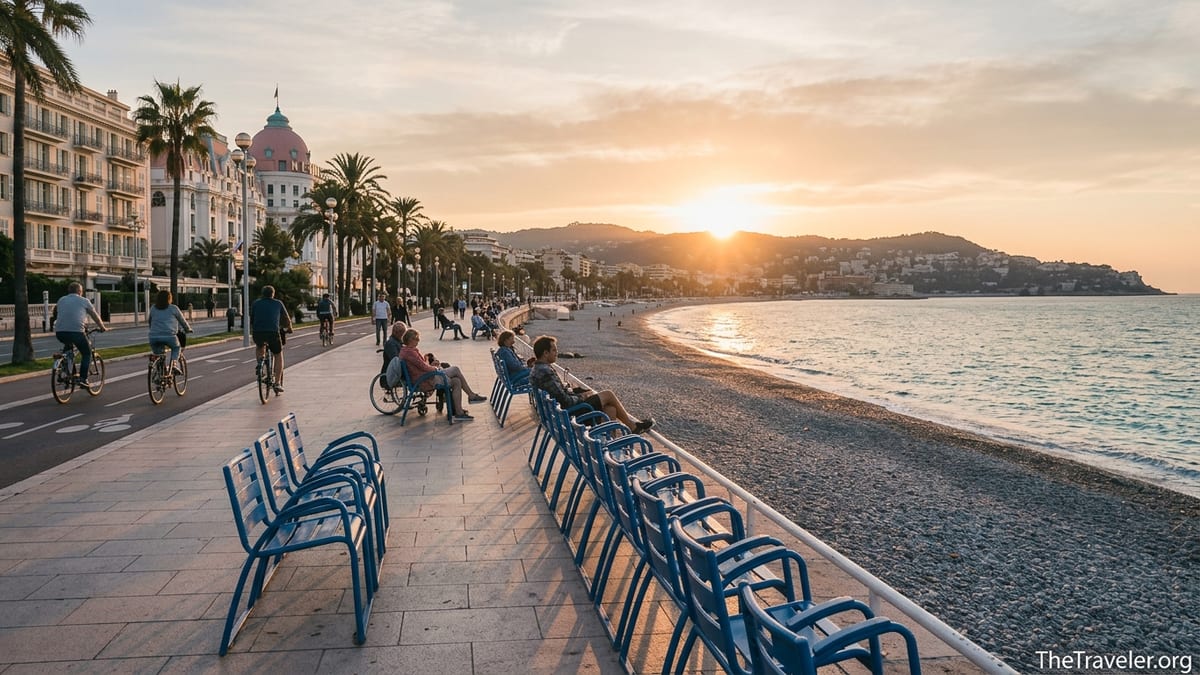
Getting Oriented: What Makes the Promenade Special
The Promenade des Anglais runs along the Mediterranean between Nice Airport in the west and the eastern edge of central Nice, skirting the pebble beaches of the Baie des Anges with a wide, level waterfront path. To your right as you walk east are the gray-pebble public and private beaches, beach clubs and the changing light over the sea. To your left are Belle Époque facades, grand hotels such as the pink-domed Negresco and turn-offs into the compact streets of central Nice and the Old Town.
The promenade itself is divided into zones: a multi-lane roadway, and on the seaward side a broad, paved strip shared by walkers, runners, families with strollers and cyclists. Painted green sections and clear symbols mark the official Voie Verte Littorale, a coastal cycleway that continues beyond Nice to Cagnes sur Mer. Walking is possible almost anywhere, but if you are on a bike you will want to stay in the dedicated lanes as much as possible to avoid conflicts with pedestrians and traffic.
Nice’s mild climate means the Promenade is active all year. In January you might see locals power-walking in light jackets while the Alps glow with snow in the distance. In July, the same stretch hosts pre-breakfast joggers, cyclists weaving between beach-goers and families out late for the cooler evening air. The same infrastructure serves all of them; timing your visit smartly is the key.
For orientation, think of three practical anchors: the airport at the western end, the Negresco roughly in the middle of the seafront hotels and the Jardin Albert 1er and Old Town at the eastern end. Most visitors will enter the Promenade somewhere between the Negresco and the gardens and then explore east or west from there.
Arriving on the Promenade: Practical Access Tips
If you are flying into Nice Côte d’Azur Airport and want to hit the Promenade almost immediately, you have several realistic choices. The city’s tram Line 2 connects the airport terminals with central Nice. There is a specific airport ticket sold as a return for around 10 euros, while standard urban tickets cost about 1.70 euros for a single journey bought from vending machines or via the Lignes d’Azur mobile app. Many travelers use the free segment of the tram between the terminals and Grand Arénas, then switch to a normal-priced ticket from there to town, which keeps costs down while still being straightforward.
An alternative is the 12+ bus that runs from the airport area along the Promenade des Anglais and into central Nice. A standard bus ticket is similar in price to a regular tram ticket and can be convenient if you want a first glimpse of the sea from your seat. The bus runs along the sea road itself, and you can step off at stops labeled "Aéroport / Promenade" or further east near Magnan, Gambetta or Congrès to join the promenade within a couple of minutes’ walk.
From Nice-Ville train station, it is a simple 15 to 20 minute walk straight down Avenue Jean Médecin and through Place Masséna to reach the eastern part of the Promenade. You can also hop on the east–west tram and get off near the Old Town, then walk two or three minutes south until the sea appears. Taxis and ride-hailing services can drop you along the seafront, but with the tram and bus system so integrated into the promenade, most visitors find public transport sufficient.
If you are driving, underground car parks like those near Place Masséna or the Palais de la Méditerranée hotel put you a short stroll from the water. Street parking on or near the Promenade is limited and heavily controlled, so plan to use a garage, especially in high season or during big events like the Nice Carnival or Ironman races that use parts of the seafront.
Walking the Promenade: Classic Routes and Local Rhythms
For walking, the most satisfying section of the Promenade is between the I Love Nice sign at the foot of Castle Hill on the eastern side and the Negresco hotel. This stretch combines postcard views, wide pavements and plenty of places to pause. A relaxed walk one way takes around 25 to 30 minutes without stops. Along the way you pass the Jardin Albert 1er, the pergolas and famous blue chairs, public beaches and a succession of Belle Époque facades.
If you have a full morning and want a stronger sense of distance, continue beyond the Negresco toward Magnan and the airport. The promenade remains very flat and the sea is always in sight. A round-trip walk from the Old Town to roughly the western city limit and back is around 10 to 12 kilometers, which many regulars use as a weekend workout. Bring water; in summer, there are public fountains in the gardens and on some beach accesses, but stretches of the seafront can feel quite exposed.
Timing your walk transforms the experience. Early mornings, especially between 7 and 9 am, offer soft light, comparatively empty pavements and locals walking dogs or heading to work. Midday in high summer brings the harshest sun and the most beach traffic, when you will share the space with families in swimsuits and street vendors. Evenings from about 6:30 pm onward are more sociable, with buskers, rollerbladers and pre-dinner strollers filling the promenade.
To add variety to a walk, consider detouring inland for a few minutes. From the Negresco, one block back from the seafront lies Rue de France, lined with small shops and cafés. From Jardin Albert 1er, cutting through the greenery brings you into Place Masséna and the tram artery, then on into the narrow streets of the Old Town where ice cream shops like Fenocchio attract long lines in summer. You can easily combine an hour on the promenade with a coffee in a side-street café and a brief exploration of Vieux Nice.
Cycling the Seafront: Rentals, Routes and Safety
The Promenade des Anglais is part of a longer regional cycle route known as the Voie Verte Littorale that runs from the port of Nice westwards past the airport to Cagnes sur Mer. In practice, this means a clearly marked, mostly segregated cycle lane, often painted green, on the seaward side of the road. For visiting cyclists, it is one of the easiest places in the Riviera to ride: flat, direct and with constant sea views.
Short-term bike rentals are easy to arrange. Several independent shops in central Nice, including outlets such as Holland Bikes and other local rental companies, are positioned within a few blocks of the Promenade and typically offer city bikes, hybrids and e-bikes. Expect to pay somewhere around 20 to 30 euros for a standard adult bike for a day, and 35 to 50 euros for an e-bike, depending on the season and model. Many shops provide helmets, locks and a basic map, and are accustomed to tourists whose main goal is simply to ride along the seafront rather than tackle mountain passes.
For a satisfying, half-day ride, start near the Port of Nice or the eastern end of the Promenade and follow the cycle lane west. Pass the Negresco, cruise by the beach clubs and continue toward the airport; you will see planes landing and departing almost overhead as you near the western edge of the city. The cycle path then flows seamlessly into the coastal route toward Saint-Laurent-du-Var and Cagnes sur Mer. Riders often mention the surreal sight of a large rhinoceros statue hanging from a crane by the waterfront in Cagnes, near the CAP3000 shopping center, as an informal landmark for turning back.
In practical terms, remember that some sections of the promenade are shared between cyclists and pedestrians, especially near busy beach accesses and around Jardin Albert 1er. Speeds should be kept moderate and bells used liberally. Families with children on small bikes or scooters should stay on the green-painted cycleway where it is separated from the main pedestrian flow. At junctions with side streets, look out for cars turning across the cycle lane. The route is designed to be accessible, but it is still urban riding rather than a fully isolated bike path.
Beyond the Promenade: Viewpoints and Detours for Sunset Lovers
Although the Promenade itself offers excellent sunset views, a few nearby detours dramatically change your perspective. The most famous is the Colline du Château, or Castle Hill, which rises just east of the promenade above the Old Town. A public elevator at the eastern end of the Promenade, near the I Love Nice sign, and a series of staircases lead up through parkland to terraces with sweeping views along the Baie des Anges. From here, the entire curve of the promenade glows in late light, with the pink dome of the Negresco and the line of palms clearly visible.
Another option is to continue walking or cycling eastward beyond the harbor toward Villefranche-sur-Mer before sunset. The coast road here becomes narrower, but the orientation of the bay means you can sometimes see the sun dipping behind the hills while the pastel buildings of Nice and the headlands are still catching the last light. This extension is especially popular with runners and road cyclists who want a bit of climb and quieter roads once they leave the flat promenade behind.
For a more local feeling, explore the Promenade du Paillon, the long green corridor often called the "coulée verte" that stretches inland from the seafront past fountains, lawns and playgrounds. From certain spots in this park, you get framed views back toward the sea and the silhouette of palm trees and hotel facades. It is not a classic horizon-sunset spot, but it can be a pleasant way to transition from a coastal walk to an evening in the city center, with dusk settling over both the park and the sea.
If you are comfortable venturing slightly farther, some visitors rent bikes and ride all the way to Cagnes sur Mer for late afternoon, then return along the waterfront as the sun sets, so that the orange and pink light is always ahead of them over the bay. Others take advantage of the coastal train, riding one way and using the rail line for the return journey, bringing folded or standard bikes on the regional TER trains outside peak times for a modest supplement.
Timing the Perfect Sunset: Where to Sit and What to Expect
From late spring through early autumn, sunsets along the Promenade des Anglais are often a key daily ritual. The sun sets behind the hills to the west rather than directly into the sea, which means the real spectacle is the changing color over the Baie des Anges as the sky reflects on the water and the city lights slowly appear. Many regulars swear by arriving about 30 to 45 minutes before official sunset time to watch the full sequence of colors.
One classic ritual is to claim one of the famous blue metal chairs facing the sea. These chairs are scattered along much of the promenade, especially near Jardin Albert 1er and in front of the major hotels. They are free, movable and first-come-first-served, and in peak season they tend to fill up quickly. If you arrive early, you can sit with a takeaway drink or an ice cream from a nearby stand, watch locals playing pétanque on the beach and listen to buskers setting up behind you.
Another approach is to walk slowly during sunset instead of sitting still. Begin near the eastern end by the I Love Nice sign and stroll west, keeping the glow of the sky at your side. As you pass the Negresco, the hotel’s illuminated dome and façade make a striking contrast with the deepening blue of the sea. The combination of joggers, cyclists with small lights and couples pausing by the low sea wall creates a subtly changing, almost cinematic atmosphere without feeling staged.
In cooler months, when sunset comes earlier, consider combining the promenade with an apéritif on one of the seafront terraces or rooftop bars that open toward the bay. Many bars and cafés along the seafront offer simple early-evening specials such as a glass of local rosé or a non-alcoholic spritz style drink plus snacks for a set price. Even if you choose not to sit, the sight of candlelit terraces, illuminated palms and the continuous line of headlights on the roadway becomes part of the nightly light show.
Seasonal Factors, Events and Crowd Management
Promenade des Anglais is a year-round destination, but what you experience in February can be very different from August. In mid-winter, daylight is shorter, and you may find cool, clear days with fewer tourists and calmer pavements. This is a pleasant time to take longer walks or rent a bike for most of the day without worrying about extreme heat or intense traffic from beachgoers.
Spring and autumn shoulder seasons are often ideal for both walking and cycling, with comfortable temperatures and reasonably long evenings. In April and October, for example, you might be able to walk for several hours in light clothing, pause on the beach without crowds and still catch a sunset around typical dinner time. Hotel prices are usually lower than in high summer and bike-rental outlets tend to have more inventory and flexibility.
High summer from late June through August brings peak crowding, especially in late afternoon and early evening. The pavement can feel hot underfoot and the promenade hosts a dense mix of walkers, joggers, cyclists, electric scooters and vendors selling beach toys and cold drinks. If you plan to cycle at this time of year, mornings before 9 am and later evenings after about 8 pm are much more pleasant. Walking remains enjoyable, but you may want to avoid the busiest stretches between Jardin Albert 1er and the Negresco in the middle of the afternoon.
Major events can reshape how you experience the Promenade. The Nice Carnival, generally held in February, often includes parades near the seafront. Large sporting events such as triathlons and marathons also use the promenade as part of their running or cycling courses, which can lead to partial closures or diversions. If your visit coincides with such an event, it is wise to check with your hotel or the local tourist office about route changes and to plan your walks or rides either earlier in the day or on less affected sections west of the main festival areas.
Staying Safe and Respectful on Foot and on Two Wheels
While the Promenade des Anglais feels relaxed, it is still a major urban thoroughfare, and a few simple habits help keep your experience pleasant. On foot, stay aware of the cycle lanes. They are usually clearly marked and slightly set back from the main pedestrian strip, but in crowded areas it is easy to drift into them while looking at the sea. If you are walking in a group, avoid spreading across the full width of the path so that runners and cyclists can pass.
For cyclists, the key is to match your speed to the ambience. This is not the place for high-speed training rides; local cyclists who want to ride fast usually head inland toward Col d’Èze and other hinterland climbs. Along the Promenade, maintain a moderate pace, signal before overtaking, and use a bell rather than shouting. At night, use proper lights and reflective elements. Local police occasionally run safety campaigns and may fine riders without lights after dark.
At the water’s edge, the beaches along the Baie des Anges are mostly pebbled, which surprises some visitors expecting sand. Wear sturdy sandals or water shoes if you plan to step into the surf after a walk or ride, as the stones can be slippery. During summer, lifeguards and marked swimming zones are present on popular sections of the beach. Respect any flags or warning signs and avoid swimming near the rocky groynes that mark different beach segments.
Finally, be conscious that parts of the Promenade have a quiet, contemplative side for locals. Early-morning dog walkers, older residents sitting on the blue chairs and families strolling with children all share the path with visitors. Keeping noise levels moderate at night, using bins for any takeaway packaging and treating the promenade more like a shared living room than a theme park helps preserve its atmosphere.
The Takeaway
Experiencing the Promenade des Anglais at its best is less about ticking off a specific sight and more about tuning in to its daily rhythms. On foot, you can cover the full sweep of the bay in a couple of hours, stopping for coffee or gelato and detouring into the Old Town. On a bike, the promenade becomes a gateway to a longer coastal ride toward Cagnes sur Mer, while still remaining accessible to complete beginners and families.
Sunset is the thread that ties these experiences together. Whether you watch from a blue chair near Jardin Albert 1er, from the terraces of Castle Hill or while slowly riding back toward the city with the sky turning pink, the combination of sea, light and cityscape explains why this strip of pavement has charmed visitors for nearly two centuries. With a little planning around timing, transport and simple safety, the Promenade des Anglais can be not just a backdrop to your stay in Nice, but one of its most vivid memories.
FAQ
Q1. How long does it take to walk the full length of the Promenade des Anglais?
Walking the main seafront from near the airport to the eastern end by Castle Hill usually takes about one and a half to two hours at a relaxed pace without long stops.
Q2. Is it safe to cycle on the Promenade des Anglais if I am not an experienced cyclist?
Yes, the promenade has a mostly segregated, flat cycle lane and is suitable for cautious beginners, especially in the morning or outside peak summer crowds.
Q3. Where can I rent a bike near the promenade and how much should I budget?
Several rental shops close to the seafront offer city bikes and e-bikes; plan roughly 20 to 30 euros per day for a standard bike and more for an electric model.
Q4. What is the best time of day for sunset views on the promenade?
Aim to arrive 30 to 45 minutes before official sunset time. This allows you to see the sky change gradually and still have light for walking or cycling back.
Q5. Are there public toilets and water fountains along the Promenade des Anglais?
Yes, there are public toilets and drinking fountains near major beach accesses and in adjacent parks like Jardin Albert 1er, though they are spaced out, so plan ahead.
Q6. Can I swim at the beaches along the Promenade after a walk or bike ride?
Yes, you can swim at both public and private beaches, but remember that the shore is pebbly, not sandy, and pay attention to lifeguard flags and posted safety signs.
Q7. How do I get from Nice Airport directly to the Promenade des Anglais?
You can take tram Line 2 with an airport ticket, ride the 12+ bus that follows the seafront, or use a taxi; all bring you to the promenade area within minutes.
Q8. Is the Promenade des Anglais accessible for wheelchairs and strollers?
Yes, the path is wide, paved and largely level, with ramps at many beach accesses, so it works well for wheelchairs, mobility scooters and strollers.
Q9. What should I wear and bring for an evening walk or ride during summer?
Light clothing, comfortable shoes, water, sun protection for the late-afternoon sun and a light layer for after dark are usually sufficient; a small light helps if cycling.
Q10. Are there any safety concerns on the promenade at night?
The promenade is generally busy and feels safe, but as in any city, keep valuables secure, stay in well-lit sections and be aware of bikes and scooters sharing the path.