


More news on this day
P&O Cruises has evolved rapidly over the past two decades, adding LNG-powered flagships while still sailing popular mid-sized vessels from the early 2000s. Using publicly available fleet data, TheTraveler.org has mapped how the current P&O Cruises ocean ships line up by age, from the newest deliveries of the 2020s back to stalwarts launched around the turn of the millennium.
Get the latest news straight to your inbox!
The Newbuild Era: LNG Flagships Redefine the Fleet
At the top of the ranking stands Arvia, delivered in 2022 and widely reported as the newest ship in the P&O Cruises fleet. Built by Meyer Werft, Arvia is an Excel-class vessel and one of the largest cruise ships purpose-built for the British market. Industry coverage notes that the ship entered service in December 2022, introducing a resort-style layout intended to make the most of warm-weather itineraries.
Just behind Arvia is sister ship Iona, which entered service in 2021 after pandemic-related delays. Iona was the first LNG-powered ship for P&O Cruises and marked a step change in scale and environmental performance compared with earlier generations in the fleet. Together, Arvia and Iona anchor the top end of the ranking and represent the cruise line’s most recent investment in lower-emission propulsion and high-capacity family cruising.
These two ships form the technological and stylistic benchmark against which the rest of the fleet is now measured. Their introduction in the early 2020s effectively closed the chapter on the 2010s newbuild program and signaled P&O Cruises’ long-term commitment to large, fuel-efficient ships aimed at year-round deployment in popular holiday regions.
Mid-2010s Builds: Britannia as Modern Mainstay
Next in the age ranking is Britannia, which entered service in 2015 and quickly became one of the most recognizable ships in the P&O Cruises portfolio. While slightly older than the LNG-powered pair, Britannia is still part of the modern era in design and passenger amenities, featuring a contemporary interior style and a broad mix of dining and entertainment spaces tailored to British tastes.
Britannia’s position between the newest Excel-class ships and the older Ventura-class vessels underlines how the fleet has grown in stages rather than through a single expansion wave. Ship databases and specialist cruise publications list Britannia as a mid-2010s build, giving her a central position in any timeline stretching from 2022 back to 2000.
Operational reports suggest that Britannia continues to serve as a workhorse on popular itineraries, bridging the gap between the cutting-edge features of Arvia and Iona and the more traditional layouts of earlier ships. Her presence helps P&O Cruises maintain capacity while newbuilds take shape and older tonnage is retired.
Ventura Class and Sister Designs of the Late 2000s and 2010
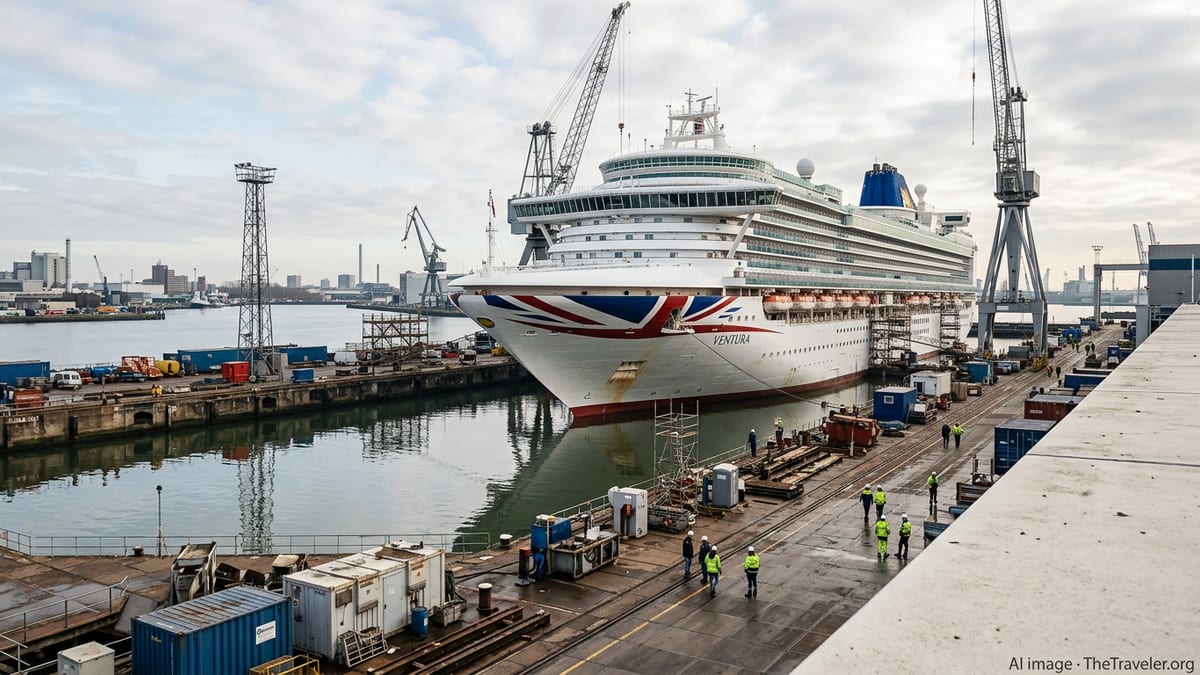
Moving further back, the late 2000s and early 2010s produced a cluster of large ships that remain central to the current fleet. Publicly available fleet lists identify Ventura, introduced in 2008, as one of the first of these modern large-capacity vessels for P&O Cruises. Ventura’s arrival marked a shift toward bigger family-friendly ships with extensive entertainment options and multiple dining venues.
Azura followed in 2010 as a sister design, refining the template with tweaks in layout and onboard offerings while maintaining similar capacity and tonnage. Passenger accounts and ship profiles frequently group Ventura and Azura together, reflecting their shared heritage and role as predecessors to the even larger Britannia and, later, the Excel-class newbuilds.
Seen in age order from 2022 back to 2000, Azura and Ventura occupy the middle section of the ranking. They are newer than the classic early-2000s ships but clearly part of a different generation from the LNG-powered flagships. Their continued deployment suggests that P&O Cruises views them as strategically important, balancing capacity, familiarity among repeat guests and manageable operating costs.
The Early 2000s: Arcadia and Aurora Hold Their Ground
At the older end of the ranking sit Arcadia and Aurora, both launched in the first half of the 2000s and still listed as active in the fleet. Industry references commonly cite Arcadia as a 2005 build and Aurora as a 2000 ship, making Aurora the oldest vessel in current P&O Cruises service. These ships were built before the era of LNG propulsion and mega-ship entertainment complexes, but they retain a loyal following among passengers who prefer a more traditional cruise experience.
Arcadia, introduced in the mid-2000s, reflects design trends of that period, with a focus on classic public rooms and a more intimate scale compared with newer mega-ships. Aurora, launched around the turn of the millennium, is often described in ship guides as a long-serving stalwart of the brand, carrying the P&O Cruises flag through multiple fleet reshuffles and retirements of even older tonnage.
Their placement at the bottom of a newest-to-oldest list does not necessarily signal imminent retirement. Refurbishment records and itinerary announcements indicate that both ships have undergone periodic updates to cabins and public areas, suggesting that P&O Cruises continues to see demand for these established vessels, particularly on itineraries favored by long-time guests.
What the 2000–2022 Age Spread Reveals for Travelers
Stacked from newest to oldest, P&O Cruises’ ocean-going fleet for the 2000 to 2022 window reads as follows: Arvia (2022), Iona (2021), Britannia (2015), Azura (2010), Ventura (2008), Arcadia (2005) and Aurora (2000). This sequence, derived from ship registries and cruise-line fleet data, shows a steady expansion rather than abrupt surges in capacity.
For travelers, the ranking highlights the variety of experiences available within a single brand. The newest ships emphasize large-scale resort features, extensive family facilities and LNG propulsion, while the mid-2000s and 2000-built vessels offer a more traditional ambiance on a smaller footprint. Mid-decade ships like Britannia sit between these extremes, combining modern hardware with familiar layout concepts.
Published coverage also indicates that, as of mid-2026, no new P&O Cruises ships have been announced beyond Arvia. That places added significance on how the existing fleet is deployed and refreshed. Cruisers comparing options for the coming seasons can therefore use the age ranking as one lens among many when choosing between the latest flagships and the older, often quieter ships that have defined P&O Cruises for much of the past quarter century.