


Pescara, the modern seaside capital of Abruzzo, sits roughly halfway down Italy’s Adriatic coast, facing long strips of pale sand and backed by the distant Apennine mountains. It is not a picture-postcard hilltown and has none of the medieval drama of more famous Italian cities, yet its beach-city energy, practical transport links and access to both coastline and high peaks make it an interesting base for travelers who want to mix sea, food and nature without the crowds of the big-name resorts.
Get the latest updates straight to your inbox!
Why consider Pescara on an Italian itinerary
Pescara lies in central Italy on the Adriatic, about 210 kilometers east of Rome by road, in the region of Abruzzo. The city was heavily bombed in the Second World War, which explains its modern grid layout and broad avenues rather than historic streetscapes. That history shapes expectations: Pescara works less as a destination for monument-hopping and more as a lived-in coastal city where you can combine beach time, nightlife and easy excursions into inland Abruzzo.
Transport connections are one of Pescara’s strongest arguments. Abruzzo Airport, about 6 kilometers from the center, is the region’s only commercial airport and is served by low-cost and national carriers on domestic and European routes. A frequent TUA city bus service, on lines such as 8 and 38, links the terminal to Pescara Centrale station and Piazza della Repubblica roughly every 15 to 20 minutes, with typical one-way fares in the range of a few euros, which keeps airport transfers simple and inexpensive for independent travelers.
By rail, Pescara sits on the Adriatic line that runs north to Ancona and south toward Foggia, and on the cross-country route from Rome via Sulmona. Trains between Rome Termini and Pescara Centrale usually take around three and a half hours on regional services, with advance one-way fares often starting in the mid 20 euro range and rising if booked last minute or on busier departures. This makes Pescara a viable seaside add-on to a Rome itinerary without needing a car.
As a base, Pescara offers advantages if you want both sea and mountains without changing hotels every night. The flat beachfront and long promenade suit families, cyclists and runners, while day trips reach historic Chieti, the coastal town of Ortona and the Costa dei Trabocchi to the south, and the Majella and Gran Sasso massifs inland. However, travelers focused on pure scenery or historic charm may find that certain smaller Abruzzo towns or villages offer a more atmospheric stay, with Pescara acting instead as a practical gateway and transport hub.
Beaches, bathing culture and summer atmosphere
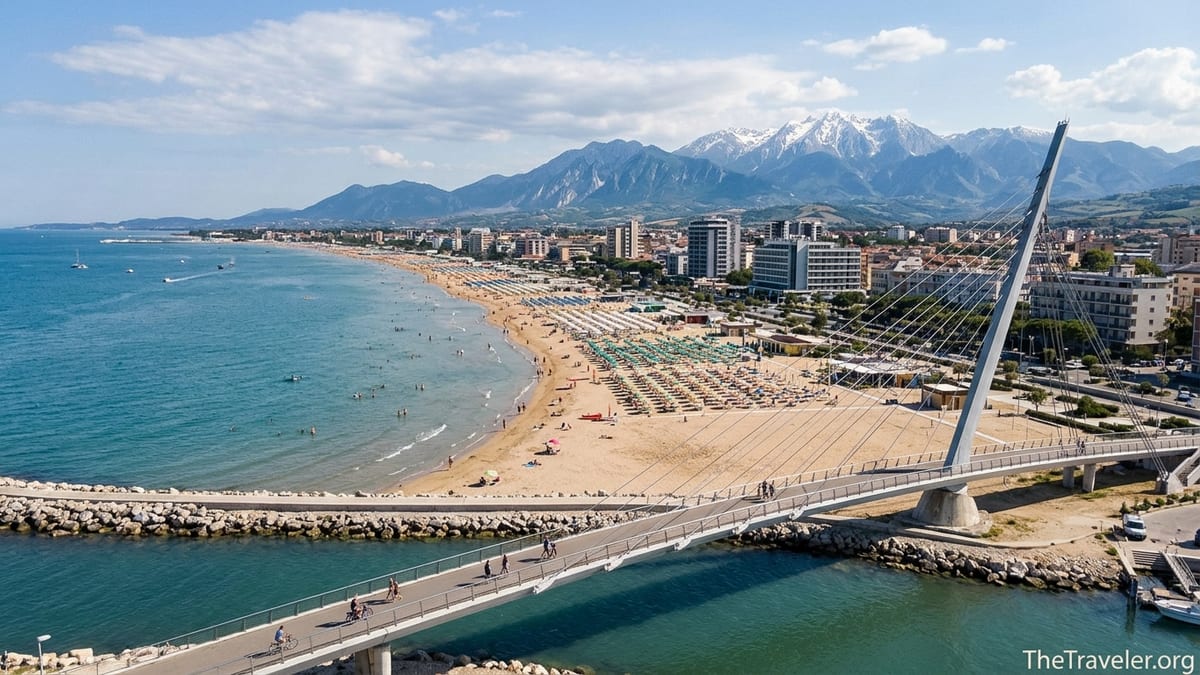
Pescara’s coastline is one long urban beach: a wide ribbon of sand with shallow water and dozens of private beach clubs, or stabilimenti balneari, separated by stretches of public, free-access sand. The sea is usually calm in summer and shelves gently, making it suitable for families with children and less confident swimmers, though the scenery is mostly urban waterfront rather than dramatic coves or cliffs.
Using the beach here generally means choosing between a free spiaggia libera and a paid stabilimento. At free sections, you bring your own towel and umbrella and use public showers or kiosks where available. At private clubs, you rent an ombrellone (umbrella) with one or two sun loungers, gaining access to showers, toilets, changing cabins and often a bar or simple restaurant. Recent online booking data for Pescara beach clubs indicates full-day umbrella and sunbed packages in 2026 commonly range from about 20 to 30 euros on regular summer days, rising on peak August weekends or for front-row positions nearer the water.
Beach facilities are regulated by the municipality and regional ordinances that require operators to provide sanitary services such as toilets, showers and foot-washing stations in good working order during bathing hours. Lifeguard coverage is present on most managed stretches in high season, and flags indicate sea conditions. This structured setup suits visitors who prioritize comfort and services over wild nature, though it can feel regimented to those used to undeveloped beaches.
Along the waterfront runs a long cycling and walking path that forms part of broader coastal routes. In summer evenings the promenade fills with joggers, families with strollers and cyclists heading to and from neighborhoods like Montesilvano to the north. The atmosphere in July and especially August is lively and sometimes hectic, with umbrellas laid out in dense grids and traffic heavy on the main seafront road. Outside the core season, from late September to May, the beaches quieten dramatically and you share the sand mainly with locals, runners and dog walkers, although many beach clubs dismantle much of their equipment.
City sights, culture and what to do beyond the beach
Despite its reputation as a modern beach town, Pescara offers several points of interest for travelers who enjoy urban wandering. One of the most distinctive landmarks is Ponte del Mare, a sweeping pedestrian and cycle bridge that arches above the mouth of the Pescara River, linking the north and south seafronts. Walking or cycling over it at sunset provides broad views of the marina, the orderly rows of beach umbrellas and, on clear days, the outline of the Apennines inland.
Close by lies the marina area, where fishing boats and leisure craft share space with waterfront bars and restaurants. This district blends working harbor life with evening passeggiata culture. In the modern center, Corso Umberto I runs from Pescara Centrale station toward the sea and forms one of the city’s main shopping and strolling streets, lined with fashion chains, cafes and gelaterie. It leads to Piazza della Rinascita, also called Piazza Salotto, a broad open square where locals meet for aperitivo at outdoor tables.
For a sense of older Pescara, head to the Pescara Vecchia district on the south bank of the river. Here, low, narrow streets host wine bars, trattorias and bars that come alive at night, especially in warmer months. This is also where you find the Museo Casa Natale di Gabriele d’Annunzio, the preserved birth house of the controversial poet, writer and political figure. The museum contains period furnishings and memorabilia and gives a glimpse of how the town looked before wartime destruction. Admission fees are modest, typically just a few euros, and visits rarely require advance booking.
Local markets provide another window into everyday life. The central market areas, with stalls selling seasonal fruit, vegetables, fish from the Adriatic and local cheeses, are ideal places to see what Abruzzesi actually eat and to buy picnic supplies. Away from the front-line tourist trade you will encounter more Abruzzese dialect, older residents taking their time over purchases and a palpable sense that this is a regional working city rather than a resort built solely for visitors.
Food, drink and where to find authentic Abruzzese cooking
Abruzzo’s cuisine combines hearty mountain dishes with straightforward coastal seafood. In Pescara, one emblematic specialty is arrosticini: skewers of small cubes of lamb grilled over a long charcoal trough and served with bread and local red wine. These are often sold in casual restaurants, simple rosticcerie or dedicated arrosticini houses both in the city and in the surrounding hinterland. Prices per skewer are usually low, so locals order them in bundles, making them an affordable way to eat out.
Another classic dish is pasta alla chitarra, made by pressing sheets of egg pasta over a stringed wooden frame called a chitarra to cut it into square-sided strands. In coastal areas like Pescara it might appear with seafood, while inland it is often served with mutton or lamb ragù. On the seafront, you will also encounter mixed fried Adriatic fish, mussels and clam-based pasta dishes. Dessert counters regularly feature parrozzo, a dome-shaped almond cake covered with chocolate, closely associated with the city.
For wine, Abruzzo is best known for Montepulciano d’Abruzzo reds and Trebbiano and Pecorino whites, many produced in the hills just inland from Pescara and Chieti. Mid-range restaurants typically offer local bottles at prices noticeably lower than in major Italian cities. Ordering the house wine, often from a nearby cooperative, can be good value, especially in eateries frequented by locals rather than visitors.
To find everyday, non-touristic dining, look one or two streets behind the seafront and away from the most polished stretches of Corso Umberto I. Trattorie and osterie that offer fixed-price lunch menus aimed at office workers, often around the low to mid teens in euros for two courses with water and coffee, are a reliable indicator of local cooking. In Pescara Vecchia, small places that fill up late with locals rather than promoting English-language menus outside are more likely to provide a genuine Abruzzese experience, though service can be brisk and reservations advisable on weekends.
Where to stay: neighborhoods and budget realities
Pescara’s compact layout means most visitors choose between three broad accommodation zones. The beachfront strip offers hotels and apartment rentals either directly on the lungomare or one block back. Staying here gives immediate access to the sand and promenade, at the cost of higher summer rates and more street noise, especially in July and August nights when bars stay open late. Families with children often favor this area for the convenience of walking from room to umbrella in minutes.
The central district around Pescara Centrale station and Corso Umberto I is another logical base. From here, you can walk to both the beach and Pescara Vecchia in roughly 10 to 20 minutes, while having quick access to trains and buses for day trips. This area mixes business hotels, smaller guesthouses and short-term apartments. It is practical for travelers arriving late at night or leaving early by train, though the immediate station surroundings feel more functional than charming.
For a quieter stay, some visitors choose residential neighborhoods slightly inland or to the north toward Montesilvano, where tree-lined streets and local shops dominate. Here, accommodation is more likely to be self-catering apartments or small B&Bs. You trade instant beach access for calmer evenings and often lower prices outside peak weeks, but you will rely more on city buses or bicycles, or a 15 to 30 minute walk, to reach the sea and central nightlife.
In terms of budgeting, Pescara is generally less expensive than larger Italian coastal cities. Mid-range double rooms in three-star hotels outside August can often be found in the 70 to 110 euro range, rising noticeably in the first half of August when Italians take their main holidays. Simple meals in local trattorie may cost 15 to 25 euros per person excluding wine, while a day at a beach club with umbrella and two loungers could add 20 to 30 euros in high season. Public transport tickets on urban buses are usually just a few euros or less per ride, making it feasible to rely on buses rather than taxis within the city.
Getting in and around: planes, trains, buses and cars
Abruzzo Airport sits on the edge of Pescara along the state road Via Tiburtina Valeria and is connected to the A25 and A14 motorways. It serves as a regional gateway for Abruzzo and parts of neighboring regions, with flights operated by carriers such as Ryanair, Wizz Air and ITA Airways on routes that change seasonally. From the terminal, TUA urban bus lines, notably 8 and 38 or services branded as Airlink, run between the airport, Pescara Centrale station and central stops like Piazza della Repubblica. Buses typically take about 15 to 20 minutes to reach the center and arrive at intervals of around 20 minutes across much of the day.
From Rome, travelers can choose between direct regional trains from Roma Termini to Pescara Centrale or long-distance buses from Roma Tiburtina bus station and the city’s airports. Train journeys generally take around three and a half hours, while buses are often scheduled at around the same duration depending on traffic. Coach companies operating this route sell tickets through their own channels and at stations, with prices that can be competitive with or lower than rail, especially if booked in advance or outside peak days.
To reach inland destinations without a car, regional trains and TUA buses are essential. The rail line linking Rome, Sulmona, Chieti and Pescara serves as a backbone for those traveling to mountain areas, while bus lines connect hubs like Sulmona to villages such as Scanno, and link Pescara with ski and hiking bases like Roccaraso and Castel di Sangro. However, schedules are often oriented around local needs, so services may be infrequent on weekends and holidays, making certain day trips challenging without careful planning.
For visitors who intend to explore Gran Sasso or Majella National Parks in depth, or to visit remote hermitages and hilltop villages on flexible timetables, renting a car remains the most practical option. Car hire is available in Pescara and at the airport, and road access to the mountains via the A24 and A25 motorways and regional roads is straightforward. Within the city, be aware of ZTL (limited traffic zones) in central streets where cameras enforce access restrictions; parking in the seafront area often involves paid blue-line spaces, especially in summer, and free spots can be difficult to find near the beach at peak times.
Day trips and itineraries: coastlines and mountains
Several rewarding day trips are reachable from Pescara, some comfortably by public transport and others more realistically with a car. Chieti, the provincial capital on a hill about 20 kilometers inland, is accessible by frequent trains and buses and offers a historic center, Roman remains and museums along with wide views over the surrounding landscape. South along the coast, Ortona is a compact town with a castle above the sea and connections onward to the Costa dei Trabocchi, the stretch of shoreline characterized by old wooden fishing platforms projecting into the water.
The Costa dei Trabocchi, stretching roughly between Ortona and Vasto, has seen investment in a cycling and walking route that in parts follows a disused railway line along the sea. From Pescara, you can take a regional train to towns like San Vito Chietino or Fossacesia and then explore on foot or by rented bicycle, although train stations and access paths can involve some walking and gradients. This area feels more scenic than Pescara’s urban front and is one of the most appealing coastal landscapes in Abruzzo for visitors interested in photography and quieter coves.
Inland, Sulmona is an attractive historic town reached by train from Pescara on the line toward Rome. It is known for its medieval streets, Roman aqueduct and production of sugared almonds. From Sulmona, buses connect to Scanno and its lake, though travel times and frequencies mean that combining both there and back in a single day from Pescara can be long and may require early starts and careful attention to return departures. Similarly, Gran Sasso and Majella National Parks are theoretically reachable via a mix of train and bus, but many trailheads and highland villages are far from stations, which is why travelers serious about hiking often add car rental for at least a couple of days.
When planning, consider realistic travel times. A simple day trip by train from Pescara to Ortona or Chieti can take under an hour each way and leave ample time to explore. Reaching Sulmona by train may take around two hours depending on the service, with additional bus legs to Scanno or nearby villages. Journeys into Gran Sasso by public transport often involve a combination of train or long-distance bus to cities like L’Aquila, followed by local buses, which can limit you to visiting just the town rather than high trails if you do not drive.
Sample 2, 4 and 7 day plans
For a short two-day stay focused on sea and city life, you might spend day one settling into a beachfront or central hotel, then walking along the lungomare and crossing Ponte del Mare to orient yourself. In the evening, stroll Corso Umberto I from the station to the sea, pause for aperitivo in Piazza della Rinascita and dine on seafood near the harbor or in Pescara Vecchia, perhaps including arrosticini or a seafood pasta.
On day two, divide your time between a morning at a beach club and an afternoon of culture. Reserve an umbrella and sunbeds at a stabilimento, swim and people-watch until lunch, then head into Pescara Vecchia to visit the Museo Casa Natale di Gabriele d’Annunzio and explore the narrow streets. End the day at a wine bar sampling Montepulciano d’Abruzzo and local snacks before a late dinner.
With four days, you can add a coastal excursion. After two days as above, dedicate day three to a day trip by train to Ortona and, if timings allow, a short exploration of a section of the Costa dei Trabocchi, either on foot or by rented bike. On day four, take the train to Chieti for a change of scene and to experience a more traditional Abruzzese hill town atmosphere before returning to Pescara for a final evening on the promenade.
A seven-day stay allows you to combine sea, towns and at least one mountain foray. Days one and two follow the beach and city program. On day three, visit Sulmona by train and return the same evening. Day four could be devoted to Ortona and the trabocchi coast. Day five might be a rest and food-focused day in Pescara, exploring markets and lesser-known neighborhoods. For days six and seven, consider renting a car and driving into either Gran Sasso or Majella National Park, basing yourself for one night in a mountain village or agriturismo so that you can hike or explore without rushing back to the coast the same day.
Climate, seasons, families, accessibility and honest limitations
Pescara experiences a typical Adriatic climate with warm to hot summers and mild, sometimes wet winters. Beach season usually runs from roughly June to early September, with the busiest period concentrated in the last weeks of July and the first half of August when Italian holidaymakers arrive and many umbrellas are pre-booked. Sea temperatures become comfortable for swimming from late May or June and stay pleasant into September, though full beach services outside the main season may be reduced as clubs dismantle some infrastructure.
For families, Pescara’s flat terrain, shallow beach and structured facilities are significant advantages. Many stabilimenti provide playground areas, pedal-boat rentals and family-friendly changing facilities. Strollers handle the promenade and central streets quite easily, and supermarkets and pharmacies are plentiful. However, traffic along the main coastal road can be heavy in summer and crossing between inland accommodation and the beach requires attention at wide junctions.
Accessibility is generally better here than in many historic Italian centers, because much of Pescara is modern and flat. Ramps and wide pavements are more common than in hill towns, and some beach clubs are equipped with accessible walkways and equipment to reach the water. That said, quality and availability of accessible facilities vary from one establishment to another, so travelers with mobility needs should verify details directly with accommodations or beach clubs before arrival.
It is important to balance Pescara’s strengths with its limitations. Urban development means a lot of concrete, wide roads and modern apartment blocks, and the coastal scenery within the city limits is less striking than that of the Costa dei Trabocchi or certain northern Abruzzo beaches. In high summer the seafront can feel crowded and traffic-heavy, and noise from bars may bother those staying directly on the lungomare. Reaching the most beautiful mountain and park areas without a car is possible but often slow and restricted by sparse public transport schedules, which may frustrate travelers with ambitious hiking plans.
How Pescara compares to other Abruzzo coastal bases
When choosing a base on Abruzzo’s coast, it is helpful to compare Pescara with other destinations such as Vasto or Giulianova. Pescara stands out for its airport, major train station and bus connections, which make arrivals and departures straightforward. Its nightlife, shopping streets and year-round urban activity are stronger than in many smaller resorts, so travelers who enjoy evenings out, varied dining and a city atmosphere may prefer it.
Vasto, further south, offers a historic hilltop old town with views of the sea and easier access to scenic sections of the Costa dei Trabocchi. Its marina and beaches are less urban in feel, and many travelers describe the surrounding coastline as more picturesque than Pescara’s central strip. However, Vasto lacks Pescara’s international airport and sees fewer direct long-distance rail and bus connections, making it a little more involved to reach.
To the north, towns like Giulianova and others along the Teramo coast provide long sandy beaches similar in character to Pescara’s but at a smaller scale. They can feel more straightforwardly holiday-oriented, with promenades lined by seasonal accommodations and beach clubs, yet offer fewer cultural sights and urban services. For visitors whose priority is a relaxed beach holiday with minimal city bustle, these resorts may be attractive alternatives.
In deciding whether Pescara deserves a place on your itinerary, consider your priorities. If you want a convenient Adriatic base with good transport, a lively modern city, long sandy beaches with full services and the possibility of forays into Abruzzo’s mountains and historic towns, Pescara can work well for two to seven days. If your ideal Italian holiday centers on postcard hilltop views, intimate coves or centuries-old architecture, you may prefer to base yourself in inland Abruzzo or along the more rugged stretches of the Costa dei Trabocchi, using Pescara primarily as a transport hub rather than your main destination.