


More news on this day
Qantas chief executive Vanessa Hudson has described persistent air traffic control delays at Sydney Airport as “not OK”, as a run of recent incidents and investigations intensifies scrutiny of how the country’s busiest gateway is managed.
Get the latest news straight to your inbox!
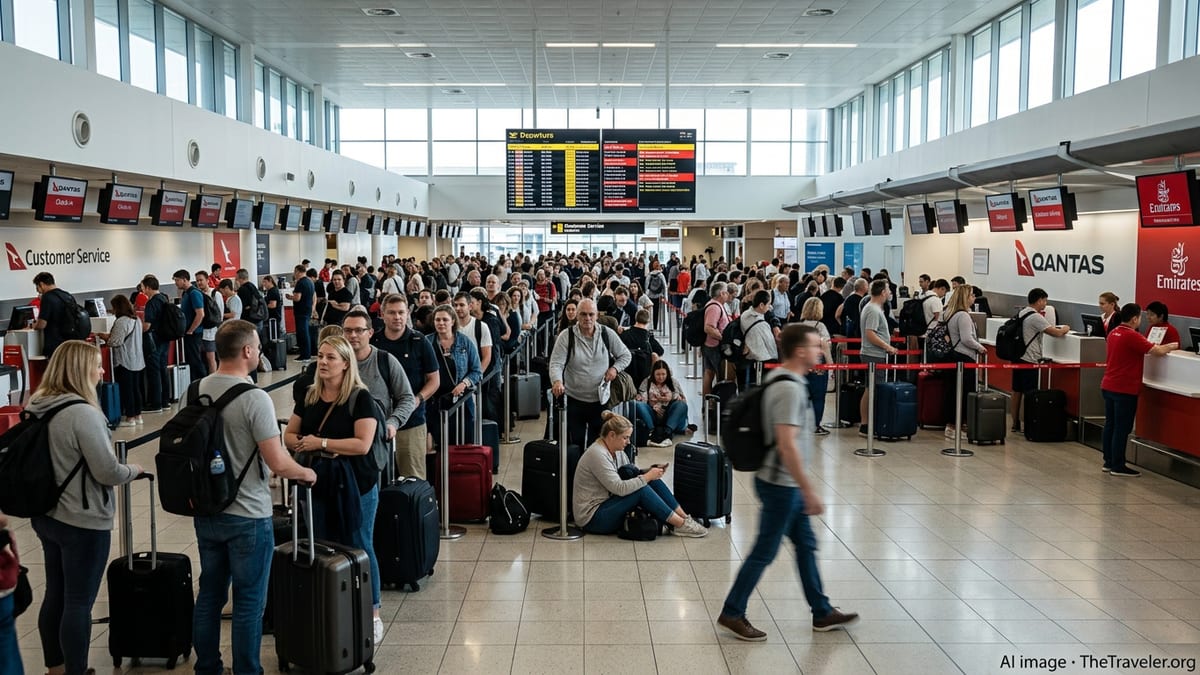
Hudson highlights impact of ATC staffing gaps on Qantas passengers
According to recent coverage of Qantas’ full-year results briefing in Sydney, Hudson told investors that air traffic control staffing shortages at Sydney Airport have disrupted operations across the airline’s network and affected an estimated 60,000 Qantas customers in recent months. Travel industry reports indicate she characterised the situation as “not okay”, while stressing that the carrier is working with air traffic control providers to improve reliability.
Publicly available information from the briefing shows Hudson drew a line between operational disruption and safety, supporting the safety record of the airport and Airservices Australia, which manages the nation’s air traffic control system. She reportedly said safety remained the primary focus for both airlines and controllers, even as passengers continue to face schedule changes, missed connections and extended journey times.
The comments come as on-time performance and cancellation rates across Australia’s major airports remain a sensitive issue for travellers and regulators. Qantas has previously argued in public submissions that adverse weather, airport operating limits and air traffic control staffing constraints are key contributors to delays, particularly at capacity-constrained Sydney Kingsford Smith Airport.
String of safety investigations puts Sydney operations under the microscope
The renewed focus on delays coincides with heightened safety scrutiny at Sydney Airport after a series of runway and taxiway incidents prompted separate investigations by the Australian Transport Safety Bureau. Recent reporting shows that three tarmac-related events involving Qantas and Virgin Australia aircraft have been referred to the national safety watchdog in the space of several weeks, including a case in which a Qantas jet crossed the take-off path of a Virgin Boeing 737, forcing controllers to cancel the latter’s departure clearance at the last moment.
According to coverage by national broadcasters and wire services, the most recent incidents involve taxiing conflicts on 16 and 25 August, one of which included a Jetstar Airbus A320 and a Bombardier aircraft. None of the cases resulted in injuries, but they have intensified debate over whether existing procedures and infrastructure at Sydney are keeping pace with record passenger numbers and a complex mix of domestic and international traffic.
Airservices Australia chief executive Rob Sharp, in a recent public statement, acknowledged that disruptions at Sydney have been “frustrating” for passengers, airlines and the airport. He said the organisation remained confident in the safety of operations but accepted that further improvements were needed, particularly in Sydney, where staffing and traffic levels have tested the resilience of the system.
Airservices and Qantas point to staffing, weather and infrastructure limits
Airservices Australia and Qantas have both pointed in public documents to a combination of air traffic staffing, weather and infrastructure constraints as drivers of delays at Sydney. In submissions to government and competition regulators, Qantas has argued that ground delay programs imposed by air traffic control, together with slot and curfew rules at Sydney, can cascade across its network, forcing schedule changes on busy domestic and international routes.
Separately, coverage from local aviation outlets has highlighted infrastructure bottlenecks on the ground, including constraints around aircraft power and taxiway configuration, as contributors to congestion. Sydney Airport has previously said it is investing in systems that allow airlines to minimise reliance on fuel-burning auxiliary power units while aircraft are parked, but the airport continues to record some of the highest delay rates among major Australian gateways.
Industry analysis suggests that even relatively minor issues, such as a reduced “airport acceptance rate” when air traffic controller numbers are tight or during poor weather, can rapidly disrupt operations when an airport is already operating near capacity. Passenger accounts shared on travel forums and social media frequently describe late-running departures from Sydney triggering missed connections on long-haul flights to Asia, Europe and North America.
Slot rules and political pressure sharpen debate over accountability
Hudson’s “not OK” comment also lands in the middle of a broader policy debate over how responsibility for delays at Sydney should be shared between airlines, air traffic control and the airport operator. Official documents tabled in Australia’s parliament show that Qantas holds more than 100 movement slots in each of Sydney’s morning and afternoon peak periods, under rules intended to manage the airport’s strict hourly cap and night curfew.
Sydney Airport has previously argued that slot allocation rules can encourage airlines to hold onto peak-time slots even when reliability suffers, while Qantas has publicly rejected suggestions it “hoards” slots. In a detailed position paper released last year, the airline said it faces penalties if it does not use allocated slots and insisted that weather, air traffic control constraints and other external factors underpin most delays and cancellations that passengers experience at Sydney.
Recent reporting on the latest runway incidents has prompted fresh political attention in Canberra, with senior ministers seeking more rapid reporting of safety events and clearer lines of accountability. While regulators have stressed that Australia’s aviation safety record remains strong by global standards, policymakers are signalling that reliability and transparency will be central to forthcoming reviews of airport performance and air traffic services.
What the delays mean for travelers heading through Sydney
For travelers, the emerging picture is of an airport system under pressure, where staffing shortages in air traffic control, complex runway operations and tight slot and curfew rules combine to leave limited slack when anything goes wrong. Industry data and customer accounts indicate that even short ground holds at Sydney can quickly ripple into longer waits at the gate, diversions to other airports and missed onward flights.
Consumer advocates say the current environment underlines the importance of building extra connection time into itineraries that route through Sydney, especially during peak morning and evening periods. Some travel advisers recommend at least two to three hours between a domestic arrival and an international departure where possible, given the potential for weather and air traffic restrictions to push services off schedule at short notice.
For Qantas, Hudson’s acknowledgement that the situation is “not OK” signals that the airline is keen to be seen as pushing for solutions while defending its safety record. For travelers planning trips through Sydney in the coming months, publicly available information suggests that monitoring flight status closely, allowing additional buffer time and understanding passenger rights in the event of disruption will remain essential parts of navigating Australia’s busiest airport.
Sources:
Travel Weekly: Qantas CEO says ATC shortages are ‘not okay’ but backs safety at Sydney Airport
SBS News: Sydney Airport's 'core issue' exposed by third runway incident
Reuters: Australia transport safety regulator probes incidents at Sydney Airport
Mirage News: Statement from Airservices Australia CEO Rob Sharp
Qantas: Setting the record straight on Sydney Airport slots