


For many visitors, the Delhi Airport Metro Express Line, often called the Orange Line, is the fastest and most predictable way to get from Indira Gandhi International Airport’s Terminal 3 into the city. Running directly between the airport and New Delhi Metro Station beside New Delhi Railway Station, it can cut a one-hour taxi ride through traffic down to around 20 minutes underground. This guide walks you through tickets, timings, luggage rules, and when the metro clearly beats a taxi, using real-world examples so you know exactly what to expect on arrival.
Get the latest updates straight to your inbox!
What the Delhi Airport Express (Orange Line) Actually Is
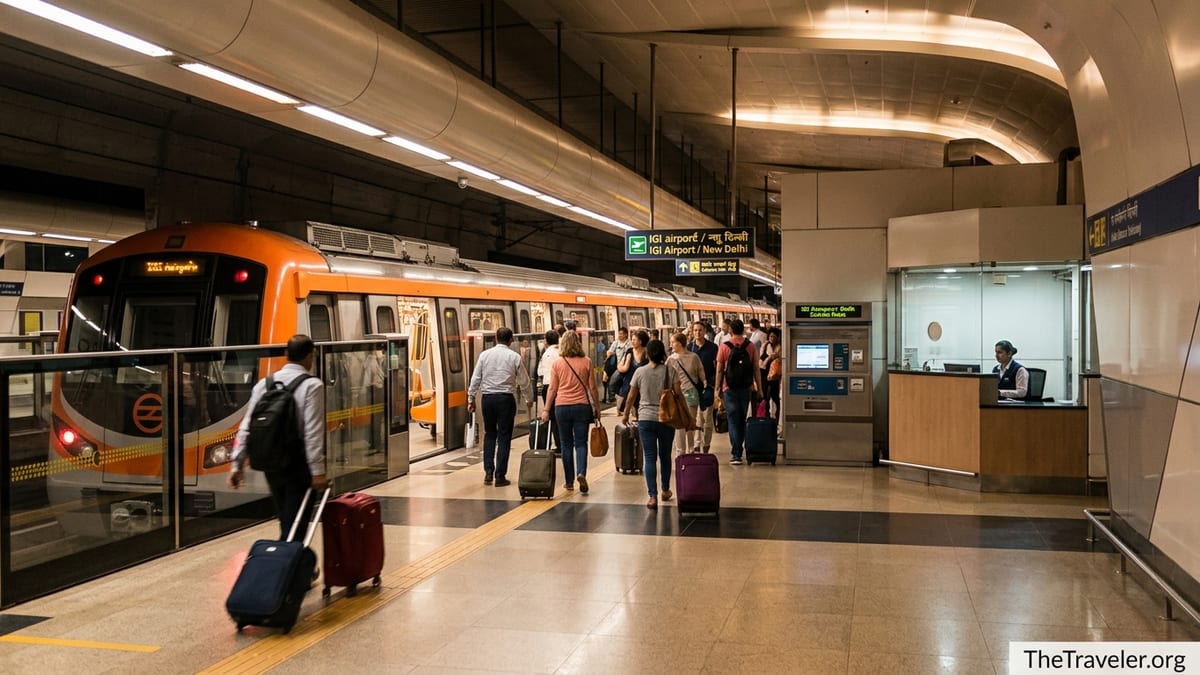
The Airport Express is a premium, limited-stop metro line linking New Delhi Metro Station in the city center with Indira Gandhi International Airport’s Terminal 3, plus key stops at Shivaji Stadium (for Connaught Place hotels), Dhaula Kuan, Delhi Aerocity and Dwarka Sector 21. Trains are air conditioned, have dedicated luggage racks and wider aisles, and travel at higher speeds than the regular Delhi Metro. In practice, this means a ride from Terminal 3 to New Delhi usually takes about 20 to 22 minutes, compared with 45 to 75 minutes by road depending on traffic.
The line is fully integrated into the Delhi Metro network but operates slightly differently: fares are higher than ordinary lines, security is a bit tighter, and staff are used to dealing with first-time visitors, foreign passengers and people with large suitcases. If you land at Terminal 3 on an international flight from London, New York or Singapore and your hotel is near Connaught Place or Paharganj, the Airport Express is usually the most efficient first leg into the city.
From New Delhi station, you can transfer directly to the Yellow Line for destinations such as Chandni Chowk, Old Delhi Railway Station, Rajiv Chowk, Hauz Khas or Gurugram (Huda City Centre). This makes the Orange Line not only an airport transfer service, but also a fast backbone connection that lets you reach much of the city with just one or two changes.
At the airport end, the line serves Terminal 3 directly via the IGI Airport (T3) Metro Station and also connects to the broader metro network at Dwarka Sector 21, which is useful if you are heading towards west Delhi or the Blue Line corridor. For most air travelers, however, the important stretch is simply T3 to New Delhi Station.
Stations, Terminals and How to Navigate T3 and New Delhi
The station you will use at the airport is IGI Airport (T3) Metro Station, located below Terminal 3. After clearing immigration and customs, follow the overhead signs for “Metro / Airport Express Line.” You take an elevator or escalator down one level to the ticketing concourse, where you will find staffed counters, ticket vending machines and security screening. The walk from arrivals to the metro station is typically 5 to 10 minutes, entirely indoors and signposted.
New Delhi Metro Station is at the city end of the line and is adjacent to New Delhi Railway Station on the Paharganj side. The two are connected via a short, mostly underground walkway with clear signage. If you are connecting to a long-distance train, allow at least 15 to 20 minutes to walk from the Airport Express platform, clear metro security, navigate the corridors, and find your railway platform, especially if you are catching popular trains such as the Bhopal Shatabdi or Rajdhani services that depart from the main station.
The New Delhi Metro complex is also an interchange with the Yellow Line, one of Delhi’s busiest north–south routes. Inside the metro system, transfer from the Airport Express to the Yellow Line is straightforward: you simply follow signs to Yellow Line platforms without exiting through the turnstiles. If you are heading to hotels around Connaught Place, you can choose to get off earlier at Shivaji Stadium station, which sits within a short auto-rickshaw ride of many business hotels, guesthouses and offices in that area.
If your flight arrives or departs from Terminals 1 or 2, the Airport Express does not serve those terminals directly. For Terminal 1, many travelers ride the Airport Express to Delhi Aerocity station and then take the free or low-cost airport shuttle bus or a short taxi ride to T1. For Terminal 2, the closest Airport Express stop is still IGI Airport (T3), and you then connect by airport shuttle. This extra step can still be faster and cheaper than a direct taxi from the city during peak traffic.
Tickets, Fares and How to Pay
Fares on the Airport Express are higher than the regular Delhi Metro but still inexpensive by international standards. As of mid-2026, a single journey between IGI Airport (T3) and New Delhi is around 60 to 80 Indian rupees, depending on the exact fare stage and any minor revisions. In practice, most visitors pay in the region of 60 to 100 rupees for a full run on the line, which is roughly 0.75 to 1.25 US dollars at typical exchange rates.
You can buy paper QR-code tickets from staffed counters or automated ticket machines at all Airport Express stations. At Terminal 3, many arriving passengers simply walk up to the counter, state “New Delhi,” pay in cash, and receive a QR slip that you scan at the gates. Machines usually accept cash and sometimes cards, but card success can vary, so carrying some cash is wise immediately after landing. QR tickets are single-use: you scan in at origin and out at your destination, and the gates will keep the slip.
Frequent users often opt for Delhi Metro smart cards, which are reusable contactless cards that you tap in and out across the entire network, including the Airport Express. If you plan to stay in Delhi for several days and use the metro more than a few times, buying or topping up a smart card at the Airport Express station can save time later. Some domestic travelers also use contactless bank cards or mobile wallets for metro entry, but this works more reliably on regular lines than on the Airport Express and can vary by bank and device, so it is best treated as a backup rather than your only plan.
Although the Airport Express is a premium service, there is no first-class or reserved seating. Your ticket simply allows you to enter the system and ride between your chosen stations. If you accidentally exit at the wrong stop or overshoot your destination, station staff can usually help recalibrate your fare at the customer service window, often by charging or refunding a small difference in cash.
Timings, Frequency and How Early the First Train Runs
The Airport Express Line is designed with flight schedules in mind and typically starts running earlier than many regular metro lines. As of 2026, first trains from both New Delhi and IGI Airport (T3) generally depart just before or around 5 am, with the last services leaving around 11 pm to 11:30 pm. Exact times can shift slightly with timetable adjustments, so before a very early morning flight it is sensible to check the latest first-train departure for your specific day of travel.
Train frequency is usually in the range of every 10 to 15 minutes during most of the day. At peak times, such as weekday mornings and evenings, you are more likely to see trains closer together, while late at night and very early in the morning gaps can be a little longer. Even at quieter times, however, waiting more than 15 minutes is uncommon on this line, which is one reason it is trusted by commuters who work at the airport and by frequent fliers.
For a typical daytime arrival at Terminal 3, you can expect the whole process from aircraft door to metro platform to take anywhere from 30 minutes (for a domestic flight with no checked baggage) to 90 minutes or more (for a full long-haul international arrival with immigration queues and checked luggage). Factoring in average train frequency and the 20 to 22 minute ride to New Delhi, most travelers can plan to be in central Delhi about 60 to 120 minutes after landing, with the wide range largely driven by immigration and baggage, not the metro itself.
If you have a very early morning flight, for example a 6:30 am departure to Dubai or Bangkok, you should work backwards from the airline’s check-in cut-off. If check-in closes at 5:45 am and the first train from New Delhi to the airport is a little before 5 am, the airport metro may be too tight for comfort, and in that case a pre-booked taxi at 3:30 to 4 am could be safer. Conversely, for flights departing after 8 am, many city-center passengers prefer to take the first or second Airport Express trains rather than sit in unpredictable dawn traffic.
Luggage, Security and Onboard Experience
Airport Express trains are specifically designed for passengers with luggage. Each carriage has multiple baggage racks near the doors, and there is ample standing space around them. As a general rule, standard airline checked suitcases and cabin bags are accepted without issue. You pass your bags through x-ray scanners at station security, similar to entering an airport terminal, but there are no special check-in or tagging procedures for most passengers.
If you are traveling with unusually large or heavy items, such as oversized sports equipment or multiple very large suitcases, station staff may advise you to use a taxi instead. The system aims to balance capacity and safety, so one or two large suitcases and a backpack per person are routine, but an entire group with eight or ten huge bags might be gently discouraged from crowding a single carriage. Many families arriving from long-haul flights still use the metro successfully by dividing bags between adults and older children.
Onboard, the ride is generally smooth, quiet and air conditioned. At busy times, such as late evening after several international flights arrive in quick succession, carriages between the airport and Aerocity can fill up, but the atmosphere usually remains calmer than on regular metro lines, partly because the passenger mix is more oriented to air travelers and airport staff. Announcements are made in English and Hindi, and station names are clearly displayed in both languages, so even first-time visitors with jet lag can follow the route.
Security on the Airport Express is comparable to the rest of Delhi Metro, with bag scanners and metal detectors at entry, CCTV coverage, and visible staff presence. Many solo travelers, including women arriving after dark, report feeling safer taking the Airport Express into the city and then a short ride with a reputable taxi or app-based cab from New Delhi or Shivaji Stadium, rather than staying alone in a car for an entire hour-long journey from the airport on unfamiliar roads.
New Delhi Station Tips and Real-World Transfer Scenarios
New Delhi Metro Station can seem confusing at first, especially if you arrive with jet lag and a heavy backpack, but a little preparation goes a long way. The Airport Express platforms are deeper underground than the Yellow Line platforms. When you step off the train, follow the clearly marked exits: one set leads toward New Delhi Railway Station and the Paharganj side, another toward Ajmeri Gate, and others toward different metro connections. If your next leg is a mainline train, keep an eye out for signs marked “New Delhi Railway Station” and “Paharganj side.”
In a typical scenario, a traveler arriving from Europe might land at T3 at 3 pm, clear immigration and baggage by 4:30 pm, and board the Airport Express around 4:45 pm. Arriving at New Delhi just after 5 pm, they would then need roughly 20 minutes to walk through the passage to the main railway station, pass any security checks, and navigate to their platform. For a 6 pm departure on a long-distance train such as a Shatabdi or Rajdhani, this leaves some buffer but not much. In such cases, having your train ticket details and platform number ready in advance, and avoiding detours into the crowded station food court, can prevent last-minute stress.
If your destination is a hotel near Connaught Place, you have two practical options. You can ride the Airport Express to Shivaji Stadium, which is closer to many central hotels, then take an auto-rickshaw or short app-based taxi ride of 5 to 10 minutes. Alternatively, continue to New Delhi station, transfer to the Yellow Line, and go one stop to Rajiv Chowk, which lies beneath Connaught Place. The choice often comes down to luggage and time of day: if it is rush hour and you want to avoid crowded Yellow Line trains, getting off at Shivaji Stadium and taking a short cab can be more comfortable.
For budget travelers heading toward Old Delhi and backpacker districts around Chandni Chowk, a common pattern is Airport Express to New Delhi, transfer to the Yellow Line heading north, and ride two stops to Chandni Chowk station. From there, it is a 10 to 15 minute walk or short cycle-rickshaw ride to many guesthouses. This combination keeps your time on the road surface short and predictable while letting you reach historic neighborhoods that taxis would otherwise approach slowly through congested lanes.
When the Airport Metro Is Better Than a Taxi
Choosing between the Airport Express Metro and a taxi often comes down to three variables: time, cost and convenience. For solo or couple travelers with moderate luggage, the Airport Express usually wins on both time and price for journeys to central Delhi. A one-way metro ticket from T3 to New Delhi might cost around 60 to 80 rupees and take about 20 minutes, while a taxi covering the same distance can cost anywhere from 500 to 900 rupees or more once night surcharges, airport access fees and app-based platform charges are included, with travel times ranging from 30 minutes late at night to over an hour in peak traffic.
In real-world terms, consider a late afternoon arrival on a weekday, when the road to Connaught Place and Paharganj is often clogged. Taking a taxi from T3 to a hotel near New Delhi Railway Station might mean sitting in traffic jams near Dhaula Kuan and along arterial roads, arriving in 60 to 75 minutes and paying around 700 to 1,000 rupees. The Airport Express, by contrast, gets you to New Delhi in about 20 minutes irrespective of surface traffic, and from there an auto-rickshaw to your hotel could cost around 50 to 100 rupees and take 5 to 15 minutes depending on exact location.
The equation shifts if you are traveling as a family of four with several large suitcases, or if your destination is well away from metro lines, such as parts of outer Gurgaon, Noida Extension or certain farmhouse belts toward Chattarpur. In those cases, the total metro cost for four people, plus the hassle of moving multiple heavy bags through stations and onto connecting metros or taxis, can make a single pre-booked taxi or ride-hailing vehicle more attractive despite the higher fare. For a group with six large suitcases heading to a serviced apartment in Golf Course Road in Gurgaon arriving at 11 pm, many would sensibly choose a direct cab even if it costs 1,500 to 2,000 rupees.
Another scenario where the metro clearly wins is for passengers connecting between the airport and New Delhi Railway Station for same-day trains. Because rail schedules are fixed and city traffic is unpredictable, shaving 20 to 40 minutes off the road journey can be the difference between catching and missing a train. Many regular travelers now automatically factor in the Airport Express as the default leg for this corridor, reserving taxis mainly for the last short segment between the metro station and their hotel or onward rail platform.
Practical Tips for First-Time Users
First-time visitors often worry that navigating the Airport Express and New Delhi station will be complicated, but small habits can simplify the experience. Keep your passport, flight details and accommodation address handy, as ticketing staff and security officers occasionally ask for basic information if something unusual arises. Pick up a small amount of local currency at the airport so you are not dependent on card payments for your first ticket or for an onward rickshaw from New Delhi or Shivaji Stadium.
When boarding at Terminal 3, try to avoid bunching at the first carriage you see. The middle carriages often have more space and free luggage racks, especially during busy evening waves when several international flights land at once. Once on board, place your largest suitcase in a rack rather than blocking doors or aisles, both for your comfort and other passengers’ safety. Keep small valuables like wallets and phones on your person, not in unattended bags, as you would in any large-city transit system.
On arrival at New Delhi station, pause for a moment before heading for the exits to check the signage and your route. Decide whether you are going toward the railway station, the Yellow Line, or the taxi and auto stands. This 30-second pause can prevent you from being swept by the crowd toward the wrong exit, which would then mean a longer walk back underground or at street level. If you are unsure, ask uniformed metro staff rather than touts or unofficial guides, especially near New Delhi Railway Station, where unsolicited offers of help sometimes lead to aggressive sales pitches for hotels or taxis.
Finally, keep in mind that while the Airport Express is very reliable, occasional disruptions can occur, especially during major events, protests or technical issues. If you are traveling for an international flight, it is always wise to have a backup plan in mind, such as the approximate cost and time for a taxi from your hotel to the airport, and to allow a safety margin of at least 30 to 45 minutes beyond what the metro timetable alone would suggest.
FAQ
Q1. What are the typical operating hours of the Delhi Airport Express Line?
The Airport Express usually starts running from around 5 am and continues until about 11 pm to 11:30 pm from both New Delhi and IGI Airport (T3), with slight variations by day and timetable changes. For very early flights, always check the latest first-train time before relying on the metro.
Q2. How much does a ticket from Terminal 3 to New Delhi Metro Station cost?
As of mid-2026, a single ticket between IGI Airport (T3) and New Delhi typically costs in the region of 60 to 80 rupees for most passengers, though exact fares can change slightly with periodic revisions.
Q3. Can I use the Delhi Metro smart card on the Airport Express Line?
Yes, standard Delhi Metro smart cards are valid on the Airport Express Line. You can buy or top up a card at Airport Express stations and tap in and out just as you would on other lines.
Q4. Is the Airport Express safe to use at night, especially for solo travelers?
The Airport Express is generally considered one of the safer ways to travel between the airport and central Delhi, with CCTV, security screening at entrances and a steady flow of airport staff and travelers. Many solo travelers, including women, prefer it to long road journeys after dark, then take a short taxi or auto from New Delhi or Shivaji Stadium to their accommodation.
Q5. How much luggage can I bring on the Airport Express Metro?
Typical airline baggage, such as one large suitcase and one cabin bag per person, is routinely accepted. Trains have dedicated luggage racks, but very large or numerous items may be restricted, so if you are carrying multiple oversized bags, a taxi could be more practical.
Q6. How long does the journey from T3 to New Delhi Station take?
The non-stop ride between IGI Airport (T3) and New Delhi on the Airport Express usually takes about 20 to 22 minutes. You should add extra time for walking within the stations, buying tickets and any onward connections.
Q7. What is the best way to reach Connaught Place using the Airport Express?
You can either get off at Shivaji Stadium station, which is very close to many Connaught Place hotels and offices, and then take a short taxi or walk, or continue to New Delhi, transfer to the Yellow Line and travel one stop to Rajiv Chowk under Connaught Place.
Q8. Is the Airport Express cheaper than taking a taxi from the airport?
For solo travelers or couples heading toward central Delhi, the Airport Express is usually significantly cheaper than a taxi. While fares vary, metro tickets are generally under 100 rupees, whereas taxis from T3 to central areas often cost several hundred rupees or more once airport fees, night charges and traffic delays are factored in.
Q9. Can I connect easily from the Airport Express to Indian Railways trains at New Delhi?
Yes. New Delhi Metro Station is connected to New Delhi Railway Station by a covered walkway. Allow at least 15 to 20 minutes to walk from the Airport Express platform to your railway platform, longer if you have heavy luggage or are unfamiliar with the station layout.
Q10. Should I take the Airport Express or a taxi if my hotel is in Gurgaon or far from the metro?
If your hotel is close to a metro station, combining the Airport Express with a regular metro line can still be fast and economical. However, for destinations deep in Gurgaon, Noida Extension or areas without convenient metro access, a pre-booked taxi or ride-hailing car may be more convenient, especially if you have multiple bags or are traveling late at night.