


More news on this day
A radar malfunction at Athens International Airport this week has disrupted operations during the peak summer travel period, forcing arrival restrictions, extended holding patterns and significant delays for hundreds of flights across Greece and wider Europe.
Get the latest news straight to your inbox!
Capacity Cut as Approach Radar Fault Emerges
Publicly available operational data and aviation analyses indicate that a recent malfunction affecting approach radar at Athens International Airport reduced the number of aircraft that could land each hour, triggering knock-on disruption throughout the network. The issue emerged during an already busy late June travel window, as holiday traffic to Greek destinations accelerated.
Reports suggest that arrival capacity at the airport, normally set around 28 aircraft per hour in peak daytime periods, was temporarily lowered to roughly 24 landings per hour while the radar issue was addressed. That reduction, although seemingly modest, created a bottleneck during high-demand waves and quickly translated into extended airborne holding, ground delays and schedule reshuffles.
According to industry monitoring, the malfunction was resolved by the following morning, but the backlog of delayed flights took longer to clear. Aircraft arriving late into Athens missed original departure slots for onward legs, contributing to a rolling pattern of delays that affected both domestic island services and international connections.
The disruption comes in a summer when the airport had already been operating close to its declared capacity. Prior to the radar fault, seasonal planning parameters showed Athens managing dozens of arrivals per hour at peak, with limited margin for unexpected technical outages.
Long Delays Add to a Season of Strain
Local and regional coverage describes lengthy queues and extended waiting times for passengers at Athens in recent weeks, with the radar failure adding another layer of disruption to an already pressured operation. Earlier in June, mandatory checks on precision landing and navigation systems had temporarily slowed traffic flows, and separate reports highlighted congestion and new biometric border controls adding minutes to processing times.
Consumer rights platforms tracking delays across Europe have repeatedly listed Athens among the region’s more heavily disrupted hubs this month, citing high numbers of late departures and arrivals even before the radar malfunction. On some days, hundreds of flights were reported as delayed, underscoring how sensitive the airport’s schedule has become to any constraint in available runway or airspace capacity.
The recent radar issue is the latest in a series of technical and operational challenges documented for the Greek capital’s gateway over the past year, including earlier system checks and isolated equipment problems. Network reports compiled by European air traffic management bodies for previous seasons have already flagged Athens as vulnerable when radar or related systems are taken offline or operate at reduced performance.
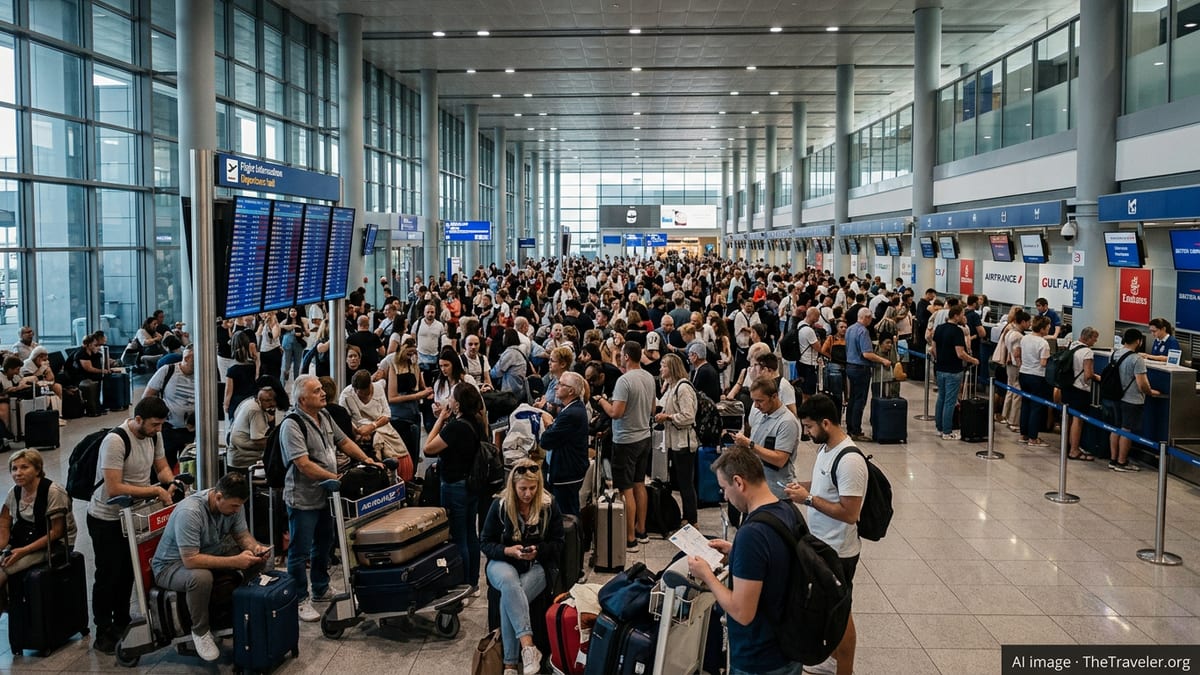
For travelers, the cumulative effect has been highly visible. Accounts shared on social media and travel forums describe crowded departure halls, uncertainty over departure times and tight or missed connections, particularly for passengers relying on Athens as a transfer point between long haul services and domestic island flights.
European Network Impact and Delay Patterns
The Athens radar malfunction also rippled through the wider European air traffic network. Analysis of recent network operations data shows Greece contributing a significant share of summer delay minutes in the region, with the capital’s airport a key driver when arrival rates are constrained for technical reasons.
When an arrival rate is cut, even by a handful of movements per hour, scheduled flights must either accept tactical delays or be re-sequenced. Aircraft already en route may be placed into holding patterns, while departures bound for the affected airport can face ground stops, speed reductions en route or revised takeoff times. These measures help maintain safety margins but inevitably lengthen journey times and complicate airline crew and fleet planning.
Because Athens serves as a central hub linking mainland Europe with the Greek islands and eastern Mediterranean destinations, disruption there tends to generate disproportionate knock-on effects. Aircraft that arrive late into Athens often operate subsequent sectors, so a single delayed arrival can cascade into several late departures across the day.
Recent statistics released by the airport for the first months of 2026 already showed rising traffic volumes compared with the previous year, suggesting that demand has returned strongly to pre-pandemic trends. In that context, even short-lived technical failures such as the radar malfunction can have outsized consequences for punctuality.
What Passengers Experienced on the Ground
Travelers passing through Athens around the time of the radar disruption reported a mix of departure delays, longer-than-expected waits on board parked aircraft and last-minute gate changes. In some cases, passengers described being informed of revised departure times in short increments, only to see their flights pushed back repeatedly as air traffic managers worked through the constrained arrival and departure sequence.
For those making onward connections, the uncertainty proved particularly stressful. Several accounts describe passengers arriving from European cities with limited time to transfer to domestic flights to islands such as Santorini, Mykonos and Crete, only to learn that their onward services were also delayed or required rebooking.
At the same time, inbound tourism flows meant many travelers were unfamiliar with the airport layout and processes, complicating efforts to navigate security, passport control and gate changes quickly. Some travelers reported that airport staff were attempting to prioritize passengers at risk of missing imminent departures, but overall throughput was limited by both airside and landside constraints.
Airlines operating at Athens have been using a variety of responses, from rerouting aircraft and swapping equipment to requesting updated slots and adjusting schedules on short notice. Industry commentary indicates that carriers are also reviewing contingency plans for future technical events, including options for spreading risk across different time bands during peak summer weekends.
Advisory Tips for Upcoming Summer Travelers
With the radar malfunction resolved but the broader summer peak still building, aviation analysts and passenger advocacy groups are advising travelers to treat Athens as a high-demand hub that remains vulnerable to further disruption this season. Public guidance emphasizes the importance of monitoring flight status closely and allowing generous buffers for connections, particularly when traveling onward to islands on separate tickets.
Passengers with upcoming trips through Athens are encouraged to arrive at the airport well ahead of departure time, especially for non-Schengen or long haul flights where additional security and border checks apply. Travel commentators suggest at least three hours for international departures and a minimum of 90 minutes for domestic flights, with extra time during early morning and late afternoon peaks.
Flexible planning can also help mitigate the impact of any renewed technical issues or capacity restrictions. Where possible, booking longer connection windows, traveling with carry-on luggage only and using airline mobile applications for real-time updates may improve the chances of making onward flights if schedules shift.
As Greece enters the heart of the summer tourism season, the recent radar failure at Athens International Airport serves as a reminder that even brief technical glitches can significantly affect Europe’s busy holiday corridors. Travelers passing through the hub in the coming weeks are likely to benefit from a cautious, well-prepared approach.