


More news on this day
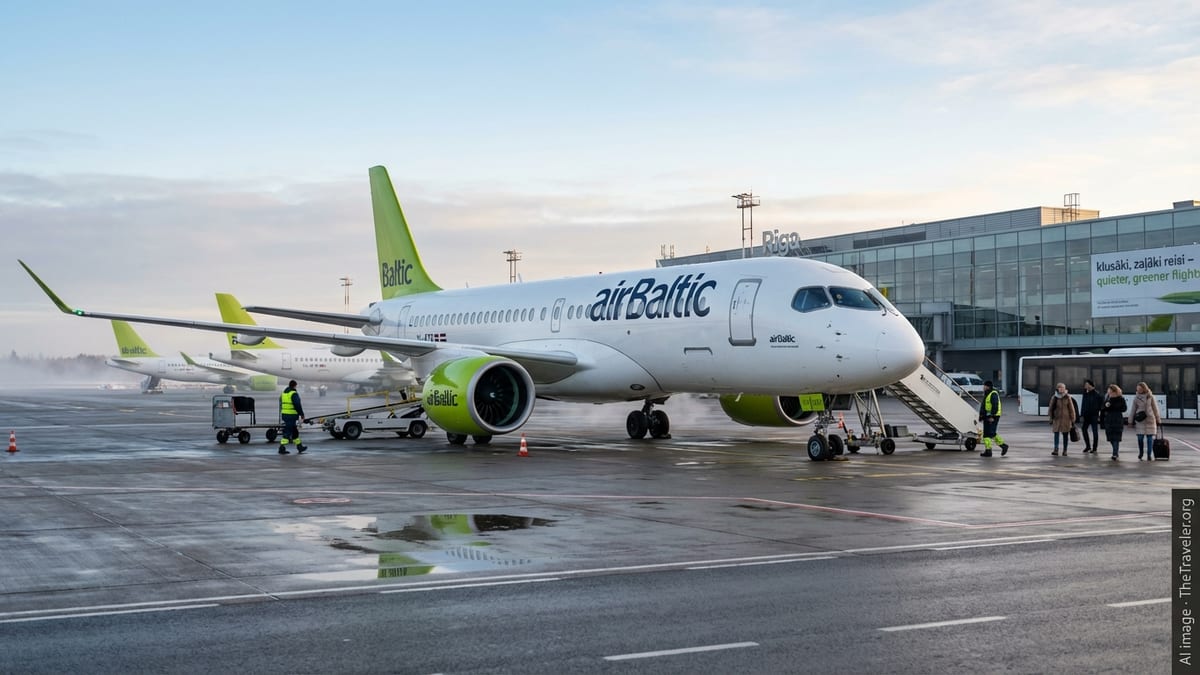
Latvia’s flag carrier airBaltic is moving to reduce the number of Airbus A220 jets it keeps in active service, triggering a broad shake-up of routes from its Riga hub and prompting closer scrutiny of the airline’s strategy and finances.
Get the latest news straight to your inbox!
A220 Fleet Falls Back After Years of Rapid Growth
Publicly available fleet data for early 2026 indicate that airBaltic operates an all-Airbus A220-300 fleet, with just over 50 aircraft in its inventory. However, reports from industry trackers and recent discussion among Baltic aviation observers suggest that only around 36 of those aircraft are being regularly deployed in passenger service, with others parked, in heavy maintenance or used more selectively.
The apparent pullback follows several years of aggressive expansion in which airBaltic became Europe’s largest A220 operator and a launch customer for the type. Company presentations and manufacturer disclosures have repeatedly underlined a long-term ambition to grow to around 100 A220-300s by the end of the decade, positioning Riga as a major transfer hub for Northern and Eastern Europe.
Any reduction in the effective fleet available for daily flying therefore marks a notable shift in tone. Instead of simply adding capacity, airBaltic now appears to be prioritising aircraft utilisation, maintenance planning and cash generation, even if that means fewer frames are active at any one time than headline fleet numbers might suggest.
Industry analysts note that such a move can be a rational response to higher fuel prices, supply-chain constraints around engines and a tougher demand environment across parts of Europe. For a relatively small carrier heavily concentrated in one region, keeping more aircraft on the ground can sometimes be less costly than flying unprofitable frequencies.
Route Cuts and Timetable Changes Ripple Through Riga
The capacity reset is being felt most clearly in Riga, where the airline has spent the past decade building one of the largest networks of direct flights in the Baltic region. Over recent months, published schedules and passenger reports point to a pattern of route suspensions and frequency reductions, especially on thinner point-to-point services.
Within the Baltic states and neighbouring markets, connections such as Kaunas to Riga have been suspended, with rising fuel costs and weaker load factors cited in local coverage as contributing factors. Elsewhere, services like Warsaw to Riga, relaunched only this year, are being discontinued again after a short run, leaving rival carriers to backfill demand via their own hubs.
The impact is particularly acute for travellers who relied on early morning or late evening departures for business trips and same-day returns. With some airBaltic rotations removed from the timetable, passengers are increasingly pushed towards alternative routings through Warsaw, Helsinki or other regional hubs, often at higher fares or with longer total journey times.
At the same time, Riga’s airport, which has marketed itself as a fast and efficient transfer point, must now contend with a thinner bank of connecting flights in certain time windows. While the airport still offers a broad range of destinations, the reduction in overlapping frequencies and marginal routes subtly erodes its competitive edge against larger European hubs.
Financial Pressures and Strategic Reassessment
The timing of the fleet and network adjustments coincides with heightened public debate in Latvia over the national carrier’s long-term financial performance. Historical data compiled by regional media and official reports show that airBaltic has required repeated capital injections and loan support over the past decade, leaving the state with significant exposure to the airline’s fortunes.
Discussions on local forums and in business coverage in mid-2026 have referenced internal cost-cutting efforts, a refreshed business plan and a renewed focus on trimming loss-making routes. Commentators point to high overheads, exposure to volatile fuel prices and the cost of maintaining a young, single-type fleet as key challenges the company must manage if it is to reach sustainable profitability.
The decision to keep only part of the A220 fleet flying intensively can be read in that context: a bid to align capacity more closely with demand, reduce variable expenses and buy time to complete internal restructuring. While the A220 is widely regarded as efficient on a per-seat basis, each additional aircraft still represents substantial fixed and financing costs that must be justified by consistent revenue.
Latvia’s government, as majority shareholder, faces a delicate balance. On one hand, airBaltic is viewed domestically as a strategic asset that supports tourism, trade and connectivity for the wider Baltic region. On the other, there is growing pressure to limit further public support and ensure that any future expansion in the A220 order book is matched by clear evidence of sustainable returns.
Passenger Experience and Reputation Under Strain
For passengers, the downstream effects of the fleet reduction are felt less in technical statistics and more in disrupted travel plans. Social media posts and recent online discussions highlight frustration over short-notice schedule changes, cancellations on newly launched routes and difficulties rebooking at acceptable times or prices.
Some travellers have praised the onboard comfort of the A220, noting its relatively spacious cabin, large windows and quiet operation compared with older regional jets. Nevertheless, others argue that a premium perception of the aircraft type does little to compensate for perceived inconsistencies in reliability, baggage policies or customer service when things go wrong.
These mixed experiences come at a sensitive moment for the brand. With competition intensifying from low-cost carriers on leisure routes and from major network airlines on key business corridors, airBaltic must protect not just its balance sheet but also passenger confidence. Persistent timetable volatility risks pushing high-yield travellers towards rival hubs, undermining the very connecting traffic the airline depends on.
Travel agencies and frequent flyers in the region are closely watching how the winter 2026 schedules evolve. A more stable, predictable timetable using a smaller active fleet could help restore trust, but only if customers perceive that the new plan is realistic and that last-minute changes become the exception rather than the rule.
What the Shake-Up Means for the Baltic Aviation Landscape
The retrenchment in airBaltic’s A220 operations carries implications beyond a single airline. For Riga and the wider Baltic region, reduced capacity from the dominant local carrier creates openings for rivals to expand, particularly on routes where demand remains solid but yields have been pressured by competition.
Industry observers note that foreign airlines have already been building a stronger presence in Baltic airports, adding capacity from their own hubs and, in some cases, exploring new direct connections that bypass Riga altogether. If airBaltic maintains a smaller active fleet for an extended period, that trend could accelerate, gradually diluting Riga’s status as the default gateway to the region.
At the same time, the strategic benefits of a modern, fuel-efficient A220 fleet remain clear. Should market conditions improve and financing remain available, airBaltic retains the option to reactivate more aircraft, increase utilisation and once again pursue net growth. The current shake-up may therefore be less a reversal of its A220 strategy than a pause intended to recalibrate the scale and pace of expansion.
For travellers planning trips to and through Latvia, the most immediate takeaway is practical rather than structural: schedules are in flux, and relying on a formerly dense web of connections through Riga now requires closer attention to timetables and contingency plans. How quickly airBaltic can stabilise its operations with a leaner active fleet will shape not only its own recovery, but also the competitive map of Northern European air travel in the years ahead.