


More news on this day
Rapid Rail Sdn Bhd, the operator of Kuala Lumpur’s core urban rail network, is moving through a period of intensive upgrades, new technology rollouts and financial support as the Malaysian capital leans more heavily on public transport.
Get the latest news straight to your inbox!
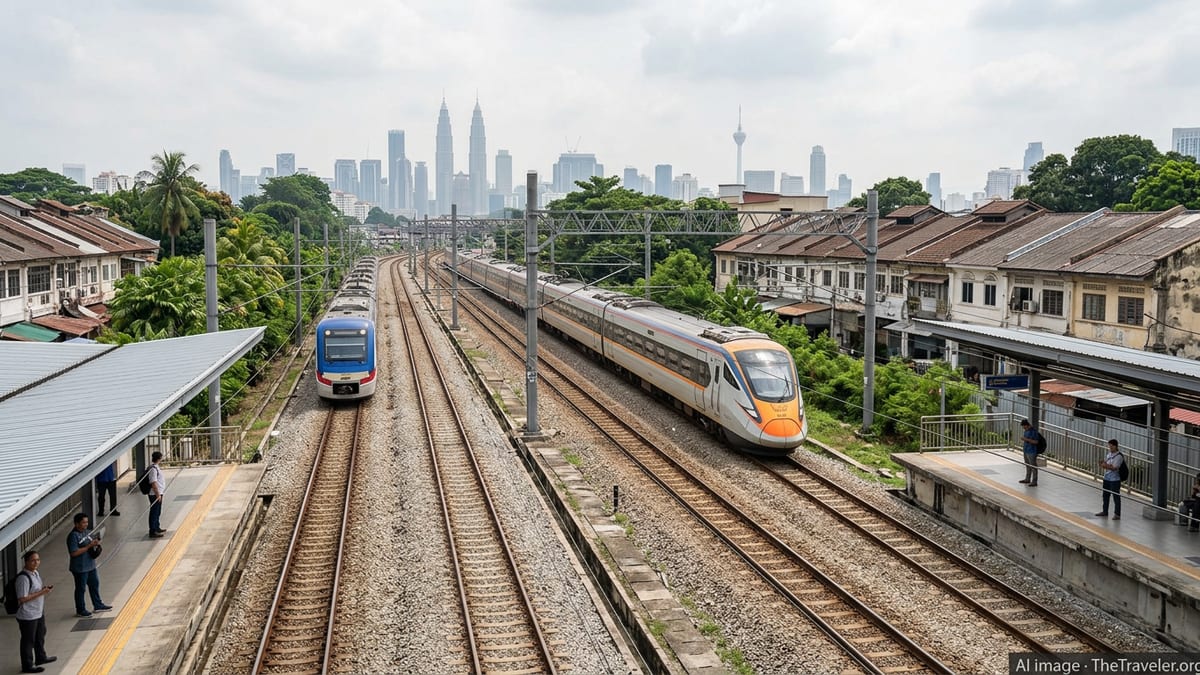
Key operator in Klang Valley’s integrated rail network
Rapid Rail Sdn Bhd is a subsidiary of Prasarana Malaysia Berhad and is responsible for operating much of the Klang Valley Integrated Transit System, including the Kelana Jaya, Ampang and Sri Petaling light rail lines, the KL Monorail and the MRT Kajang and Putrajaya lines. Publicly available information describes the company as a central pillar in efforts to create a seamless, multi-operator rail system serving the wider Kuala Lumpur metropolitan area.
The company’s role extends beyond daily train operations to long term planning for fleet renewal, systems upgrades and station accessibility improvements. Official material on Prasarana’s corporate platforms outlines Rapid Rail’s evolution from the early 2000s restructuring of Kuala Lumpur’s fragmented rail concessions into a more unified state-owned framework.
As Kuala Lumpur’s population and travel demand have grown, Rapid Rail’s lines have increasingly formed the backbone of commuting into the city’s core business, retail and government districts. The rail network is integrated with bus routes managed by sister company Rapid Bus, and forms part of a broader strategy to raise public transport’s modal share and reduce road congestion in the Klang Valley.
Rising ridership and financial pressures
Recent coverage in Malaysian media indicates that passenger volumes on Rapid Rail operated services have climbed steadily through 2024 and 2025, with Rapid KL’s rail network surpassing one million daily trips in late 2025. Reports attribute this growth to network extensions, service improvements and policy measures encouraging commuters to shift from private vehicles to public transport.
At the same time, the operator is contending with rising operating costs and an expanding asset base. According to business news reporting in early 2026, Prasarana injected around RM700 million of capital into Rapid Rail in 2025 to help cover the gap between fare revenue and operating expenditure. The move was framed as part of a broader effort to keep services running reliably while preserving affordable fares for passengers.
Parallel to the capital injection, a separate announcement in December 2025 detailed price adjustments for several Rapid KL travel passes taking effect from 1 January 2026. The changes were presented as the first revision since 2009 and were linked to higher input costs and the broader expansion of the public transport network. Alongside the adjustments, a new 30 day multimodal pass was introduced to encourage regular use of both rail and bus services.
Service upgrades, accessibility and digital tools
Rapid Rail has been pushing a programme of system and station upgrades designed to tackle crowding, improve accessibility and enhance the passenger experience. In 2025, Malaysian press coverage highlighted the completion of lift upgrades at several KL Monorail stations, including Bukit Bintang area stops, following safety inspections by relevant agencies. The refurbished lifts were positioned as part of efforts to make rail travel easier for passengers with reduced mobility, older riders and families with strollers.
The Kelana Jaya Line, one of the busiest light rail corridors, continues to undergo significant modernisation. Earlier technical briefings have pointed to projects to introduce new four car train sets and upgrade signalling and power systems to support more frequent services and reduce crowding during peak hours. Additional rolling stock procurement, signalled in budget documents and operator statements, is intended to replace aging trains and increase capacity.
On the digital front, Rapid Rail is preparing a real time train crowd monitoring system intended to show passengers which coaches are more or less crowded before a train arrives. Announced in September 2025, the feature is expected to be integrated into existing passenger information channels, allowing riders to distribute themselves more evenly along platforms and potentially reduce dwell times at busy stations.
These initiatives build on earlier moves by the Prasarana group to publish key performance indicators for rail and bus services and to encourage wider use of its journey planning and service status applications. The aim is to combine physical upgrades with more transparent, data driven communication with regular commuters and occasional travelers.
Operational challenges and network resilience
Despite the upgrade programmes, Rapid Rail’s network has continued to face periodic disruptions linked to technical faults, weather events and external incidents. In March 2026, local news outlets reported disruptions affecting the Kelana Jaya LRT, parts of the MRT network and the KL Monorail after a power outage associated with severe weather. Such incidents have underscored the vulnerability of above ground infrastructure to storms common in the Klang Valley.
Also in March 2026, a separate notice outlined temporary adjustments to last train times on the MRT Putrajaya Line to facilitate repair works after a power supply cable theft. The episode highlighted the operational impact that infrastructure theft and vandalism can have on complex urban rail systems and the need for security measures along track alignments.
In response to past service disruptions, Rapid Rail and its parent company have publicised contingency measures such as deploying additional trains on unaffected lines, strengthening bus bridging services and using digital channels to share real time service updates. Publicly available statements describe these measures as part of a broader focus on resilience and recovery when faults occur.
Transport analysts following the sector note that, while short term disruptions attract attention, the longer term trajectory for Kuala Lumpur’s rail network has been continued expansion and integration, with Rapid Rail remaining a central operator in that process.
Supporting major events and future outlook
The network’s strategic importance was highlighted in preparations for the 47th ASEAN Summit in October 2025, when the Ministry of Transport announced longer peak hours and higher train frequencies on selected Rapid KL lines to manage anticipated surges in ridership. Reporting from that period noted shorter headways on the Kelana Jaya Line and KL Monorail, as well as increased frequencies on the MRT Kajang and Putrajaya lines, to support both daily commuters and visiting delegates.
Looking ahead, policy documents and media analyses suggest that Rapid Rail is expected to play a growing role as Kuala Lumpur advances transit oriented development and seeks to curb car dependence. Additional train procurements, ongoing fleet refurbishment and continued station accessibility works are likely to shape the passenger experience over the next several years.
Observers point out that maintaining a balance between affordable fares, rising operating costs and the need for continuous investment will remain a central challenge. The recent capital injection from Prasarana and the recalibration of multi ride passes indicate that financial support from the government and careful fare policy will continue to underpin the system.
For travelers and residents in Kuala Lumpur, the developments at Rapid Rail translate into more frequent trains on key corridors, better step free access at busy stations and a gradual shift toward more data driven passenger information. As these initiatives take hold, the company’s performance will remain a key barometer of how successfully the city’s wider public transport ambitions are being realised.