


When a long-awaited trip collapses into hours at the gate or an overnight airport stay, most travelers just want to get home. The last thing they have energy for is quoting European Union regulations to an airline call center. That is where flight compensation services such as Refund.me and Flightright come in. Both promise to turn your delayed or cancelled flight into cash under EU Regulation 261/2004, but they differ in cost, coverage, speed, and reputation. Understanding those differences can mean hundreds of euros more, or less, in your pocket after a disrupted journey.
Get the latest updates straight to your inbox!
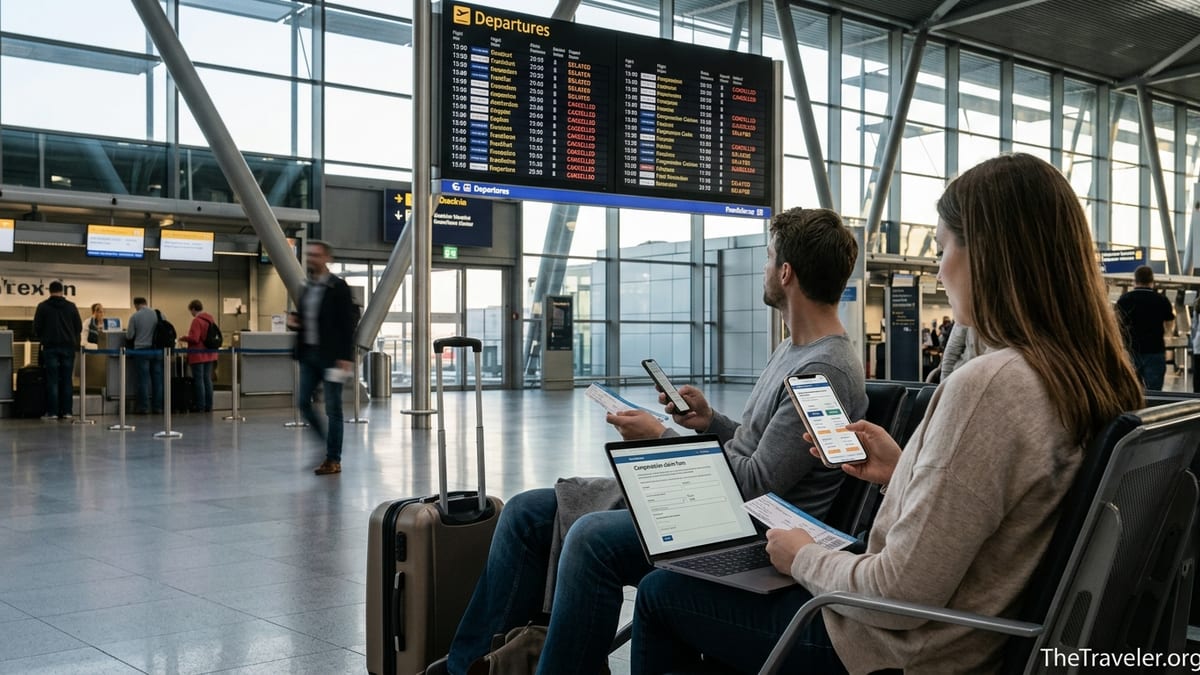
How EU261 Compensation Works in Real Life
Before comparing Refund.me and Flightright, it helps to understand what they are actually chasing on your behalf. Under EU Regulation 261/2004, often shortened to EU261, travelers on many flights departing from the European Union or arriving in the EU on an EU carrier may be entitled to fixed cash compensation for long delays, cancellations, and denied boarding, as long as the disruption is not caused by extraordinary circumstances such as severe weather or air traffic control strikes. The amounts are standardized: typically 250, 400, or 600 euros per passenger depending on distance and delay length. A family of four on a cancelled New York to Paris flight operated by an EU airline could be owed up to 2,400 euros in compensation, separate from refunds or rebooking.
In theory, you can claim this money directly from the airline by filling out online forms or writing to customer service. In practice, many carriers delay, reject, or simply ignore claims, especially when the disruption is borderline or the cause is disputed. A traveler whose Madrid to Berlin flight arrives four hours late might receive a polite email blaming “operational issues” with no mention of compensation. If they push back, the airline may argue that the delay was outside its control, even when that is questionable. This is the friction point where services like Refund.me and Flightright step in, offering to handle the paperwork, legal arguments, and if needed court action, in exchange for a share of any money recovered.
These companies operate on a “no win, no fee” model. You do not usually pay anything upfront. Instead, they take a success-based fee from the compensation if they win. For travelers who would never chase the airline otherwise, a 25 to 35 percent cut can feel like found money. But if you are willing to spend a few hours writing emails or contacting a national enforcement body, that same fee can look expensive. The choice between handling a claim yourself, using Refund.me, or using Flightright largely comes down to how much time, energy, and legal risk you want to assume.
Consider a concrete scenario: a solo traveler from Boston to Lisbon on an EU carrier suffers a five-hour departure delay from Paris. According to EU261, this likely qualifies for 600 euros. If they submit a claim alone and the airline pays after some back-and-forth, they keep the full 600 euros. If they instead use a company charging about 30 percent plus tax, they may net closer to 400 euros after fees. On the other hand, if the airline stonewalls individual claims but pays promptly when confronted by a legal-tech firm with a track record in local courts, the net 400 euros through a service could be more realistic than 600 euros they will never see on their own.
Refund.me: Background, Coverage, and Recent Reputation
Refund.me emerged as an early player in the European legal-tech space focused on air passenger rights. It marketed itself as an automated platform handling claims not only under EU261 but also under similar rules in countries such as India, Canada, Ukraine, and Turkey. In its early years it received industry recognition for using technology to simplify claims and offered mobile apps to let passengers upload boarding passes and disruption details on the go. For a while it was commonly mentioned alongside other pioneers such as Flightright and AirHelp.
In terms of what it covers, Refund.me has historically targeted standard EU261 situations: delays of more than three hours, cancellations where passengers arrive significantly later than scheduled, and denied boarding due to overbooking. Real-world examples on review and comparison sites include travelers whose London to Rome flights were cancelled the night before departure, or families stuck overnight after missed connections in hubs like Frankfurt or Amsterdam. In many of these cases, Refund.me negotiated with airlines and, in some instances, pursued legal action through partner lawyers in the airline’s home country.
However, Refund.me’s online reputation in the mid-2020s is mixed and appears uneven across platforms. Some specialist comparison sites still reflect earlier positive feedback and describe it as a solid option for multi-jurisdiction coverage. At the same time, consumer-review platforms show a noticeable number of recent complaints, often from passengers who purchased cancellation or refund add-ons for events or non-flight bookings and then struggled to obtain payouts. Many of those reviewers describe long response times, requests for extensive documentation, or complete lack of follow-up after initial contact, suggesting that service quality can vary significantly depending on the product and sales channel.
For a traveler, the key practical takeaway is that Refund.me is not only a classic EU261 claim handler; it is also tied into various “refund protection” products sold through ticketing partners for races, events, or non-air travel purchases. Someone clicking a small “refund insurance” box when booking a Spartan race or a convention ticket may later find themselves dealing with Refund.me even though no flight is involved. That dual role partly explains why some reviews focus on event cancellations rather than flight disruptions. When evaluating Refund.me for an airline compensation claim, it is worth filtering recent online experiences specifically related to flight delays or cancellations, as those are more directly comparable to what Flightright offers.
Flightright: Scale, Legal Muscle, and Fee Structure
Flightright is a German-based legal-tech company that has specialized in air passenger claims under EU261 and related regulations for more than a decade. It is widely described in industry and legal media as one of the largest players in Europe, with hundreds of employees and operations in multiple languages. Flightright’s core pitch is straightforward: it checks whether your flight qualifies, handles all communication with the airline, and if necessary takes the case to court, at its own risk, in exchange for a success-based commission.
Flightright publicly states that its standard success fee is around the high twenties as a percentage of the compensation amount, plus applicable value-added tax where required. Concrete examples published in its own fee breakdowns and comparison pieces show typical effective fees in the range of roughly 30 to 35 percent after tax. For instance, for a 250 euro short-haul claim, the effective deduction might land around 70 to 90 euros, leaving the traveler with something like 160 to 180 euros after payment. For a 600 euro long-haul claim, the total fee can be substantial, sometimes above 200 euros, but the passenger still sees a net payout clearly higher than the amounts for shorter routes.
One of Flightright’s perceived strengths is its willingness to litigate and its track record in court. It has been involved in numerous cases before national courts and the Court of Justice of the European Union, sometimes as an assignee of passengers’ claims. Legal documents and press coverage describe instances where passengers formally transferred their right to compensation to Flightright, which then pursued airlines for full reimbursement under EU261 rules. Flightright often highlights claimed success rates close to 99 percent in court, which, while marketing-driven, signals that the company generally only pursues cases it believes are strong.
In practice, that legal leverage can have real-world consequences. Travelers report cases such as a three-person family on a Barcelona to Berlin flight delayed more than three hours where the airline initially argued the delay was due to “extraordinary circumstances.” After individual complaints were rejected, the family forwarded the booking to Flightright. Within several months, and after legal escalation, each passenger reportedly received 400 euros in compensation, with Flightright collecting a success fee from each payout. Situations like this illustrate the trade-off: passengers give up a substantial slice, but they avoid the burden of arguing technical case law with an airline’s legal department.
Fees, Payouts, and How Much Money You Actually Get
When comparing Refund.me and Flightright, most travelers focus first on how much of the compensation they will actually receive after fees. Both operate on a “no win, no fee” model, so the key difference is the percentage they keep and whether there are any extras such as administrative charges or court surcharges. Publicly available information suggests that Flightright’s standard success fee typically sits around the upper 20s as a percentage, plus value-added tax in many European jurisdictions. Overviews of claim company fees indicate that, after tax, the effective bite can approach the low to mid-30 percent range on some cases.
Refund.me’s current pricing is harder to pin down in detail because it has historically worked with different partners and products, but broadly it has also positioned itself as a percentage-based, no-win-no-fee service. Independent comparison sites that track claim companies often show Refund.me’s effective fee as roughly comparable to or slightly below some of the higher-fee competitors, but not dramatically cheaper than mainstream players such as Flightright. In other words, travelers should not assume that Refund.me is a budget option; real-world differences in net payouts between the two may turn on a few percentage points, not half the claim.
To make the trade-off concrete, imagine a delayed Lisbon to Stockholm flight where each passenger qualifies for 400 euros. If they choose Flightright and the total effective fee ends up around 32 percent, each person would receive roughly 272 euros. If Refund.me’s effective fee for a similar case were, for example, closer to 28 percent, the net payout would be around 288 euros for each traveler. Over a group of four, that difference adds up to roughly 64 euros. For some families, that margin will matter; for others, perceived reliability, communication quality, and speed will be more important than squeezing out an extra few percentage points.
Travelers should also remember that any of these services are taking compensation that is already fixed by law. They do not negotiate higher amounts; they simply enforce existing entitlements. If a London to Barcelona flight qualifies for 250 euros under EU261, no lawyer or claim handler can turn that into 500 euros. The primary financial question is whether the convenience and legal support these firms provide justifies their commission, or whether the traveler is better off filing directly with the airline, and if necessary escalating to a national enforcement body or small claims process in the relevant country.
Speed, Communication, and User Experience
Beyond fees, everyday traveler experience often comes down to speed and communication. Here, there are noticeable differences in how Refund.me and Flightright are described in recent online accounts. Flightright, as a high-volume operation, typically handles screening and filing quickly, often confirming within minutes whether a flight appears eligible. For many straightforward cases where the airline cooperates, travelers report payouts within several weeks to a few months. That said, when cases go to court, timelines can stretch significantly, with some passengers waiting six months or more while Flightright’s legal partners pursue judgments.
Communication with Flightright is mostly handled through an online dashboard and email updates. Travelers input their booking number and disruption details, sign a digital assignment or power of attorney document, and then watch status changes such as “claim filed,” “airline responded,” or “legal action initiated.” Some customers praise this structured process and the fact that Flightright continues pressing even when airlines initially say no. Others express frustration when months pass with only occasional updates, especially in complex cross-border cases. The experience can feel impersonal, but that is partly the price of scale.
Refund.me’s communication record is more uneven. Satisfied users describe smooth email exchanges, clear instructions about what documents to upload, and outcomes delivered within realistic timeframes. However, a noticeable number of recent reviewers, particularly those who interacted with Refund.me through event or ticketing partners rather than directly for flights, report long delays, unanswered emails, and claims closed or denied after extensive requests for documentation. For example, some customers who bought cancellation protection for races or conferences say they were asked for detailed medical reports or legal documents and then heard nothing for weeks after submission.
For a traveler choosing between the two, this means expectations should be calibrated differently. If your priority is a large, specialized EU261 firm that focuses heavily on airline disputes, Flightright offers a more transparent and predictable pipeline, albeit sometimes at the cost of slower responses during legal stages. If you value multi-country coverage and are comfortable navigating a service whose responsiveness may vary depending on the channel through which you engage them, Refund.me can still be an option. In both cases, you should be prepared for the process to take significantly longer than a typical credit card refund, especially when the airline fights back.
Regional Reach, Case Types, and When Each Service Works Best
Both Refund.me and Flightright primarily build their business around EU261, but they do not operate identically across markets. Flightright is deeply rooted in Germany and has gradually expanded its presence across much of Europe, handling claims from passengers based in countries such as Spain, France, the Netherlands, and Scandinavia. Its focus is almost entirely on air passenger rights: delayed or cancelled flights and denied boarding, plus related issues such as missed connections within a single booking. If you are a traveler based in Berlin whose Frankfurt to Madrid flight on a European airline was cancelled, Flightright is well positioned and familiar with German and Spanish court environments.
Refund.me’s positioning has historically been broader both geographically and in terms of case types. It has claimed to handle EU261 claims but also to work with regulations and policies in countries such as India, Canada, Ukraine, and Turkey, as well as compensation or refunds related to other forms of travel or ticketed events. That can be helpful for a frequent traveler who regularly flies to and from non-EU destinations or who often books events with add-on refund protection. A passenger traveling from Toronto to Frankfurt on a non-EU carrier, for example, might find that EU261 does not cover the westbound leg but may still have certain rights under Canadian regulations; Refund.me’s wider regulatory focus could, at least in principle, help navigate that complexity.
At the same time, the broader the coverage, the more important it is for travelers to verify exactly what is included in any given product or service. Buying a “refund guarantee” linked to a concert ticket is not the same as assigning an EU261 compensation claim for a cancelled flight. Terms, documentation requirements, and grounds for denial can differ sharply. Before relying on Refund.me in a non-EU flight scenario, travelers should read the fine print about which laws apply and what triggers eligibility. For pure EU261 cases within Europe, Flightright’s specialization can be an advantage because its systems, data, and legal precedents are tuned specifically to that regulation.
In practice, an EU-based traveler whose main concern is compensation for delayed or cancelled flights within or to Europe will often find Flightright a clearer fit. A traveler who frequently buys tickets or events bundled with cancellation protection might encounter Refund.me organically through those partners and may see value in staying within that ecosystem, provided they go in with realistic expectations about required documentation and processing time.
Direct Claim vs Refund.me vs Flightright: Making a Smart Choice
When a flight disruption happens, you effectively have three broad options: claim compensation yourself directly from the airline, use a service like Flightright, or use a service like Refund.me. The right choice depends on your personal tolerance for paperwork, your confidence in arguing with large companies, and how quickly you want the issue off your plate. If your disruption is straightforward, such as a four-hour delay on a Paris to Rome flight clearly caused by an aircraft technical issue, filing directly with the airline can be surprisingly effective. Many carriers now have online forms specifically for EU261 claims, and in clean cases they sometimes pay within a few weeks, letting you keep the full 250 or 400 euros.
However, once a case becomes complicated, travelers often find that persistence and knowledge of legal precedents are required. Airlines may classify an avoidable crew shortage as an extraordinary circumstance, or argue that a missed connection was your fault even when tight scheduling and ground handling delays played a role. If you do not have the time or appetite to write formal letters, reference case law, and possibly file complaints with national enforcement bodies, a specialized service can be worth the commission. In those situations, Flightright’s narrow focus on air passenger rights and visible track record in court make it the stronger option for many EU-based travelers.
Refund.me may still appeal in some scenarios, particularly if you are dealing with a mix of EU and non-EU regulations or if your claim arises through a refund protection product you already purchased when booking. For instance, a traveler who booked a major sporting event in Europe, paid extra for cancellation protection, and then had to cancel due to illness might find that the only route to a refund is through Refund.me. That is a different kind of claim from a standard EU261 delay compensation, but for that traveler, the comparison is not between Refund.me and Flightright so much as between Refund.me and no coverage at all.
In weighing options, consider the amount at stake. For a solo passenger on a 250 euro claim, losing 70 to 90 euros in fees may feel significant. For a group of six on a 600 euro-per-person claim where airlines are pushing back hard, the practicality of handing everything to a legal-tech firm and still walking away with several thousand euros net can be compelling. Also consider your own travel patterns: if you fly to or within Europe regularly and expect to rely on EU261 more than once, taking the time to learn how to file effective direct claims could save substantial money over the years.
The Takeaway
Viewed side by side, Flightright tends to be the stronger choice for classic EU261 flight compensation claims within Europe, while Refund.me occupies a more mixed and sometimes less predictable role that spans both airline disruptions and broader refund protection products. Flightright’s main advantages are its tight specialization in air passenger rights, transparent percentage-based fee model, and established history of pursuing airlines in court when necessary. For a traveler who simply wants a delayed or cancelled European flight turned into cash with minimal hassle, and who accepts giving up roughly a third of the payout in fees, Flightright is a robust, mainstream option.
Refund.me offers a broader, more flexible footprint that can extend beyond the strict boundaries of EU261, including certain non-EU regulations and event-related cancellations. That versatility can be useful in edge cases, but it also coincides with a more uneven pattern of recent customer experiences, especially for claims tied to third-party ticketing partners. Travelers considering Refund.me for a flight disruption should research the most recent, flight-specific reviews and be prepared for potentially demanding documentation requirements and variable response times.
For many travelers, the most financially efficient strategy is a hybrid one: first attempt to claim directly from the airline, especially for clear-cut disruptions. If the airline refuses or ignores the claim and the amount is significant, then consider escalating to a specialist like Flightright for EU261 cases. Refund.me remains a secondary option when your situation involves mixed regulations or when you have already purchased a refund protection product that routes claims through its platform. Whichever route you choose, the key is to recognize that in many cases the law is on your side. Turning that legal right into money in your account is largely a question of how much of your own effort you are willing to invest and how much you are prepared to pay someone else to fight on your behalf.
FAQ
Q1. Does EU261 apply to flights to and from the United States?
EU261 can apply to flights departing from the European Union to the United States on any airline, and to flights from the United States to the EU only when operated by an EU carrier. For example, a New York to Paris flight on a French airline is covered, but the same route on a non-EU airline is usually not covered on the westbound leg.
Q2. Which is generally better for a simple EU flight delay, Refund.me or Flightright?
For a straightforward delay or cancellation on an EU route, many travelers find Flightright the safer and clearer choice because it focuses almost exclusively on EU261 flight claims and has a long track record dealing with large European airlines in and out of court.
Q3. How much of my compensation will I lose in fees if I use Flightright?
Flightright typically charges a success-based fee in the high twenties as a percentage of the compensation, plus applicable taxes, which often results in an effective deduction somewhere around one third of the payout, though the exact figure can vary by country and case.
Q4. Is Refund.me cheaper than Flightright?
Refund.me does not consistently promote a significantly lower fee than Flightright for standard EU261 claims. In many comparisons, the difference in net payout between the two services is relatively small, so travelers should focus at least as much on reliability and communication as on minor fee differences.
Q5. Can I use both Refund.me and Flightright for the same disrupted flight?
No. Airlines and courts generally expect only one claimant per compensation claim. If you assign or transfer your rights to either Refund.me or Flightright, you cannot then pursue the same claim through the other service or on your own without risking confusion or legal conflicts.
Q6. How long does it usually take to get money from these services?
Timelines vary widely. In simple cases where the airline quickly accepts liability, some travelers receive compensation within a few weeks. When airlines resist and cases go to court, it can take several months or more. Neither Refund.me nor Flightright can guarantee a specific payout date.
Q7. Is it better to file a claim directly with the airline first?
Often yes. Filing directly can save you the commission if the airline pays without much resistance. Many travelers choose to try the airline’s EU261 form or customer service first and turn to a specialist such as Flightright only if the carrier refuses, delays, or rejects a claim without convincing reasons.
Q8. What documents do I need to use Refund.me or Flightright?
Typically you will need your booking confirmation, e-ticket or boarding pass, identification details, and a description of what happened, including dates, flight numbers, and how long you were delayed. In some non-flight or event-related claims with Refund.me, additional documents such as medical certificates or legal papers may also be required.
Q9. Are these compensation services regulated like law firms?
The regulatory status varies by country. Many claim companies work with or through licensed lawyers in the relevant jurisdiction and operate under consumer protection and legal services rules, but they are not always traditional law firms in every market. Travelers should review each company’s terms and local legal framework if regulatory oversight is a concern.
Q10. When is it not worth using a compensation service at all?
Using a service may be less attractive when the potential compensation is small, such as 250 euros for a short flight, or when you have the time and confidence to pursue the claim yourself. In those situations, the percentage fee can feel disproportionate, and handling the process directly can keep the full amount in your pocket.