


Few cities confuse arriving travelers quite like Rio de Janeiro. The city has two main airports, with similar names, different codes, and very different locations. Add evolving terminals and separate domestic and international zones, and it is easy to wind up at the wrong terminal or even the wrong airport altogether. This guide walks you through the layouts of Rio’s Galeão (GIG) and Santos Dumont (SDU) airports in clear, practical terms so you know exactly where you are landing, where to collect your bags, and where your ride will be waiting.
Get the latest updates straight to your inbox!
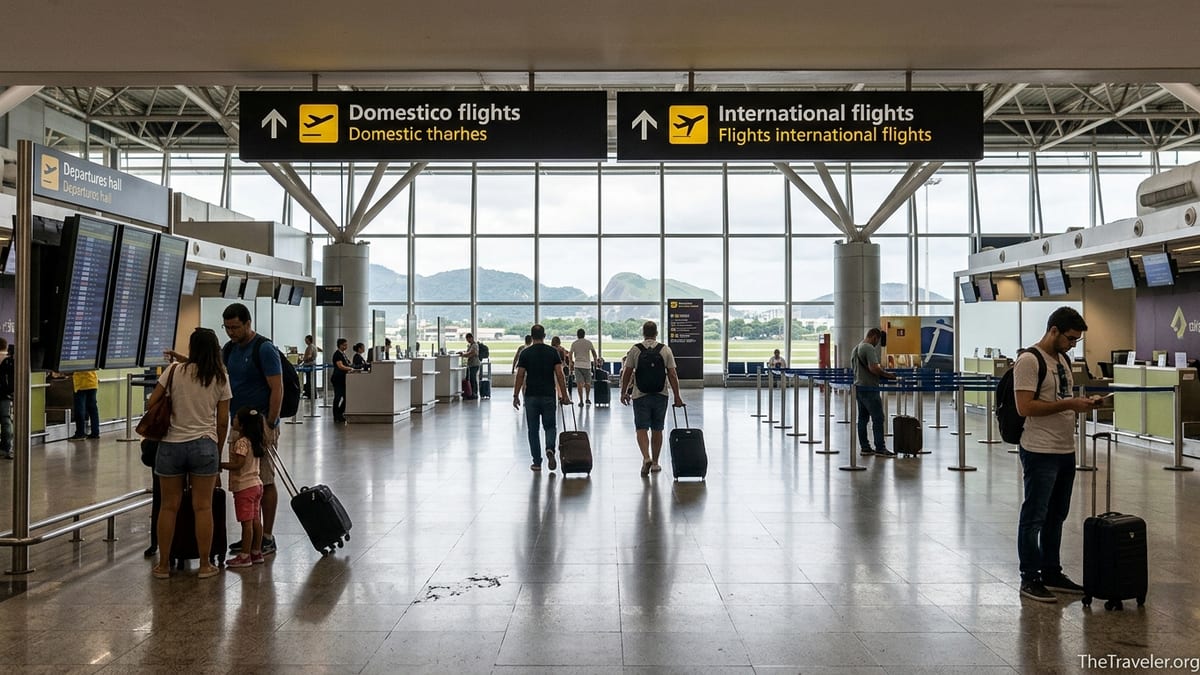
Understanding Rio’s Two Main Airports: GIG vs SDU
Rio de Janeiro is served primarily by two passenger airports: Rio de Janeiro Galeão Tom Jobim International Airport, usually just called Galeão or GIG, and Santos Dumont Airport, known as SDU. GIG is the big international gateway located on Governador Island, roughly 20 to 25 kilometers from Copacabana, depending on the route and traffic. SDU sits right on Guanabara Bay at the edge of downtown, just a short drive from popular neighborhoods like Lapa, Flamengo, and the cruise port. Both show up as “Rio de Janeiro” in booking engines, which is where confusion often begins.
In practice, most long haul international flights and many domestic routes use GIG. If you are flying in from North America or Europe, odds are high your ticket will show the IATA code GIG. By contrast, SDU is heavily focused on high frequency shuttle flights to São Paulo and other domestic destinations. Airlines such as LATAM, GOL, and Azul run multiple daily hops between SDU and São Paulo’s Congonhas or Guarulhos airports, making SDU very popular with business travelers who need quick access to Rio’s central business district.
Because both airports serve the same city, travelers occasionally book a flight arriving at one and a departure from the other without realizing it. For example, a visitor might land at GIG from Miami in the morning, then reserve a cheap onward ticket from SDU to Belo Horizonte for that afternoon. On a map it can look like a single location, but the transfer between airports can easily take an hour or more at busy times. Always double check the three letter code on your ticket, not just the city name, before booking hotels, airport transfers, or tight connections.
Local tour operators and hotel concierges in Copacabana and Ipanema report that “wrong airport” arrivals are one of the most common emergency calls they receive. A typical scenario involves a traveler who told a taxi at their hotel to go to “the Rio airport” for an early morning flight, only to realize on arrival that their flight actually departs from the other airport across town. Knowing the distinction between GIG and SDU and getting in the habit of using their codes when you speak to drivers and book rides is the simplest way to avoid this headache.
Galeão (GIG) Terminal Layout: Terminals 1 and 2 in Practice
Officially, Galeão has two passenger terminals: Terminal 1 and Terminal 2. In everyday use, however, Terminal 2 is the active heart of the airport for both check in and arrivals. Terminal 1 is an older building connected to Terminal 2 that still hosts some departure gates and services, but its own check in and baggage claim facilities have been mothballed. That means that whether you are flying domestic or international, you will enter and exit the airport through Terminal 2 and may then walk to a gate area in the old Terminal 1 building for boarding.
Terminal 2 is organized vertically in a way that will feel familiar if you have used other large international airports. The ground level is focused on arrivals. This is where you come out after immigration and customs, retrieve your checked luggage from carousels, and meet drivers or connect to taxis, app based rides, and buses. Escalators and elevators lead up to the main departures level above, where airline check in counters are arranged in long, numbered islands. Domestic check in desks are concentrated toward one side of the hall and international counters toward the other, with overhead signs in Portuguese and English marking each section clearly.
The departures level then feeds into the secure areas for domestic and international flights. Once you have checked your bags, you will access security screening and, if flying internationally, passport control through separate entrances. Domestic boarding gates include those located in the Terminal 2 concourse and some in the linked Terminal 1 building, reached via a long enclosed corridor with moving walkways. International gates are clustered in the newer parts of Terminal 2, where you will also find airside duty free shops and lounges such as the Plaza Premium Lounge located in the international departures area.
For most travelers, the practical takeaway is that you do not have to worry about picking a terminal when arriving at GIG. If your boarding pass mentions a gate in Terminal 1, you will still check in at Terminal 2, pass security there, and then follow overhead signs through the connecting corridor to reach the older gate area. The walk can take around 5 to 10 minutes at a normal pace. Travelers with reduced mobility can request wheelchair assistance at check in so an airport staff member can accompany them through the connection between the buildings.
Arrivals, Baggage Claim, and Pickups at GIG
All passenger arrivals at GIG funnel into Terminal 2’s ground floor. If you are on an international flight, you will first clear passport control, then walk through to the baggage hall where carousels are arranged in numbered rows. Domestic arrivals skip immigration and go straight to baggage claim. Bilingual monitors above each carousel and large electronic boards near the hall entrances display flight numbers and assigned belts, making it straightforward to confirm where your bags will appear.
Customs control is located just beyond the carousels. Brazil often uses a red and green channel system, with one lane for travelers declaring goods and another for those with nothing to declare. Once you pass this point, you will exit into the public arrivals hall, where you will see a mix of airport services, ATMs, car rental counters, and occasionally hotel or tour desks. This is also your cue to decide how you are getting into the city. Official taxi booths typically quote fixed rates to popular neighborhoods. For instance, visitors in 2026 commonly report paying in the ballpark of the equivalent of 25 to 35 US dollars to reach Copacabana by regular cab, depending on traffic and surcharges.
If you are using a ride hailing app such as Uber, 99, or Cabify, follow in terminal signs that point to designated app based pickup areas. At GIG these are generally located a short walk outside the arrivals level, with specific zones marked for each terminal level and sometimes separated by color coded signage. The app will usually tell you to choose a meeting point like “Door B” or “Sector Azul” and show a small map. It is worth pausing before you order the ride to confirm which curbside sector you are standing in so that your driver can find you quickly.
Passengers connecting from an international arrival at GIG to a domestic flight often wonder whether their bags will be checked through. Even if your airline tags luggage through to your final destination, Brazilian rules typically require all arriving international passengers to collect their checked bags at the first point of entry, clear customs, and then recheck them with the onward carrier. In practice, that means you will pick up your suitcase in Terminal 2, pass customs, turn left or right into the public departures hall, and drop your bag again at the domestic check in counters before heading upstairs to security. Plan at least two and a half to three hours between flights when combining an international arrival at GIG with a domestic connection on a separate ticket to avoid a tight rush.
Domestic vs International Departures at GIG
When it is time to depart from GIG, the most important distinction is whether your flight is domestic or international. Both types depart from Terminal 2, but the check in areas, security lanes, and boarding piers are separated. As you enter the departures hall from the curb, overhead signs will guide you to “Voos Domésticos” for domestic flights or “Voos Internacionais” for international flights. Airline check in islands are grouped accordingly. For example, LATAM might use a set of counters in the domestic section for flights to São Paulo or Salvador and different counters in the international section for flights to Santiago or Madrid.
After checking in and dropping bags, you will proceed to the appropriate security checkpoint. Domestic security at GIG is typically a straightforward process similar to that at other Brazilian airports: you show your boarding pass and ID, place carry on items through an X ray machine, and pass through a metal detector. For international flights, security is followed by exit immigration, where you present your passport and boarding pass to a federal police officer. At busy times such as late evening banks of flights to Europe and overnight departures to North America, the outbound passport control lines can grow long, so many regular travelers budget at least two hours before departure time for international flights.
Once inside the secure area, domestic and international concourses each offer their own selection of shops, cafes, and seating. Domestic gates may include those in the Terminal 1 building, which are accessed via a connecting corridor as mentioned earlier. International gates are closer to the duty free areas. Some international flights still bus passengers to remote stands on the tarmac in peak periods, so boarding may involve taking an escalator down to a lower level and boarding a shuttle bus. Listen carefully to boarding announcements in both Portuguese and English, since gate changes are not uncommon and may involve a significant walk.
A useful real world example comes from travelers catching an early morning long haul flight to Europe. Many report that arriving at GIG’s departures hall around three hours before their scheduled departure gave them enough time to check in, pass security and immigration, grab a quick snack, and walk to their gate without rushing, even when lines were longer than expected. In contrast, those who arrived just one hour before departure sometimes found that check in had already closed or that it took much longer than anticipated to clear outbound passport control.
Santos Dumont (SDU) Layout: Compact and Central
Santos Dumont Airport is the opposite of sprawling Galeão. It is a compact airport with operations concentrated in a single main terminal building that directly faces the bay. This tighter footprint makes SDU easier to navigate, particularly for first time visitors or those with tight domestic connections. It also delivers some of the most memorable landings in Brazil, with aircraft making low approaches over the water and city skyline before touching down on runways built out into the bay.
Within the terminal, the ground floor is dedicated primarily to arrivals. After landing on a domestic flight, you will taxi to a gate or stand and then follow signs into the arrivals corridor, which leads to the baggage claim hall. Carousels are clearly numbered and the space is relatively small, so even at busy times it is rare to feel as lost as one might in a much larger hub. From here, sliding glass doors open into the public arrivals area, where you can turn toward the curbside lanes for taxis and app based rides or head deeper inside toward cafes and services.
Departures at SDU are handled mainly on the upper levels. Airline check in counters are grouped by carrier and destination, with overhead signage in Portuguese and English. Because SDU serves only domestic routes, there is no outbound passport control, which simplifies the process for foreign visitors connecting from elsewhere in Brazil. After checking in, you will pass through security and emerge into a departures concourse with gates arranged along long glass walls. From many of these gates you will have clear views of Sugarloaf Mountain and the downtown skyline, which makes SDU particularly beloved by aviation photographers.
Another practical benefit of SDU’s compact design is the short distance from plane to curb. Business travelers flying in from São Paulo on an early morning shuttle often report being in a downtown meeting room within 20 to 30 minutes of touchdown when traffic is light. Taxis, ride hailing pickups, and bus stops are just outside the arrivals doors on the ground level, and you can walk to certain nearby hotels around the Marina da Glória area in 15 to 20 minutes if you are traveling light and comfortable with the city streets.
Arrivals, Baggage Claim, and Pickups at SDU
Because SDU handles only domestic flights, arriving there is a relatively simple experience. After your plane parks, you will walk along jet bridges or be transferred by bus to the terminal. Signs point you toward “Desembarque” and then to baggage reclaim on the ground floor. Carousels are arranged side by side and display arriving flight numbers, so it is easy to spot your belt. Many flights on the SDU São Paulo shuttle routes have high frequencies, which means baggage halls can get busy in peak commuter windows, but the smaller scale of the space keeps orientation straightforward.
Once you have collected your luggage, you exit into the arrivals hall where you will find ATMs, some convenience stores, car rental counters, and seating areas. Exiting the glass doors to the outside, dedicated curbs are marked for official taxis and app based ride pickups. As at GIG, ride hailing services typically assign a specific meeting point such as a numbered column or color coded sector on the arrivals curb. Real world travelers often note that they can request an app based car as soon as they reach the baggage carousel and have it arrive by the time they step outside, since SDU is close to dense neighborhoods and downtown.
For public transport, SDU is well integrated into city bus and light rail routes. Buses heading along the beachfront toward Copacabana and Ipanema stop just outside the terminal, and the VLT light rail line links SDU with the cruise terminal and central train station. While schedules and exact routes change, the combination of short distances and frequent service makes SDU the easier airport if your accommodation is in central Rio or you need to catch a ship at the port. Many cruise passengers specifically choose domestic connections that land at SDU rather than GIG in order to minimize transfer time and cost.
One detail to remember is that because SDU is so central, curbside space is limited. During weekday rush hours, the arrivals road can become congested with private cars, taxis, and app based vehicles waiting for passengers. If you are meeting someone arriving at SDU, it can be more comfortable to wait inside the arrivals hall near the doors and coordinate by messaging app instead of trying to stand outside among the moving traffic lanes.
Common Wrong Airport and Wrong Terminal Mistakes
The most frequent mistake visitors make in Rio is confusing GIG and SDU. This can happen at several stages of a trip. Some travelers accidentally book the wrong airport when searching for flights, especially when comparing prices to and from São Paulo, which also has multiple airports. For example, a traveler might purchase a ticket from New York to Rio that lands at GIG, then buy a separate low cost ticket from SDU to Foz do Iguaçu, assuming both legs use the same airport. Others book round trip domestic tickets to São Paulo using SDU and then casually tell a transfer driver that they need to go to “the international airport,” which leads them to GIG instead.
There are also many stories of people going to the wrong airport on departure day. A classic example involves a traveler staying in Copacabana who orders a ride hailing car early in the morning and simply selects “Rio de Janeiro Airport” in the app without noticing whether the default destination is GIG or SDU. The driver, focused on traffic, takes them to GIG, only for the passenger to realize at the curb that their boarding pass actually shows SDU, with a departure time now dangerously close. The resulting cross town dash can be stressful and expensive, especially during rush hour when the Linha Vermelha highway is clogged.
Within GIG itself, smaller but still frustrating mistakes often involve terminal confusion. Because the airport technically has two terminals, some international passengers landing late at night misinterpret ground transportation apps that mention “Terminal 1” or “Terminal 2” and wait at the wrong curb. Meanwhile, departing passengers with gates labeled “Terminal 1” on their boarding passes sometimes panic at check in, worrying they are at the wrong building, even though all check in and arrivals processes are handled in Terminal 2. Clear signage has reduced this confusion, but it still appears regularly in traveler reports.
SDU’s compact layout limits internal confusion, but travelers can still misjudge where to meet drivers. For example, a visitor might arrange for a private transfer and tell the company to meet them “at departures” because that is what they are used to at other airports, while their driver is waiting with a sign at the arrivals level. Since stairways and ramps between levels are short, such mix ups are generally solved quickly, but being precise about “ground floor arrivals exit” versus “upper level departures entrance” can save time.
How to Avoid Mix Ups and Time Sinks
The best defense against wrong airport or wrong terminal mistakes in Rio is to develop a habit of checking and repeating the three letter airport code in every step of your planning. When you book flights, verify whether the code on your ticket is GIG or SDU, especially for domestic legs linked to São Paulo or other Brazilian cities. When you share your itinerary with a hotel, write “Arriving at GIG” or “Departing from SDU” rather than just “Rio airport.” When you open a ride hailing app, double check the destination name before confirming, and look for “Galeão Tom Jobim (GIG)” or “Santos Dumont (SDU)” in the list.
If you are combining international and domestic flights on the same day, try to keep all segments on a single booking with one airline alliance whenever possible. For instance, if you fly from Los Angeles to Rio on a major carrier and then onward to Recife, buying the whole itinerary in one ticket means the airline is responsible for reaccommodating you if your inbound flight is delayed. It also increases the chances that bags are tagged through correctly, even if you still need to reclaim them for customs at GIG. By contrast, separate tickets using different airports require much more buffer time, since a delay on your first leg will not obligate the second airline to help you.
Time of day matters as well. The transfer between GIG and SDU can be surprisingly quick very late at night or early on a weekend morning, sometimes under 30 minutes in light traffic. In the late afternoon on a weekday, however, the same route can stretch to an hour or more. If you must switch airports between flights, build in a generous cushion of at least four to five hours between scheduled arrival and departure to account for possible delays, baggage claim, immigration, customs, and road congestion. Many local travel agents discourage same day inter airport transfers for tight connections altogether unless there is no alternative.
Lastly, keep an eye on airline and airport announcements. Brazil has at times adjusted route allocations between GIG and SDU to manage noise and slot restrictions, which can lead to changes in which airport a particular domestic flight uses. Airlines will typically notify passengers by email if a departure is moved from GIG to SDU or vice versa, but such messages can be easy to miss amid other travel communications. A quick check of your booking a few days before travel to confirm the airport code and terminal details is a small step that can prevent major inconvenience.
The Takeaway
Navigating Rio de Janeiro’s airports is far easier when you understand the basic layout and roles of GIG and SDU. Galeão (GIG) is the large, island based hub that handles nearly all international arrivals and a mix of domestic flights, organized around the modern Terminal 2 for both arrivals and departures. Santos Dumont (SDU) is the compact, centrally located domestic airport by the bay, offering fast access to downtown and breathtaking views on takeoff and landing. Knowing which one you are using shapes where you book hotels, how you plan transfers, and how much buffer time you build into your itinerary.
Within each airport, arrivals, baggage claim, and pickup processes follow logical, layered layouts. At GIG you descend into Terminal 2’s arrivals level, clear immigration if needed, collect bags, and then head directly into a large public hall with taxis, app based rides, and buses. At SDU, you move through a much smaller ground floor arrivals area to a compact curbside, where central Rio is just minutes away. Domestic and international departures are separated clearly by signage at GIG, while SDU’s all domestic operation keeps procedures simple.
The main pitfalls for travelers are not the terminals themselves but complacency: picking the wrong airport in a booking engine, telling a driver “the airport” without specifying GIG or SDU, or assuming that inter airport transfers are as quick as they look on a map. With a little extra attention to the three letter codes on your ticket, realistic time planning, and clarity when ordering rides or giving directions, you can avoid costly wrong airport detours and spend your time enjoying Rio’s beaches, hills, and nightlife instead.
FAQ
Q1. Which Rio airport should I choose, GIG or SDU?
Galeão (GIG) is usually best for international flights and some domestic routes, while Santos Dumont (SDU) is ideal for domestic trips when you want quick access to downtown and the cruise port.
Q2. How long does it take to transfer between GIG and SDU?
In light traffic, the drive can take around 30 to 40 minutes, but in rush hour it can exceed an hour. Plan at least four to five hours between flights if you must change airports.
Q3. Are Terminal 1 and Terminal 2 both used at GIG?
Terminal 2 is the main terminal for check in and arrivals. Terminal 1 is connected and still hosts some departure gates, accessed via a corridor from Terminal 2, but it no longer has its own check in or baggage claim.
Q4. Where do I find baggage claim at GIG?
Baggage claim for both domestic and international flights is on the ground floor of Terminal 2. Follow the “Baggage Claim” and “Desembarque” signs after leaving your aircraft and, if applicable, passport control.
Q5. Is SDU only for domestic flights?
Yes. Santos Dumont (SDU) handles domestic routes within Brazil, especially shuttle flights to São Paulo and other major cities. There are no international arrivals or departures at SDU.
Q6. How early should I arrive at GIG for my flight?
For domestic flights, arriving around two hours before departure is generally sufficient. For international departures, aim for at least two to three hours, especially during evening peaks.
Q7. Where do ride hailing services pick up at GIG and SDU?
At both airports, ride hailing pickups are at designated curbside areas outside the arrivals levels. The apps will indicate specific sectors or doors; check terminal signs and choose the correct meeting point.
Q8. Can I walk between terminals inside GIG after security?
Yes. If your gate is in the older Terminal 1 building, you will walk from Terminal 2 through an enclosed corridor after passing security. The walk typically takes around 5 to 10 minutes.
Q9. What happens to my luggage if I arrive internationally at GIG and connect domestically?
Normally you must collect your checked bags at GIG, clear customs, then recheck them at domestic counters in Terminal 2 before going back through security for your onward flight.
Q10. How can I avoid going to the wrong Rio airport on departure day?
Always double check the three letter airport code on your boarding pass, confirm it with your hotel or driver, and verify that your ride hailing app destination says either Galeão (GIG) or Santos Dumont (SDU) before you set off.