


More news on this day
As global temperatures climb, airlines are facing a quieter but growing operational problem: on the hottest days, some flights may no longer be able to take off on time, or at all, without shedding weight or waiting for cooler air.
Get the latest news straight to your inbox!
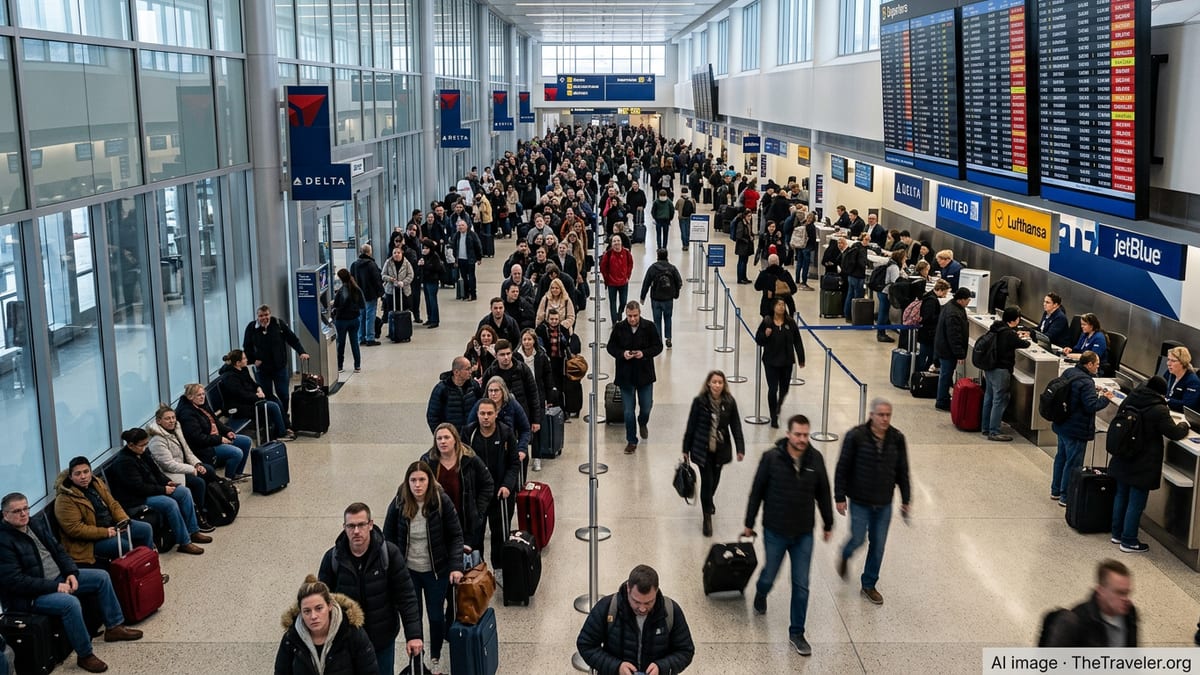
Hotter air, thinner lift and stricter weight limits
The basic physics behind the problem are long established. Aircraft rely on dense air to generate lift under the wings and thrust through the engines. As air warms, it becomes less dense, meaning an aircraft must either accelerate to a higher speed, use more runway, or depart lighter to achieve a safe takeoff.
Scientific studies over the past decade have quantified how that effect scales in a warming climate. Research affiliated with NASA’s Goddard Institute for Space Studies and Columbia University found that rising mean and extreme temperatures can force weight restrictions on 10 to 30 percent of flights departing during the hottest hours by mid to late century at some airports. The projected payload cuts are modest on individual flights but significant at system scale, affecting fuel, cargo and passenger loads.
More recent work published in journals such as Climatic Change and Atmosphere has extended the analysis to airports in North America, Europe, China and the Mediterranean. These studies consistently show an increase in the number of “weight‑restriction days,” particularly at airfields with short runways or high elevations, where performance margins are already tight.
The effect is not limited to future scenarios. Observational analyses indicate that the frequency of days requiring at least some performance adjustment has already risen since the 1980s at a number of major hubs, tracking the trend in hotter summer extremes.
Heatwaves bring real-world disruptions at busy hubs
While much of the discussion has unfolded in technical journals, passengers have already seen glimpses of the issue during severe heatwaves. During an intense hot spell in Phoenix in 2017, regional jets operating for a major U.S. airline were unable to depart in the hottest part of the afternoon because temperature readings approached 120 degrees Fahrenheit, beyond the conditions under which those aircraft were certified to take off safely from the available runway.
Case studies compiled by transport agencies and climate risk assessments for the aviation sector describe similar challenges at other “hot and high” airports, where a combination of high elevation and extreme heat erodes takeoff capability. In such conditions, airlines can be forced to delay flights into cooler evening hours, reduce passenger counts, leave cargo behind or tanker less fuel and plan additional refueling stops.
These operational choices ripple through already congested schedules. A weight-limited departure may require time-consuming changes to load plans at the gate. Shifting multiple flights out of peak-heat windows can create new bottlenecks in the early morning and late evening, adding pressure on air traffic control and ground operations.
Reports from recent European and North American heatwaves show that, although weather-related delays are often blamed on storms, extreme heat itself is beginning to appear more often in official disruption summaries as airfields test the limits of their design envelopes.
Regional hotspots: Euro-Mediterranean, North America and Asia
Climate modeling indicates that some airport regions are more exposed than others. A study focused on the Euro-Mediterranean area, a recognized climate hotspot, found that by later this century, hotter extremes could significantly reduce the maximum takeoff weight available to common single-aisle aircraft during the hottest hour of the day at numerous coastal and island airports.
Research on Chinese airports using global warming scenarios of 1.5 and 2 degrees Celsius projects a clear rise in summer maximum temperatures, translating into more days where aircraft performance is constrained. Similar analyses for Canadian and U.S. airports show that weight-restriction days become more common under higher-emissions pathways, particularly at inland hubs and shorter-runway fields.
Smaller and regional airports often face the steepest trade-offs. Many lack space or funding to significantly lengthen runways, and their route networks rely on high load factors to remain profitable. In such settings, losing a few rows of passengers or a pallet of freight on a regular basis can make marginal services harder to sustain.
Tropical and subtropical airports, which already operate near temperature thresholds for much of the year, are also flagged in recent climate and aviation risk assessments. Even modest additional warming can push routine summer conditions into ranges where performance penalties become unavoidable without infrastructure upgrades or schedule changes.
Economic stakes for airlines, airports and travelers
For travelers, the most visible impact of these trends is likely to be more frequent delays, last-minute seat reassignments, or requests for volunteers to take later flights. Behind the scenes, however, airlines and airports are facing mounting economic questions about how to manage the cost of heat-related constraints.
Studies modeling future operations suggest that weight restrictions, extra fuel stops, aircraft swaps and passenger re-accommodation could increase daily recovery costs significantly by mid-century relative to today. Lost revenue from offloaded cargo and unsold seats, coupled with higher fuel burn per passenger when planes cannot depart at optimal weight, erodes already thin profit margins on some routes.
Airport operators must also consider infrastructure stress. Very high surface temperatures can soften asphalt runways and taxiways or strain cooling systems in terminals and jet bridges, further complicating ground handling during the same periods when aircraft performance is degraded. Planning documents from international aviation bodies highlight higher average and extreme temperatures as a leading climate risk identified by airport stakeholders.
These challenges intersect with broader efforts to decarbonize aviation. As carriers invest in more efficient airframes and engines, there is growing interest in designs that are both lower in emissions and more resilient to hot-day performance limits, such as lighter materials and improved wing aerodynamics.
How the industry is preparing for a hotter sky
Publicly available adaptation plans show that airlines, manufacturers and regulators are beginning to factor rising temperatures into long-term decisions. Some carriers already adjust schedules seasonally at susceptible airports, favoring early morning and late-night departures when air is cooler and denser. Others assign aircraft with better takeoff performance to routes that regularly face hot-day constraints.
Airport authorities are studying options such as runway extensions where space and budget allow, upgraded pavement materials that can withstand higher surface temperatures, and more shade and cooling for ground crews who must work longest during peak heat. International organizations have started to compile guidance on assessing climate risks to aviation and identifying priority investments.
On the regulatory side, the certification envelopes that define the range of temperatures under which each aircraft type is approved to operate are under renewed scrutiny as record heat becomes more common. While safety margins are designed to be conservative, more frequent excursions toward the upper limits may prompt a closer look at testing standards, performance charts and the communication of constraints to operators.
For now, most travelers will continue to experience extreme heat as an occasional inconvenience rather than a constant barrier to flight. Yet the emerging body of climate and aviation research suggests that without adaptation, rising temperatures are likely to make those disruptions more frequent. For an industry built around precise timetables and tight connections, even small shifts in the atmosphere’s density can add up to more time spent waiting on the ground.