

More news on this day
Hundreds of passengers were left stranded at King Khalid International Airport in Riyadh on Thursday as at least 75 flights were cancelled and more than 150 delayed, triggering fresh disruption for Saudia, Qatar Airways, FlyDubai, Emirates and other carriers on crucial routes linking the Saudi capital with London, Dubai, Cairo, Bengaluru and several regional hubs.
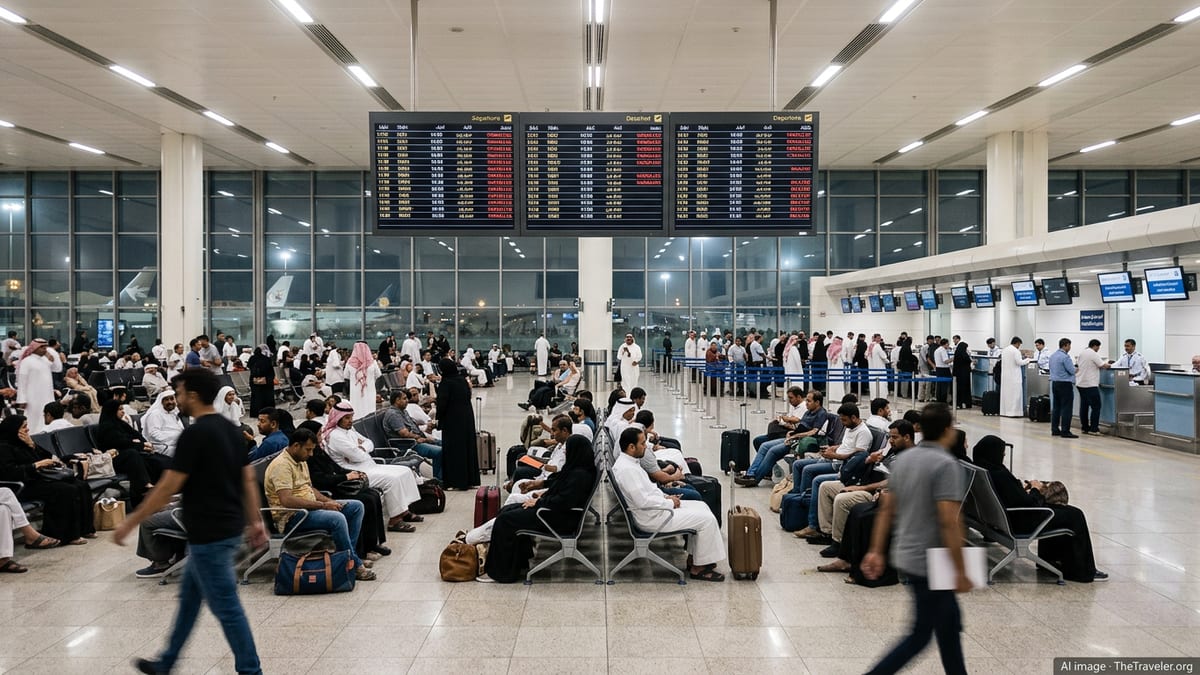
Severe Disruptions at King Khalid International Airport
The latest wave of disruption at Riyadh’s main international gateway unfolded amid continuing knock-on effects from days of airspace restrictions and schedule reshuffles across the Gulf. According to operational data compiled by regional aviation trackers and industry outlets, King Khalid International Airport recorded around 76 cancellations and 94 delays in a 24 hour window, one of the highest tallies in the Middle East outside Dubai and Doha.
Passengers arriving at the airport early Thursday reported crowded check in halls, long queues at airline service desks and confused travelers waiting for information as departure boards refreshed with a growing list of cancelled or heavily delayed services. Many had already endured earlier schedule changes from other regional hubs and were attempting to re route via Riyadh, only to be caught in a second round of disruption.
Airport authorities said they were working with airlines to manage the backlog of affected travelers, prioritizing those with urgent travel needs and families with young children. Ground staff were seen distributing water and basic refreshments in some busy departure areas, although several passengers complained that accommodation and meal vouchers were slow to materialize.
Flag Carriers and Gulf Airlines Forced to Cut Schedules
The disruption at Riyadh is part of a broader regional shake up that has forced major Gulf and regional airlines to pare back schedules, redirect aircraft and operate ad hoc relief services. Saudia has extended the cancellation of flights to and from key regional destinations including Amman, Kuwait, Dubai, Abu Dhabi, Doha and Bahrain, with operations on some of these routes suspended through at least Friday night local time.
Qatar Airways, which has been operating a sharply reduced schedule amid airspace constraints, has introduced limited relief flights from Riyadh and Muscat to move stranded passengers onward to Doha and long haul connections. The carrier has advised travelers not to proceed to the airport unless they receive direct confirmation that their flight is operating, warning that space on the relief services is extremely limited.
Other Gulf carriers are juggling similar pressures. Emirates and FlyDubai, both central players in the region’s disrupted network, are running a mix of repatriation style flights and partial scheduled services, with some aircraft now routed through Riyadh to pick up or drop off passengers whose original itineraries via Dubai were cancelled. Industry sources say aircraft utilization is being re planned on a daily basis as airlines adjust to changing operational clearances.
Key International Routes to London, Dubai, Cairo and Bengaluru Affected
Among the routes most affected by the Riyadh disruptions are high demand services linking King Khalid International Airport with London, Dubai, Cairo and the Indian tech hub of Bengaluru. These corridors are used heavily by business travelers, expatriate workers and families transiting between Europe, the Gulf and South Asia, amplifying the impact of each cancellation.
Several London bound flights that would normally funnel passengers from Riyadh through Dubai or Doha have been cancelled outright or rolled into consolidated services, leaving travelers scrambling for alternative connections via Jeddah, Cairo or Istanbul. In some cases, passengers report being offered seats several days later than originally planned, or rerouted through multiple intermediate stops.
Flights between Riyadh and Cairo, historically one of the busiest city pairs in the region, have also seen a wave of cancellations and rolling delays as Saudia, EgyptAir and Gulf carriers contend with aircraft and crew displaced by the wider Middle East schedule upheaval. Services to Bengaluru, an important link for the large Indian expatriate community in Saudi Arabia, have been periodically suspended or shifted to different departure times with little advance notice.
Stranded Travelers Face Long Waits and Patchwork Support
For passengers on the ground in Riyadh, the statistics translate into long waits, uncertainty and in many cases unexpected expenses. With hotels near the airport quickly filling up, some travelers reported spending the night on terminal floors or in crowded seating areas while awaiting word of a new departure time.
Communication has emerged as a central frustration. While airlines have urged customers to rely on official apps, email notifications and call centers rather than heading directly to the airport, many of those stranded in Riyadh say they received cancellation notices only after they had already checked in or cleared security. Others, particularly those on multi segment itineraries booked through third party agents, struggled to ascertain which airline was responsible for rebooking and accommodation.
Travel advisers monitoring the situation say passengers with flexible tickets are often faring better, as they can be re protected on alternative routings through less congested hubs such as Muscat or smaller Saudi airports. Those on the most popular economy fares, however, are frequently being rebooked onto the few available seats days later, with compensation and refund policies varying by carrier and point of sale.
Airlines Urge Passengers to Check Status Before Heading to the Airport
As operations remain fluid, airlines serving King Khalid International Airport are doubling down on calls for passengers to verify their flight status repeatedly in the hours before departure. Carriers including Saudia, Qatar Airways, Emirates and FlyDubai are pushing real time updates through their mobile apps, text alerts and social media channels, with some warning that flights can move from scheduled to cancelled within a short window.
Riyadh based travel agents say the most practical advice for now is to avoid speculative trips to the airport and instead wait for direct confirmation from the airline that a specific flight will operate. Travelers with urgent needs to reach destinations such as London, Dubai, Cairo or Bengaluru are being advised to explore alternative routings via less impacted hubs, even if that means longer travel times and additional stops.
While there are tentative signs that regional operations are slowly stabilizing, aviation analysts caution that the backlog of displaced passengers and aircraft will take several days to unwind. For hundreds of travelers stranded in Riyadh, the priority remains simple: a confirmed seat out of King Khalid International Airport and some certainty after days of turmoil.