


More news on this day
Rory McIlroy is set to headline the Abu Dhabi Championship this week just as a growing wave of international travel alerts and airspace warnings reshapes how players, caddies and fans make their way to the United Arab Emirates.
Get the latest news straight to your inbox!
Playoffs go ahead as regional tensions simmer
The Abu Dhabi Championship, the first event in the DP World Tour’s season-ending playoffs, is scheduled for 5 to 8 November in the UAE capital, with McIlroy among the biggest names confirmed in the field. Recent coverage of the Race to Dubai shows the Northern Irishman chasing Patrick Reed in the season-long points race, giving added competitive weight to his appearance in Abu Dhabi.
Reports on the DP World Tour schedule indicate that the Abu Dhabi stop is maintaining its original slot despite months of disruption across Middle East airspace. McIlroy’s decision to play, alongside fellow headliners such as Jon Rahm and Tommy Fleetwood, underscores the tour’s intention to proceed with its flagship events even as parts of the region face conflict-related instability.
Golf media coverage in recent days has also highlighted that some prominent players have chosen to skip Abu Dhabi, citing concerns about the broader security environment or preferring to limit long-haul travel. That has sharpened the focus on those who have made the trip, particularly McIlroy, who has never lifted a trophy in Abu Dhabi despite multiple close calls and now seeks crucial playoff points.
Heightened security planning around the Abu Dhabi venue
Publicly available tournament information and specialist golf reporting describe enhanced contingency planning at the Abu Dhabi Championship, including protocols that link on-course procedures to any nationwide mobile alert issued within the UAE. Guidance circulated to participants notes that if an official mobile phone alert is pushed to the public during play, competition will be halted and the course evacuated using the same audible signals reserved for dangerous situations such as lightning.
This type of planning reflects a broader mindset among event organizers across the Gulf, where detailed emergency and communication procedures have become standard in response to evolving regional risks. The measures are designed to allow top-tier sport to proceed while acknowledging that security conditions can change quickly, particularly in relation to missile or drone threats in nearby states.
For spectators and traveling media, the most visible changes are likely to involve entry checks, restrictions on certain items, and closer coordination between tournament staff and local agencies. While such details are not published in full, open-source reporting suggests that organizers have sought to balance a festival atmosphere around the course with a cautious approach to crowd management.
Travel advisories for the UAE shift to a more cautious tone
McIlroy’s arrival in Abu Dhabi comes at a moment when several governments have toughened their guidance on travel to the UAE. The United States raised its advisory for the country to Level 3 in late October, urging travelers to reconsider non-essential trips due to the threat of missile and drone attacks as well as the possibility of sudden escalations tied to the wider conflict with Iran. Similar notices from European and Asia-Pacific governments advise travelers to exercise a high degree of caution in the UAE.
Official travel advice from Canada, New Zealand and Australia now emphasizes the potential for rapid deterioration in regional security conditions, including renewed long-range strikes and retaliatory attacks. These notices point out that while daily life in Abu Dhabi, Dubai and other cities continues largely as normal, there remains an ongoing risk of terrorism and of indirect spillover from nearby conflicts.
Some governments recommend avoiding specific military facilities and surrounding areas, and advise travelers to stay alert for any civil defense alerts, monitor local news and register with consular services. The language used in these advisories has grown more explicit through October, reflecting concerns that the air and missile campaign seen earlier in 2026 could resume with little warning.
Airspace warnings alter routes into Abu Dhabi
The rising caution is not confined to government advisories. Aviation regulators and industry bulletins point to a patchwork of restrictions across Gulf airspace that directly affects how fans and players reach Abu Dhabi. Guidance from the European Union Aviation Safety Agency issued in late September advises carriers to avoid wide areas of the Persian Gulf and Gulf of Oman, except when needed for arrivals and departures, because of elevated risks to civil aviation in the event of further military activity.
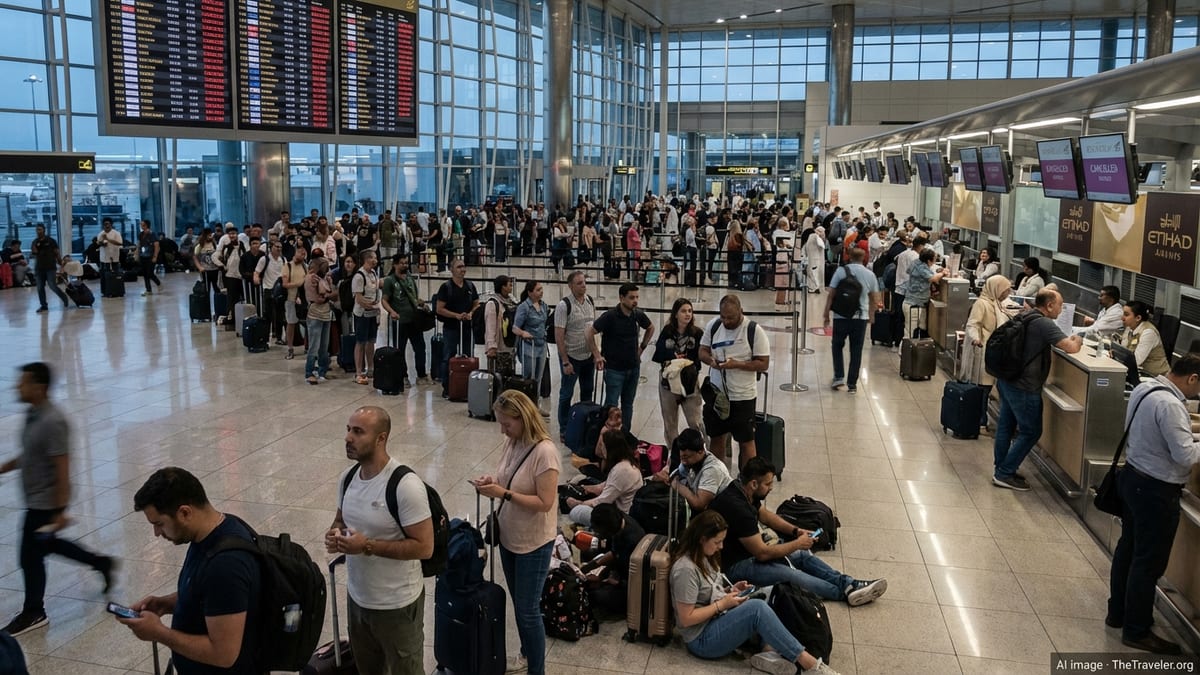
Travel-industry updates compiled in recent weeks describe reduced schedules and altered routings for major Gulf carriers, with some airlines delaying their return to Dubai and Abu Dhabi or trimming frequencies to certain regional destinations. Although Abu Dhabi’s Zayed International Airport and Dubai International remain open, flight-tracking summaries show recurring cancellations and delays on services linking the UAE with Saudi Arabia and other nearby states.
Independent tracking platforms and regional travel advisories underscore that Iranian carriers have halted flights to and from the UAE and that airlines in Europe and Asia are revising risk assessments frequently. Passengers heading to golf events in Abu Dhabi are being urged by airlines and travel agents to reconfirm itineraries, allow extra time for connections and remain prepared for last-minute changes to routings or departure times.
What the changing risk picture means for golf travelers
For international visitors considering a trip to watch McIlroy and the rest of the field in Abu Dhabi, the shifting risk calculations can be difficult to interpret. On the ground, publicly available reporting indicates that hotels, malls and golf resorts are operating normally and that the UAE continues to promote itself as a hub for winter tourism and major events. At the same time, foreign ministries now describe the regional situation as volatile rather than stable, emphasizing that security incidents elsewhere in the Gulf could quickly affect aviation or public life.
Consular guidance generally stops short of advising citizens to abandon confirmed itineraries to the UAE, focusing instead on detailed preparation. Travelers are urged to review the latest advisory on the day of departure, share itineraries with family, and familiarize themselves with local emergency alert systems that can push messages directly to mobile phones in the event of an incident.
For professional golfers and their entourages, risk assessments are usually made in consultation with tours, sponsors and security advisors, with contingency plans for alternate routings or rapid departure if needed. McIlroy’s presence at the Abu Dhabi Championship, alongside other leading names, suggests that many teams have concluded the current level of risk is acceptable, while still recognizing that conditions could change quickly.
As the opening round gets underway, the Abu Dhabi Championship stands at the intersection of world-class sport and a complex regional security environment. For fans following McIlroy’s pursuit of more Race to Dubai points, the tournament offers high drama on the course, set against a backdrop of evolving travel alerts that are reshaping journeys to the Gulf.