


More news on this day
Rory McIlroy is contesting this week’s Abu Dhabi Aldar Championship at Yas Links despite heightened regional tensions and a fresh United States travel advisory urging travelers to reconsider visits to the United Arab Emirates.
Get the latest news straight to your inbox!
Top star presses on as some rivals stay away
The Abu Dhabi Aldar Championship, which opened on November 5 at Yas Links, is the first of two back-to-back season-ending events on the DP World Tour, followed by next week’s finale in Dubai. The tournaments will decide the Race to Dubai title, with McIlroy arriving in Abu Dhabi ranked third in the season-long standings and chasing leader Eugenio Chacarra.
Reports indicate that McIlroy chose to play even as a number of leading players withdrew from the event, citing unease over the security climate in the wider region. Golf coverage from Abu Dhabi notes that 11 of the top 70 in the Race to Dubai elected not to travel for the opening playoff event, thinning what is normally one of the tour’s strongest fields.
Despite the absences, the championship field remains deep. McIlroy is joined by Jon Rahm, Patrick Reed and Tommy Fleetwood among others, maintaining the tournament’s status as a key stop on the global golf calendar. Tee-sheet information shows McIlroy paired with Chacarra and Reed in a marquee grouping for the opening round, underscoring the competitive stakes surrounding the Race to Dubai.
On the course, McIlroy’s week began with added scrutiny after he received a two-stroke penalty following his first round, with tournament officials ruling that he had improved his lie on a hole where he ultimately made double bogey. The penalty altered his opening-day score but did not change the broader storyline of a leading men’s golfer competing in Abu Dhabi amid a complicated security backdrop.
Travel advisories reshape the context for Abu Dhabi golf
The championship is taking place less than two weeks after the U.S. Department of State updated its guidance for the United Arab Emirates to a Level 3 advisory on October 23, 2026. The notice urges travelers to reconsider travel because of terrorism and armed conflict, pointing in particular to missile and drone activity linked to Iranian-aligned groups and previous large-scale strikes earlier in the year.
According to the publicly available advisory, U.S. officials cite several episodes that have affected civilian infrastructure and air travel across parts of the Gulf, including the UAE. The guidance warns that further armed attacks could occur with little or no warning, potentially disrupting commercial flights and normal travel within and beyond the Emirates.
Specialist travel trackers that consolidate advisories from multiple governments currently list the United States as maintaining the strictest formal stance on travel to the UAE, while other countries such as the United Kingdom have not issued broad, country-wide guidance against visiting. Analysts following the tourism and aviation sectors in the Gulf say this divergence has contributed to mixed signals for international visitors and event organizers.
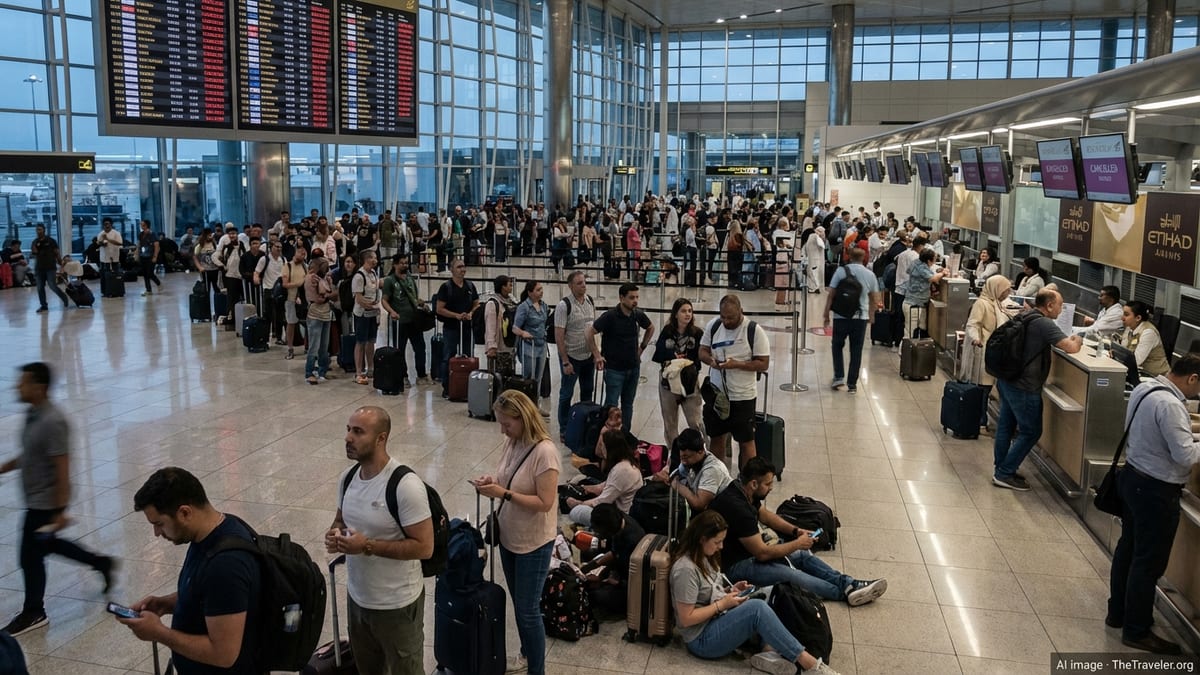
For travelers already in the region, the U.S. advisory highlights the possibility of temporary airspace closures and urges close attention to airline and airport communications. Industry summaries published earlier this year documented periods when flights in and out of the UAE and neighboring states were reduced or rerouted, reinforcing concerns that heightened tensions can quickly filter through to passenger itineraries.
Emergency procedures in place at Yas Links
Within the tournament itself, organizers and local partners have introduced additional emergency protocols for everyone on site at Yas Links. Materials distributed to players and caddies and reported by golf media describe a “Mobile Phone Alerts & Emergency Procedures” notice that explains what will happen if the UAE authorities broadcast a public mobile alert during play.
Under the outlined procedures, any government-issued alert to the public would trigger an immediate suspension of play. The notice says the suspension would be signaled by a long blast of the course air horns, matching the system already used for dangerous weather, and that players, caddies and spectators would then be directed to evacuate the course along pre-identified routes.
Those same reports indicate that the guidance was developed in response to the wider regional situation and specific attacks on civilian targets elsewhere on the Arabian Peninsula in recent months. The aim is to give participants a clear understanding of how the event would react to any broader security incident, even if it occurred some distance from Abu Dhabi itself.
Tour statements referenced in local coverage emphasize that the DP World Tour has been taking regular advice from international travel consultants and relevant government channels. While detailed security arrangements are not made public, the combination of formal emergency procedures and close coordination is intended to reassure players and tournament staff who have elected to travel.
Balancing sporting ambition with traveler caution
McIlroy’s appearance in Abu Dhabi illustrates how elite sport is attempting to keep major events on the calendar while governments simultaneously urge caution. The Race to Dubai carries significant prestige and financial reward, and for players near the top of the standings, the decision to compete can have season-defining consequences.
At the same time, the Level 3 advisory for the UAE places the country in a higher-risk category for U.S. travelers than it occupied a year ago. Public guidance from the State Department instructs travelers to reconsider non-essential trips and to maintain a readiness to adjust plans quickly if security alerts, airline schedule changes or airspace restrictions emerge.
Travel and hospitality assessments released over the past several months note that hotel and airline operators in the Gulf have had to adapt repeatedly to shifting patterns of demand, managing reduced schedules during periods of heightened concern and scaling back up when conditions stabilize. In this environment, hosting international sporting events has become a test of how reliably the region can welcome large numbers of visitors while responding to rapidly evolving security assessments.
For golf fans weighing a trip to Abu Dhabi or Dubai, publicly available guidance suggests monitoring both governmental advisories and direct information from airlines. The current tournament week shows that, for now, flights and local tourism services in Abu Dhabi continue to operate, even as the political context surrounding those journeys remains fluid.
What international travelers should know right now
For prospective visitors considering travel to Abu Dhabi during and after the championship, the latest U.S. advisory highlights several practical steps. Travelers are urged to enroll in official alert systems before departure, stay in close contact with airlines about any potential schedule changes, and be prepared for short-notice disruptions if tensions escalate.
Local tourism information for Abu Dhabi continues to promote the city as open to visitors, outlining standard entry procedures, airport facilities and airline support in case of significant delays or cancellations. Destination guidance also notes that, in the event of a major disruption such as an extended flight delay, airlines operating through Abu Dhabi International Airport are expected to assist passengers with rebooking where possible.
Security analysts caution that, although daily life in Abu Dhabi remains relatively calm compared with some neighboring areas, the risk profile for the wider Gulf has shifted over the past year. This explains why some high-profile athletes and travelers have adopted a more cautious stance, even as others, including McIlroy, continue to travel and compete.
As the Abu Dhabi Aldar Championship unfolds, the event has become a case study in how global sport, commercial aviation and government security guidance intersect. McIlroy’s push for the Race to Dubai title is unfolding against a backdrop in which travel advisories, emergency planning and regional geopolitics are as much a part of the narrative as birdies and bogeys.