


More news on this day
Royal Caribbean Group is signaling that the cruise boom is far from over, reporting record pricing, ships sailing above traditional capacity and bookings that continue to outpace last year across key markets.
Get the latest news straight to your inbox!
Record bookings and higher prices define 2026
Recent financial filings and investor updates show Royal Caribbean entering the second half of 2026 with what company materials describe as a record “booked position,” combining historically strong prices with volumes in line with or above pre-disruption norms. Publicly available information indicates that first quarter demand exceeded expectations, helped by resilient consumer appetite for experience-focused travel and strong close-in bookings.
Industry and investor reports highlight that Royal Caribbean has repeatedly pointed to successive record booking periods over the past year, including a standout Wave Season early in 2026. The company’s updated guidance for 2026 earnings leans heavily on this demand strength, with higher ticket revenue and onboard spending offsetting cost pressures elsewhere in the business.
Pricing power has become a defining feature of the current cycle. Coverage focused on cruise fares notes that Royal Caribbean’s ticket prices and many onboard offerings are more expensive than in prior years, yet remaining inventory for upcoming sailings is limited. Analysts say that combination suggests the company has been able to hold firm on rates rather than offering significant last-minute discounts.
A separate look at cruise pricing trends for 2026 finds that base fares have climbed, reflecting both higher operating expenses and what reports describe as “unprecedented demand” following several years of recovery. While the total vacation cost is rising, Royal Caribbean is still frequently framed as offering competitive value compared with many land-based resorts, especially when onboard experiences are factored into the comparison.
Ships sailing above traditional capacity
Operational data from Royal Caribbean’s latest quarterly results underscores how full its ships are sailing. Recent disclosures cite load factors above 100 percent, a figure that reflects more than two guests on average occupying many cabins as families and groups share staterooms. One industry-focused report on the company’s first quarter results pointed to a load factor in excess of 109 percent, a level associated with particularly strong demand.
The company reported carrying millions of guests in the opening months of the year, highlighting how quickly cruising has scaled not only back to pre-crisis levels but beyond them. Analysts following the sector note that occupying ships this heavily allows Royal Caribbean to maximize revenue per sailing without immediately needing large additions to fleet capacity.
High occupancy is also supporting onboard spending. Commentary from earnings analyses indicates that onboard revenue, including beverage packages, specialty dining, Wi-Fi, and shore excursions, has been a key driver of yield growth. In many cases, dynamic pricing for these add-ons has been moving higher, tracking demand trends that remain robust even as prices climb.
Market observers caution that such elevated occupancy levels can expose cruise operators to volatility if demand were to soften suddenly. For now, however, the pattern of above-full ships and limited remaining inventory is widely seen as confirmation that the cruise boom is still intact heading into the peak late-summer and holiday seasons.
Caribbean dominance and megaship momentum
Regional deployment data published by cruise-industry researchers shows the Caribbean retaining its status as the sector’s backbone in 2026, accounting for more than 40 percent of global cruise capacity. Royal Caribbean International is identified as the largest single brand in the Caribbean by guest capacity, with roughly two-thirds of its deployment focused on the region.
Despite that concentration, recent commentary from industry reports notes that pricing for Caribbean sailings has continued to increase, even as overall capacity in the region has grown. Analysts interpret this as evidence that demand for warm-weather itineraries, private-island stops and short-to-medium-length cruises remains unusually strong, particularly among North American families.
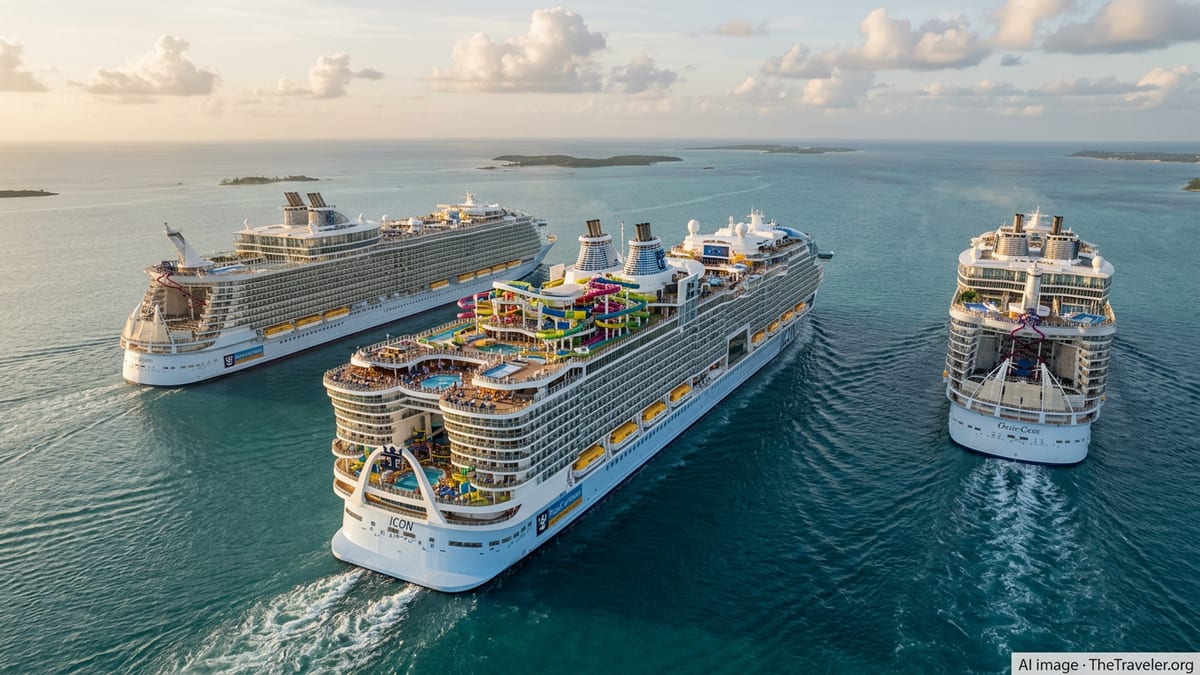
The company’s megaship strategy is also playing a central role in sustaining demand. Coverage of Royal Caribbean’s fleet plans indicates that multiple new ships are scheduled for delivery over the next several years, including additional Icon- and Oasis-class vessels designed to carry thousands of guests each. Enthusiasm for these ships, which bundle waterparks, entertainment districts and resort-style amenities, has helped drive early bookings at premium prices.
Consumer-facing reports on booking trends suggest that itineraries on the newest and largest ships are among the fastest to sell out and often command the highest per-diem rates. That pattern has encouraged Royal Caribbean to maintain an ambitious newbuild pipeline, with analysts emphasizing that future capacity additions are being closely tied to ships and products where demand already appears deep.
Costs, risks and what could slow the boom
While demand indicators remain strong, Royal Caribbean and its peers are still contending with rising costs and geopolitical uncertainty. Recent earnings analyses point out that higher fuel prices and operating expenses have weighed on 2026 margin guidance across the cruise sector, even as ticket and onboard revenues trend higher.
Brokerage and research commentary suggests that investors are watching closely to see whether cruise companies can continue to push fares higher without dampening demand, particularly if broader consumer spending weakens. Some reports note that, although interest in travel experiences remains resilient, there are early signs of more price sensitivity among certain customer segments facing higher living costs.
Global events have also created pockets of volatility. Industry coverage describes a brief slowdown in bookings for certain Mediterranean and West Coast of Mexico itineraries earlier in the year, linked to geopolitical tensions and disruptions in air travel. According to those reports, bookings subsequently rebounded, but the episode highlighted how quickly sentiment can shift in some markets.
Analysts argue that Royal Caribbean’s strong forward bookings and diversified itinerary mix help buffer many of these risks. However, they also point out that sustaining double-digit earnings growth will likely depend on a delicate balance between further price increases, disciplined capacity additions and continued strength in onboard spending.
What it means for travelers eyeing a Royal Caribbean cruise
For travelers, Royal Caribbean’s booming demand environment has clear implications. Consumer reports and planning guides emphasize that popular sailings are selling out earlier than in past years, particularly on new megaships and during school holidays. As a result, those seeking specific cabins, dates or routes are being encouraged to book further in advance than they might have before.
Pricing dynamics are also evolving. Travel coverage notes that the company relies heavily on demand-based pricing models, which tend to reward early planners with lower fares and fewer promotional restrictions. Last-minute bargains, once a staple of cruise shopping, appear less common on in-demand routes, with remaining cabins often priced at a premium instead of being deeply discounted.
Onboard, travelers are encountering higher prices for extras such as beverage packages, specialty dining and Wi-Fi, according to multiple consumer-focused reports. Some planning resources suggest monitoring these costs regularly, as pre-cruise sales and dynamic adjustments can cause notable swings in package rates over time.
Even so, many analysts and travel commentators maintain that Royal Caribbean can still offer strong value when compared with land-based resort vacations, particularly for families who take advantage of bundled entertainment and activities included in the fare. As long as ships continue to sail near or above full capacity at elevated prices, the message from the company’s latest figures is clear: cruise demand, for now, is still booming.