


More news on this day
Travelers flying into and out of Austin-Bergstrom International Airport this Friday are encountering significant disruption, with publicly available tracking data showing more than 100 flights delayed as a wave of construction projects converges with heavy late-summer demand.
Get the latest news straight to your inbox!
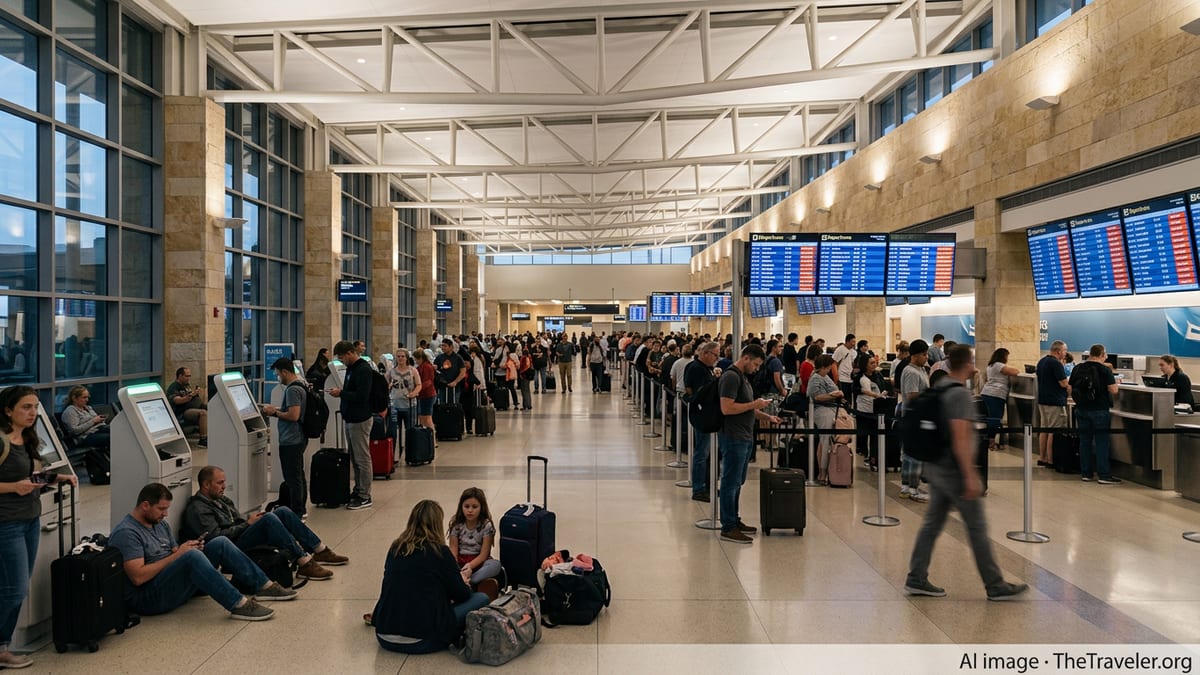
Construction surge meets peak travel demand
Flight tracking dashboards and airport operations data indicate that Austin-Bergstrom International Airport (AUS) is operating under heightened strain as construction accelerates across the airfield, terminal and surrounding roadways. The airport is in the midst of a sweeping Journey With AUS expansion program that includes a new Arrivals and Departures Hall, new concourses and additional parking capacity, all being built while the airport continues to handle record volumes of passengers.
Published airport planning documents and city records describe a multiyear Airport Expansion and Development Program intended to add gates, expand the Barbara Jordan Terminal and reconfigure key roadways serving the terminal area. Construction on several of these elements is scheduled through the late 2020s, with enabling work now visibly underway across much of the campus.
Recent statistics highlighted by local tourism and meetings reports show that AUS has already logged some of its busiest months on record, reflecting both Austin’s population growth and the city’s status as a fast-rising tech and events hub. That growth has pushed operations close to capacity on many peak travel days, leaving little slack when construction narrows access or temporarily reduces flexibility on the airfield.
Road closures and terminal work slow passenger flow
The most immediate pinch point for many travelers this Friday is on the ground, long before they reach the gate. Construction updates published by the airport detail a temporary closure and traffic-pattern change on the Presidential Boulevard return loop, the main recirculation route that drivers use to circle back to the terminal area. That closure, scheduled to span most of September, is tied to the construction of a new Yellow Garage, a key piece of the airport’s expanded parking and terminal-access plan.
Publicly available information on the project notes that work on the Yellow Garage is a prerequisite to closing the existing Red Garage so that crews can clear space for the future Arrivals and Departures Hall expansion. In practice, the interim phase means fewer familiar routes for drivers, more lane shifts and a higher chance that drop-offs and pick-ups will back up onto the airport access road during busy periods.
Inside the terminal, recent and ongoing projects have reconfigured portions of the Barbara Jordan Terminal, including areas above baggage claim and around security checkpoints. While earlier phases added new screening capacity and modernized baggage systems, portions of the building remain an active work zone. For passengers, that can translate into narrowed corridors, shifting queuing areas and longer walks between ticket counters, checkpoints and gates when crowds swell.
Delays ripple across arrivals and departures boards
Against this construction backdrop, real-time boards tracking operations at AUS on Friday show a mounting number of late flights. Aggregated schedules and status feeds indicate well over 100 departures and arrivals running behind their planned times, ranging from minor timing slips to significantly delayed segments.
Federal aviation operations dashboards list AUS as experiencing volume-related impacts at various points in the day, with advisories emphasizing that travelers should confirm status directly with their airlines. The data do not point to a single weather system or air-traffic disruption as the culprit, suggesting that a combination of local congestion, tight turn times and infrastructure constraints is contributing to the slowdown.
Historical analyses from national air-traffic performance reports show that when construction limits gate flexibility or ground-movement options at busy airports, even small disruptions can ripple quickly through the schedule. With Austin’s flight schedule already dense on peak days, particularly on Fridays, each delayed arrival can cascade into late departures for aircraft turning around to their next destination.
What travelers flying to or from Austin should expect
For passengers heading to Austin this Friday or departing from AUS, publicly available guidance from the airport and industry data providers point to a few consistent themes. Travelers should build in extra time for every step, from navigating detours on Presidential Boulevard to clearing security in a terminal that is balancing live operations with construction zones.
Airport travel advisories issued ahead of recent holiday weekends, when traffic patterns were similar to current conditions, have urged passengers to arrive earlier than they might have in previous years and to monitor construction notices before setting out. Those notices emphasize that roadway changes can affect ride-hail, taxi and personal-vehicle drop-offs, as well as access to on-site parking facilities.
Airline and federal aviation tools continue to stress that day-of conditions can change quickly and that gate, time and even terminal assignments may shift as operations teams work around work sites. With expansion activity scheduled to continue for several years, this Friday’s disruption illustrates how Austin’s rapid aviation growth and infrastructure overhaul are likely to intersect on many peak travel days ahead.
Long-term payoff from short-term disruption
Despite the frustration many passengers are feeling today, the construction driving some of the disruption is aimed at easing these very bottlenecks in the years ahead. The Journey With AUS program envisions a substantially larger terminal footprint, more gates and more modern check-in, security and baggage facilities, all designed to support the city’s forecast passenger growth into the 2030s.
Planning documents and public briefings describe a future Arrivals and Departures Hall consolidating ticketing, screening and baggage claim, along with new concourses to spread flights across additional gate areas. Combined with expanded parking and improved roadway circulation, that build-out is intended to reduce curbside congestion, shorten queues and provide greater operational flexibility during peak periods.
For now, though, Friday flyers to and from Austin are seeing the growing pains of that transition play out in real time, as dozens of delayed aircraft and crowded curbsides reflect an airport trying to expand without pausing the city’s surging demand for air travel.
https://www.flyaustin.com/construction-updates