


The Rugby World Cup returns to Australia from 1 October to 13 November 2027, with 24 teams playing 52 matches across seven host cities. For travelling fans, that six week window sits squarely in the Australian spring, bringing mild weather, long evenings and busy calendars. This guide looks at how to link the main cities, where to base yourself for matches and how to make the most of sightseeing time between kick offs.
Get the latest updates straight to your inbox!
Key facts and how the 2027 tournament is structured
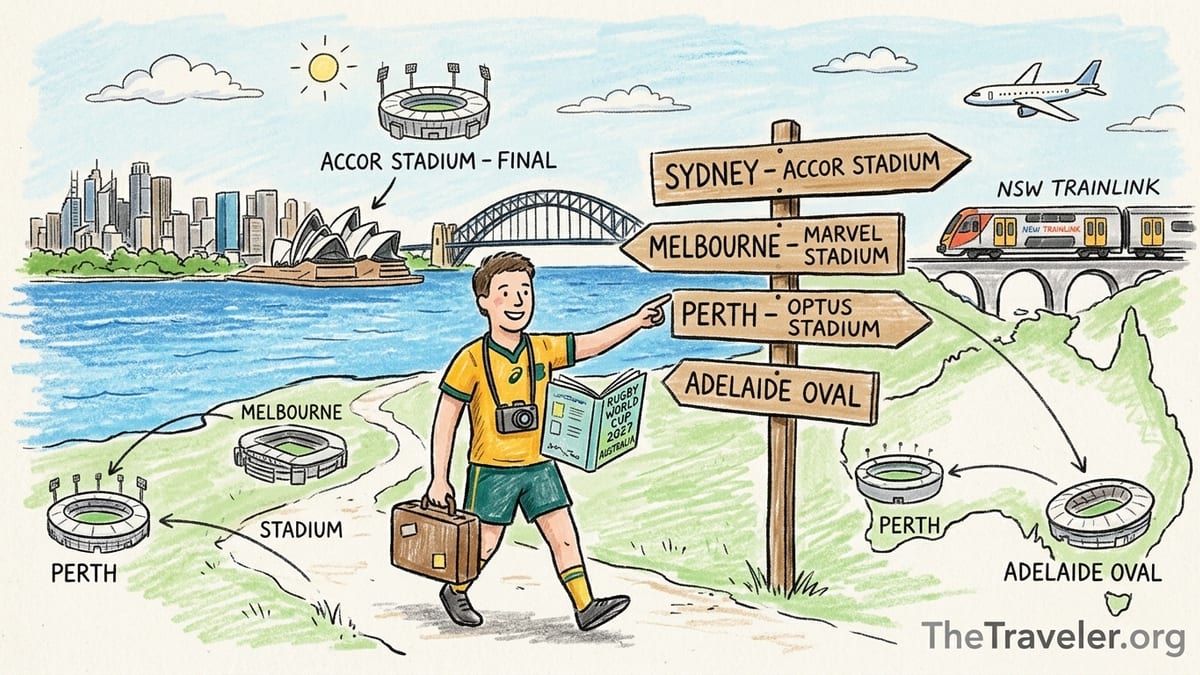
The 2027 Rugby World Cup will run from 1 October to 13 November 2027, hosted entirely in Australia. It will be the largest men’s Rugby World Cup staged so far, expanding to 24 teams and 52 matches. Games are scheduled across eight stadiums in seven host cities: Sydney, Melbourne, Brisbane, Perth, Adelaide, Canberra and Newcastle, with Sydney to host both semi finals and the final at Accor Stadium.
The official match schedule released by World Rugby confirms the opening match on 1 October 2027 in Perth, with Australia playing Hong Kong China, and pool matches spread through all seven cities before knock out fixtures concentrate in Perth, Melbourne and Sydney. Kick off times are mostly afternoon and evening local time, so visitors can make use of mornings for sightseeing or travel. Because Australia stretches three time zones, a night match in Perth will start several hours later than one in Sydney, something to factor into internal flight planning.
With more than 140,000 overseas visitors forecast by Australian and state governments, demand for beds and domestic flights in October and early November is expected to spike significantly, especially on key weekends and around finals. Travellers who lock in flexible bookings 10 to 12 months ahead are likely to find better availability and pricing than those leaving it until 2027. Tour operators connected to World Rugby’s official travel programme are already packaging flights, match tickets and hotels, which can be a useful benchmark even if you ultimately book independently.
The seven host cities and where matches will be played
World Rugby has confirmed seven host cities and eight stadiums for 2027. Sydney, Australia’s largest city, will use two venues: Accor Stadium at Sydney Olympic Park for major fixtures, including the final, and Allianz Stadium closer to the central city for selected pool matches. Melbourne will host games at Marvel Stadium in Docklands, within walking distance of Southern Cross railway station and the central business district. Brisbane will showcase Suncorp Stadium, famous among rugby fans for its steep stands and match-day buzz.
Perth, on the west coast, will stage the tournament opener and several high profile pool games at Optus Stadium, a 60,000 seat ground on the Swan River. In South Australia, Adelaide Oval will host a run of pool fixtures, including matches involving defending champions South Africa early in the tournament. Canberra’s GIO Stadium and Newcastle’s McDonald Jones Stadium will host pool matches and bring elite rugby to regions that rarely see multiple tier one nations in quick succession.
While the full breakdown of which team plays in which stadium will evolve as qualifiers are finalised and ticket inventory opens, the broad pattern is clear: Sydney and Perth will shoulder many headline fixtures, Melbourne and Brisbane will mix Wallabies games with clashes between northern and southern hemisphere powers, and Adelaide, Canberra and Newcastle will give fans a chance to experience rugby in slightly smaller, more compact cities. This distribution makes it realistic for travelling supporters to follow their team in one region, or to design a “grand tour” that hops between states over several weeks.
Travelling between cities: flights, trains and smart routing
Distances in Australia are substantial, and for most Rugby World Cup visitors, domestic flights will be the backbone of any multi city itinerary. In October 2026, a sample one way fare search on major booking engines shows Sydney to Melbourne flights starting around 120 to 150 Australian dollars with low cost carriers if booked weeks in advance, while Sydney to Perth typically runs from about 260 to 350 dollars in economy on mainstream airlines outside holiday peaks. Fares during the tournament will depend on demand, but travellers should budget for higher prices on Fridays and Sundays, especially on routes like Sydney to Brisbane or Melbourne to Perth when fans are moving for weekend matches.
Linking multiple east coast cities can be done overland if time allows. The Sydney to Melbourne rail journey, operated by NSW TrainLink, currently takes about 11 hours with economy seats and sleepers on overnight services. Fares booked direct with the operator at non peak times often fall in the 70 to 120 dollar range for seated travel, sometimes less with advance purchase or concession discounts, and can be an atmospheric way to avoid airport transfers. Greyhound and other coach companies also run overnight buses between Sydney, Canberra, Melbourne and Brisbane, which can be useful for budget minded travellers planning shorter hops between pool games.
On the ground in each city, public transport will be vital on match days. Sydney’s rail and metro lines run from the central business district to Sydney Olympic Park, with special event services typically added for major fixtures, while Melbourne’s tram and train network serves Docklands and the city’s hotel districts. Brisbane’s Suncorp Stadium sits close to Roma Street station and the nightlife hub of Caxton Street, making it easy to combine pre match dining and post match celebrations without taxis. Visitors who plan to use public transport heavily in Sydney, Melbourne or Brisbane may find daily or weekly caps on contactless payments or city transit cards useful, as these often reduce the cost once a certain spend is reached each day.
Choosing where to stay: price ranges and booking tactics
Hotel demand during the Rugby World Cup will be driven by both matches and other events in October and November, which are already popular months for conferences and domestic tourism in Australia’s major cities. As of late 2026, mid range hotel rooms in central Sydney during shoulder periods often price in the 220 to 320 Australian dollar range per night for a standard double when booked a few months in advance, with budget hotels and private hostel rooms sometimes available from 150 to 200 dollars in suburbs connected by rail. Similar price bands can be found in Melbourne’s central business district, Southbank and Docklands, though waterfront and boutique properties can climb considerably higher on weekends.
Brisbane and Adelaide generally offer slightly lower average nightly rates than Sydney and Melbourne, with many well reviewed four star hotels near the riverfront or city centre advertising prices from about 180 to 260 dollars on typical October dates checked a year out. Perth, being more isolated and heavily reliant on business travel, can fluctuate, but spring weekends away from major events often see central hotels around 220 to 300 dollars. In Canberra and Newcastle, a mix of business hotels, serviced apartments and motels means visiting fans may be able to secure comfortable accommodation from roughly 160 to 240 dollars per night, especially if they look slightly outside the compact city cores.
Because the tournament spans six weeks, splitting a stay between different neighbourhoods can make sense. In Sydney, for example, supporters attending pool games at Allianz Stadium may find Surry Hills or Paddington convenient, with bars and restaurants within walking distance, while those focused on Accor Stadium might prioritise the central business district or Parramatta, which sit on major rail lines to Olympic Park. In Melbourne, Docklands hotels put you close to Marvel Stadium, while stays in Fitzroy or St Kilda offer more of a local vibe and a short tram ride to the ground. Booking cancellable rates or apartments early, then fine tuning once fixture details and personal plans are fixed, balances flexibility with availability.
Sightseeing highlights in and around each host city
One of the pleasures of a Rugby World Cup hosted across a large country is the variety of landscapes and experiences between matches. In Sydney, classic half day options include walking from Bondi to Coogee along the coastal path, taking a harbour ferry from Circular Quay to Manly for beach time and skyline views, or joining a guided climb on the Sydney Harbour Bridge. Many of these can be slotted into a morning or afternoon before an evening kick off, particularly on days when fans are not travelling between cities.
Melbourne’s strengths lie in food, culture and sport. Visitors can spend a free day exploring the laneways and street art off Flinders Lane, tasting coffee in Collingwood or Carlton, or visiting the National Gallery of Victoria. For a longer break between matches, the Great Ocean Road, Yarra Valley wine region and Mornington Peninsula hot springs are all popular side trips, usually requiring a full day tour or self drive. In Brisbane, the South Bank precinct lines the river with parklands, museums and dining, and ferry services like CityCat provide an easy way to combine sightseeing and transport. Nearby, the Gold Coast and Sunshine Coast can be reached by road or rail in a couple of hours for beach breaks.
Perth gives travelling supporters a chance to adjust to jet lag and explore Western Australia. The riverside pathways around Elizabeth Quay, the historic port suburb of Fremantle and the wineries of the Swan Valley are all within easy reach of the city centre. Rottnest Island, known for quokkas and beaches, is a popular day trip by ferry, though it is worth pre booking in October when local school holidays can overlap with early World Cup dates. In Adelaide, fans can pair matches with Barossa or McLaren Vale wine tours, coastal drives to Glenelg or Henley Beach, or a day trip to Kangaroo Island if they have enough time between fixtures.
Canberra’s compact layout makes it simple to string together national attractions such as the Australian War Memorial, the National Gallery and the Museum of Australian Democracy around match days at GIO Stadium. Lake Burley Griffin’s foreshore has cycling and walking paths with bike hire available. Newcastle, meanwhile, offers surf beaches a short walk from the central business district, the ocean baths along Shortland Esplanade and coastal walks out to Nobby’s Head. Many visiting supporters may find that some of the most memorable tournament days are those when a low key morning at a local market or beach leads into an evening under stadium floodlights.
Practical match day tips: getting to stadiums and staying comfortable
Match day logistics will differ slightly city by city, but a few principles will apply nationwide. In Sydney, dedicated event trains and buses typically serve Accor Stadium and Allianz Stadium for major fixtures, with public transport often included in event tickets for some state events; visitors should check closer to 2027 whether similar arrangements are confirmed for Rugby World Cup matches. Allowing extra time for security checks, fan village activities and food queues is sensible, especially for opening weekend, Wallabies games and knock out rounds.
Brisbane’s Suncorp Stadium sits a short uphill walk from Roma Street station and the pubs of Caxton Street. Many locals arrive hours before kick off to soak up the atmosphere, and visiting fans may wish to do the same to avoid congestion on later services. In Melbourne, Marvel Stadium is integrated into the Docklands precinct, and fans can walk there from Southern Cross station in a few minutes under cover, which is useful in case of spring showers. In Perth, free shuttle buses and pedestrian bridges link Optus Stadium to the city and nearby suburbs, but high demand on opening weekend means it will be wise to follow local transport authority updates about special services.
October and November are spring months in Australia, with average daytime highs often sitting in the high teens to low twenties Celsius along the east coast and a little warmer in Perth and Adelaide, although heat spikes and cool snaps are both possible. Packing layers, a light waterproof jacket, a hat and sunscreen is recommended, as many stadiums expose at least some seating to full sun in afternoon kick offs. Bringing an empty refillable water bottle, checking the stadium rules on permitted items and downloading any official tournament app for last minute schedule changes, stadium maps or transport alerts can all make match days smoother.
Visas, tickets and responsible budgeting
International visitors will need to comply with Australian immigration requirements, which in recent years have included electronic visas or electronic travel authorisations for many nationalities. The federal government has already listed the 2027 Men’s Rugby World Cup as a specified event for certain temporary activity visas, a sign that additional support structures will be in place for teams, officials and associated workers. For general fans, the most important step will be to check visa eligibility and apply in good time, particularly if combining the tournament with extended travel elsewhere in the region.
Ticketing will be overseen by World Rugby and Rugby Australia through official channels and authorised agents. As of late 2026, package providers connected to the official programme are already inviting expressions of interest and outlining broad pricing tiers that combine category one to four seats with three or four star hotels and domestic transfers. Independent travellers should watch for the official public ticket sale windows and be cautious of unofficial resale platforms, which may not be authorised. For high demand games such as the opening match, Wallabies pool games and the final in Sydney, it is realistic to expect limited availability in the most central seating categories.
Budgeting for a Rugby World Cup trip to Australia involves more than tickets and accommodation. Everyday costs such as public transport fares, meals in pubs or casual restaurants, and admission to major attractions should be factored in. As a rough guide drawn from current prices, a typical main course in a mid range city restaurant might cost 28 to 40 Australian dollars, with a draught beer in an inner city pub around 10 to 14 dollars depending on brand and location. Coffee culture is strong across most host cities, and a flat white or latte commonly sits near the 5 dollar mark. Small savings, such as using supermarket picnic supplies for some lunches or buying multi day transport passes where available, can add up over a multi week trip.
Building an itinerary: example routes for different fans
The six week span of the tournament lends itself to a variety of trip styles. A supporter with two weeks to spare might fly into Perth a few days before the opening match, spend a week attending early pool games and exploring Western Australia, then take a direct flight to Sydney for a second week focused on high profile group fixtures or quarter finals. This combination offers the contrast between Perth’s relaxed west coast atmosphere and Sydney’s harbour centric energy, while limiting time lost on domestic transfers.
Another realistic pattern is an east coast rail and road journey that links Brisbane, Newcastle, Sydney, Canberra and Melbourne. Fans could start in Brisbane for a Wallabies or pool match at Suncorp Stadium, take a short flight or overnight coach to Newcastle for a regional host city experience, then continue by train to Sydney for several days of rugby and sightseeing. From there, an overnight train or flight to Melbourne would allow time for matches at Marvel Stadium and day trips along the Great Ocean Road before flying home. Those particularly keen on wine regions might add Adelaide between Melbourne and Sydney, either by flying or taking a longer multi day road trip.
Travellers on tighter budgets may choose to base themselves in a single city and attend multiple matches there rather than chasing their team across the country. Because each host city will stage several pool games, including contests between top ranked sides and emerging nations, it will be possible to craft a rich rugby experience without constant movement. For example, fans basing in Brisbane could combine Suncorp Stadium fixtures with a weekend on the Gold Coast, while those staying in Canberra could build in hiking in the nearby Brindabella Range or visits to local cool climate wineries between games.
Conclusion: turning a rugby pilgrimage into a wider Australian journey
Rugby World Cup 2027 offers a rare chance to sample much of Australia in a single trip, from the urban skylines of Sydney and Melbourne to the beaches of Brisbane and Newcastle, the west coast light of Perth and the wine regions around Adelaide and Canberra. With 52 matches across seven cities over six springtime weeks, visiting fans can design itineraries that are as intensive or as relaxed as they wish, whether following one team closely or simply chasing the most intriguing fixtures.
Success will come from early planning: securing flexible flights, researching neighbourhoods and booking cancel friendly accommodation near transport lines that reach the stadiums. Building in downtime for ferry rides on Sydney Harbour, laneway walks in Melbourne, riverfront evenings in Brisbane or day trips to wine regions and coastal national parks will transform a tournament trip into a broader Australian journey. By blending careful logistics with a willingness to explore between matches, supporters in 2027 can enjoy both world class rugby and the full variety of Australia in spring.