


More news on this day
Russia has moved its first autonomous trains from testing grounds into regular passenger service on key Moscow routes this year, signaling a new phase in the country’s effort to automate urban transport and compete with global leaders in driverless rail.
Get the latest news straight to your inbox!
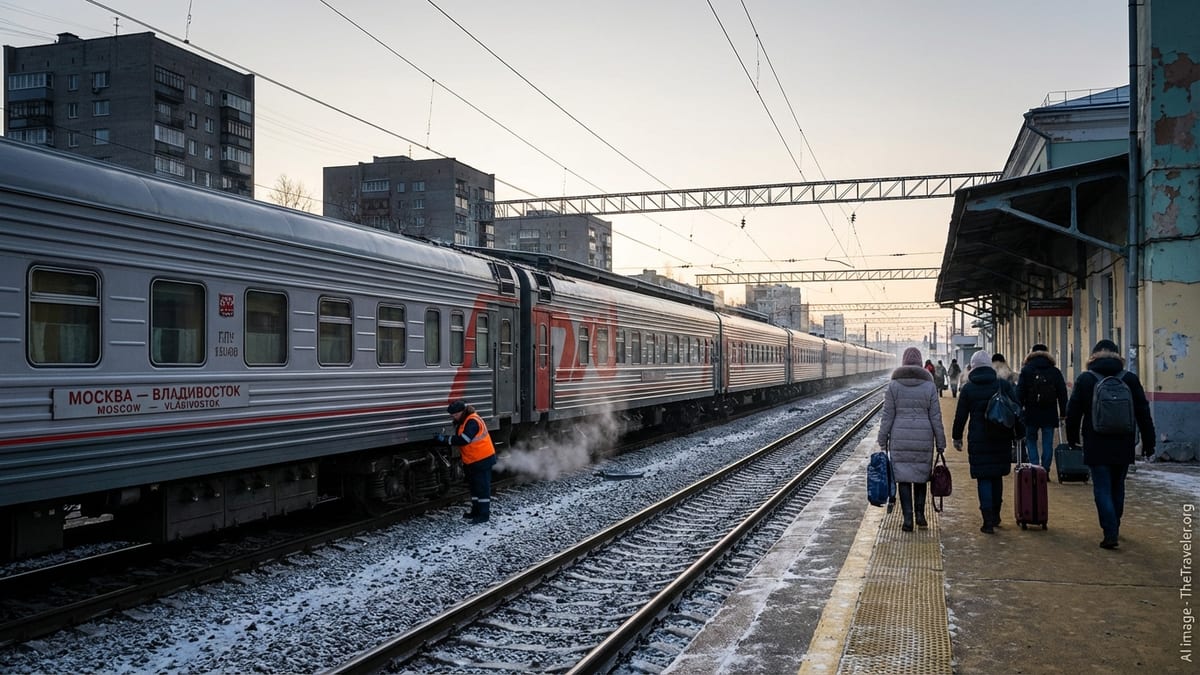
From pilot projects to daily passenger service
Publicly available information shows that Russia’s transition to autonomous rail operations has been years in the making, with Moscow serving as the main test bed. Early work focused on automating conventional electric trains on the Moscow Central Circle, using ES2G Lastochka units equipped with advanced signaling and driver assistance. Those trains initially ran with drivers in full control while automation was fine-tuned.
Reports indicate that by 2024, Russian Railways began running Lastochka trains on the Moscow Central Circle under a higher level of automation, with onboard systems managing speed, braking, and station stops while a driver remained in the cab as backup. This step, described in industry analyses as a third level of automation, allowed engineers to collect real-world performance data on busy commuter corridors.
In parallel, Moscow’s metro system started testing a fully automated train platform branded Moskva-2024 and Moskva-2026. According to coverage of these trials, the eight-car trains operate on the Big Circle Line with software developed by local specialists and linked to a dedicated digital control network. Initial runs were conducted without passengers, but on regular schedules, to validate the behavior of automatic start, stopping, and door operations in a complex underground environment.
By early 2026, Moscow’s transport authorities described a multi-stage roadmap that moves from assisted driving to fully driverless operation. The first stage is now in place, with autonomous systems actively handling train movements in regular passenger service while human operators remain on board as supervisors, mirroring approaches used in other cities when they first introduced automated metros.
Moscow’s tram network joins the autonomous transition
The capital’s tram network has emerged as the other major proving ground for Russian autonomous rail. According to published coverage in Russian and international media, Moscow launched its first autonomous passenger tram on a city route in late 2025, using an AI-based control system capable of handling traffic lights, junctions, and interactions with road traffic.
Initial trials of the tram technology began without passengers in 2024, running thousands of kilometers on a dedicated test track and on selected urban corridors. Reports note that the trams operated without traffic violations during this period, a key requirement before city officials allowed the system to carry everyday riders.
The first stage of the tram deployment, now in regular service, still keeps a driver in the cab as an additional safety layer. Automation manages acceleration, braking, and adherence to signals, while the human operator monitors conditions and can intervene. The aim, according to Moscow’s long-term plans, is to shift to fully driverless passenger operation once the software demonstrates consistent reliability in varied weather and traffic conditions.
For travelers, the rollout has been subtle rather than dramatic. The new trams and trains look similar to the latest rolling stock that has appeared in Moscow over the past few years, with modern interiors, information screens, and charging points. The primary difference is under the hood, where redundant computers, sensors, and communication systems now handle tasks that were once the sole responsibility of drivers.
Technologies behind Russia’s autonomous trains
Russia’s autonomous rail projects rely on a mix of train-borne and wayside technology. Onboard systems integrate satellite navigation, digital maps of the network, automatic train protection, and obstacle detection. This data flows to central control centers, where dedicated software platforms coordinate train movements and maintain safe headways on busy lines.
In the Moscow Metro, preparations for driverless operation have included installing a fifth-generation communication network along the Big Circle Line. Open documentation on these upgrades describes a continuous high-bandwidth link between trains and control systems, allowing frequent status updates and real-time response to changes in traffic or equipment conditions.
On surface railways such as the Moscow Central Circle, autonomous Lastochka trains use a combination of trackside signaling, radio communication, and on-train computers to manage speed and distance. The systems are designed so that if communications are lost or if sensors detect an anomaly, the train automatically slows or stops, with the onboard attendant able to assume manual control.
The tram network’s autonomous units add another layer of complexity, since they run in mixed traffic. Vision systems, lidar, and radar help the trams identify cars, pedestrians, and track obstacles. Software trained on local conditions analyzes this sensor data to adjust driving behavior at intersections, curves, and pedestrian crossings, reflecting a global trend toward integrating automotive-style driver assistance into rail-bound vehicles.
Implications for travelers and the wider rail sector
For passengers visiting or living in Moscow, the visible impact of this year’s autonomous rollouts is likely to be most noticeable in service regularity rather than spectacle. Automation makes it easier to maintain tight headways on metro and suburban lines, which can reduce waiting times and improve connections with the broader transport network that includes the Moscow Central Diameters, buses, and river trams.
Industry observers point out that autonomous systems can also reduce human error and standardize driving behavior across a fleet. On heavily trafficked urban corridors, that translates into smoother braking and acceleration, fewer abrupt stops, and more predictable journey times. Given Moscow’s status as a major test bed, these operational lessons are expected to influence how automation is introduced on other Russian railways over the next decade.
Russia’s move into regular autonomous train service places it among a growing group of countries using automation beyond closed airport shuttles or isolated metro lines. The combination of metro, commuter rail, and tram initiatives is particularly significant, as it reflects an attempt to create a unified autonomous ecosystem across modes rather than a single flagship line.
At the same time, analysts note that geopolitical factors and sanctions have pushed Russia to prioritize domestic development of software, sensors, and control equipment for these systems. The decision to rely on locally produced technology could shape how quickly similar projects appear outside Moscow, and whether Russian-made autonomous rail solutions find markets abroad.
What comes next on Russia’s driverless roadmap
Roadmaps made public by Moscow’s transport planners indicate that the next several years will focus on expanding autonomous operations and gradually reducing the role of onboard staff. On the Moscow Central Circle, plans call for Lastochka trains to transition from supervised automation to full autopilot late this decade, once regulators and operators are satisfied with safety performance.
Within the metro, testing of Moskva-2026 trainsets without passengers is expected to give way to regular automated service with onboard attendants before the end of the decade. Over time, entire lines could move to unattended operation, following patterns already seen in Asia and Western Europe. The city’s long-term ambitions include a fully autonomous metro line in the early 2030s.
Moscow’s tram network is also slated for further upgrades, with hundreds of vehicles forecast to receive autonomous systems over the next decade. As the number of automated routes grows, passengers may find that driver cabs gradually disappear from the newest rolling stock, replaced by passenger space and surveillance systems monitored from control centers.
For travelers and transport watchers, Russia’s first steps into regular autonomous train service in 2026 mark the start of a long transition rather than a single breakthrough moment. The performance of Moscow’s driverless-capable trains and trams in daily service will be closely watched, both within Russia and by cities worldwide that are weighing how far and how fast to automate their own rail networks.