


More news on this day
Europe’s ambitious digital border overhaul is colliding with peak summer travel, as Italy aligns with Germany, France, the Netherlands, Switzerland and other Schengen states in pressing ahead with the new Entry/Exit System despite mounting reports of queues, missed flights and hours long delays at major gateways.
Get the latest news straight to your inbox!
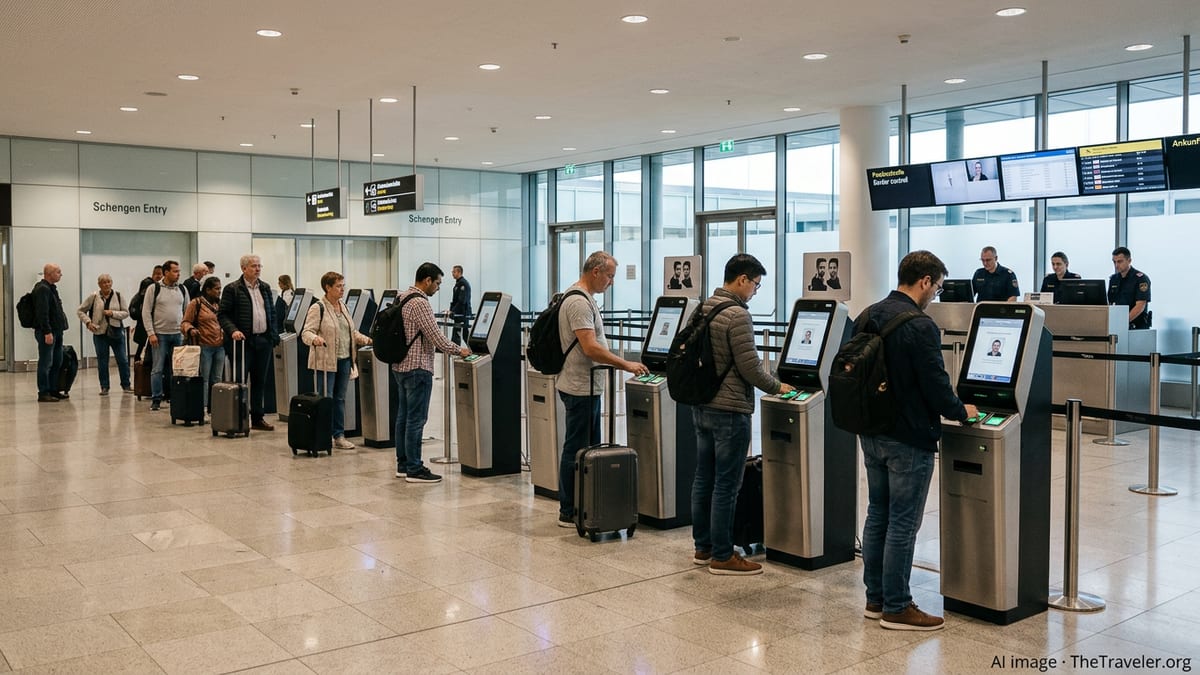
Border Technology Upgrade Enters High-Stakes Phase
The European Union’s Entry/Exit System, a biometric platform designed to log non-EU nationals each time they cross the bloc’s external frontier, reached full operational status across most of the Schengen area in April 2026. The system replaces manual passport stamping with the collection of fingerprints and facial images and is intended to tighten security and track overstays more reliably.
Publicly available information from airports and industry groups indicates that the transition has been anything but smooth. Data compiled by Airport Council International Europe and other travel bodies suggests that at peak times, border processing at some hubs has slowed by 70 percent or more, with waits commonly stretching to two or three hours and, in the worst cases, up to four or five.
The rollout is now facing a real-world stress test as the July and August holiday season begins. Passenger volumes across Europe typically double in these months, greatly amplifying any weakness in staffing levels, equipment reliability or passenger handling procedures at border checkpoints.
For policymakers in Brussels and national capitals, the stakes are high. The Entry/Exit System is a flagship component of the bloc’s broader push to modernize border management with digital tools, and its performance this summer will heavily influence public perceptions of whether technology is improving travel or making it more difficult.
Italy Holds the Line While Others Reach for the Brake
As pressure grows to relax or suspend the new checks during the busiest weeks of the year, Italy has emerged among those countries insisting that the system continue to operate. Public statements and news coverage from late spring indicate that Italy, alongside Portugal, has resisted calls to pause digital registration for British and other non-EU visitors, even as some neighbors experiment with exemptions.
That stance places Italy in a camp with Germany, France, the Netherlands, Switzerland and several other Schengen members that have opted to keep investing in additional kiosks, staff and reconfigured queues rather than step back from the technology. Reports from national airport operators in these countries describe a mix of heavy disruption and rapid adaptation, as terminals add signage, open overflow processing areas and refine how passengers are triaged between traditional desks and self-service lanes.
At the same time, regional contrasts are emerging. Coverage from Greece, for example, shows that authorities there have temporarily relaxed requirements for certain traveler groups in an effort to shield island gateways from severe congestion. In France and Belgium, airport and airline associations have openly urged European institutions to allow border posts to suspend Entry/Exit checks when passenger numbers exceed on-the-day capacity, arguing that without such flexibility some flights are departing half empty because travelers remain stuck in queues.
Italy’s decision to stay aligned with the core group of countries backing the system signals confidence that local contingency measures can keep traffic moving. Rome’s two main airports and Milan’s Malpensa and Linate have all been identified in trade coverage as locations where infrastructure upgrades and staff redeployments are being accelerated to cope with the new demands of biometric screening.
Queues, Missed Flights and Patchy Passenger Experience
Since full enforcement began in April, travelers transiting Europe’s busiest hubs have reported a patchwork of experiences. At airports such as Paris Charles de Gaulle, Amsterdam Schiphol, Frankfurt, Barcelona and Geneva, observers have described snaking lines at passport control, with non-EU visitors sometimes told to arrive up to three hours ahead of departure to avoid missing flights.
Industry analyses circulated in recent weeks link the worst bottlenecks to first-time biometric enrolment. Initial registration can take several minutes per traveler, a significant change from previous manual checks that often took seconds. When large numbers of passengers arriving from the same long-haul flight all require first-time capture, queues grow rapidly, especially where there are limited kiosks or too few border officers on duty to intervene.
Reports from passenger-rights organizations and travel assistance firms note a rising number of misconnections within Europe, particularly for travelers with tight transfer windows who must clear border control between flights. In such cases, delays are generally classified as border or infrastructure issues rather than airline-caused disruption, which can affect whether passengers are eligible for financial compensation under EU rules.
Compounding the frustration, some travelers have shared accounts suggesting that biometric records are not always being recognized on subsequent trips, leading to repeat enrolments and additional time at the border. While officials involved with the project have previously framed early technical glitches as teething problems, online forums and consumer reports from late June describe multi-hour waits at certain airports where repeated registration has become common.
Germany, France, Netherlands and Switzerland Under Scrutiny
Germany, France, the Netherlands and Switzerland, each hosting major intercontinental hubs, have become focal points in coverage of the Entry/Exit System’s impact. Early operational snapshots from April and May highlighted long queues at Frankfurt and Munich, as well as at Amsterdam Schiphol, where local media carried accounts of missed departures and appeals from passengers for clearer guidance.
In France, major airports serving Paris, the Mediterranean and Atlantic coasts have been among the most affected, according to travel-industry briefings. Border facilities there handle large volumes of British and long-haul traffic, so the proportion of passengers needing enrolment is particularly high. Similar challenges have been recorded at Geneva and Zurich, where Switzerland participates in the Schengen regime despite not being an EU member.
Airport and airline associations representing these countries have coordinated messaging to European institutions, warning that current conditions risk becoming unsustainable without rapid adjustments. Position papers cite chronic underinvestment in border staffing, physical space constraints in older terminals and the absence of a common playbook for when and how to introduce temporary relief measures.
Despite the criticism, none of these states has stepped away from the technology. Procurement notices, budget documents and public briefings monitored by industry media point instead to ongoing efforts to add kiosks, fine-tune queue layouts and expand communication campaigns so passengers understand when they will be subject to biometric checks and how to prepare.
Travelers Urged to Build in Extra Time as Summer Peaks
With July now under way and schools on holiday in several key markets, travel operators are advising passengers to treat the months ahead as a transition period in which disruption is likely to remain uneven and, at times, severe. Industry guidance commonly recommends that non-EU travelers flying to or via the Schengen area allow significantly more time at departure airports, particularly where they must clear border control before boarding or during a connection.
Several airlines with large leisure networks into the Mediterranean have updated their travel advice to suggest arrival at the airport at least three hours before scheduled departure, even for short-haul flights, whenever Entry/Exit checks are expected. Airport websites and social media feeds in Italy, Spain and Portugal show a similar pattern of messaging focused on longer lead times, use of online check-in and careful planning of connections.
For now, responsibility for managing queues rests largely with national authorities and airport operators. Some hubs are experimenting with separate lanes for passengers who have already completed their biometric registration on a previous trip, while others are trialling mobile border teams that can be deployed to congested points at short notice. Industry analysts note that the effectiveness of these measures varies widely from country to country and even from terminal to terminal.
What appears increasingly clear from the first months of full-scale operation is that Europe’s border technology upgrade is not a short-lived adjustment. Travel bodies tracking the rollout suggest that it could take several seasons before processing times stabilize at a new baseline, and that the performance of Italy, Germany, France, the Netherlands, Switzerland and their neighbors this summer will shape expectations for years to come.