


More news on this day
Ryanair is facing renewed scrutiny over its treatment of disrupted passengers after travelers stranded for around 15 hours on a European route reported receiving just £3.38 each in compensation, a sum many say highlights the growing gap between passenger expectations and what airlines are obliged to provide under current rules.
Get the latest news straight to your inbox!
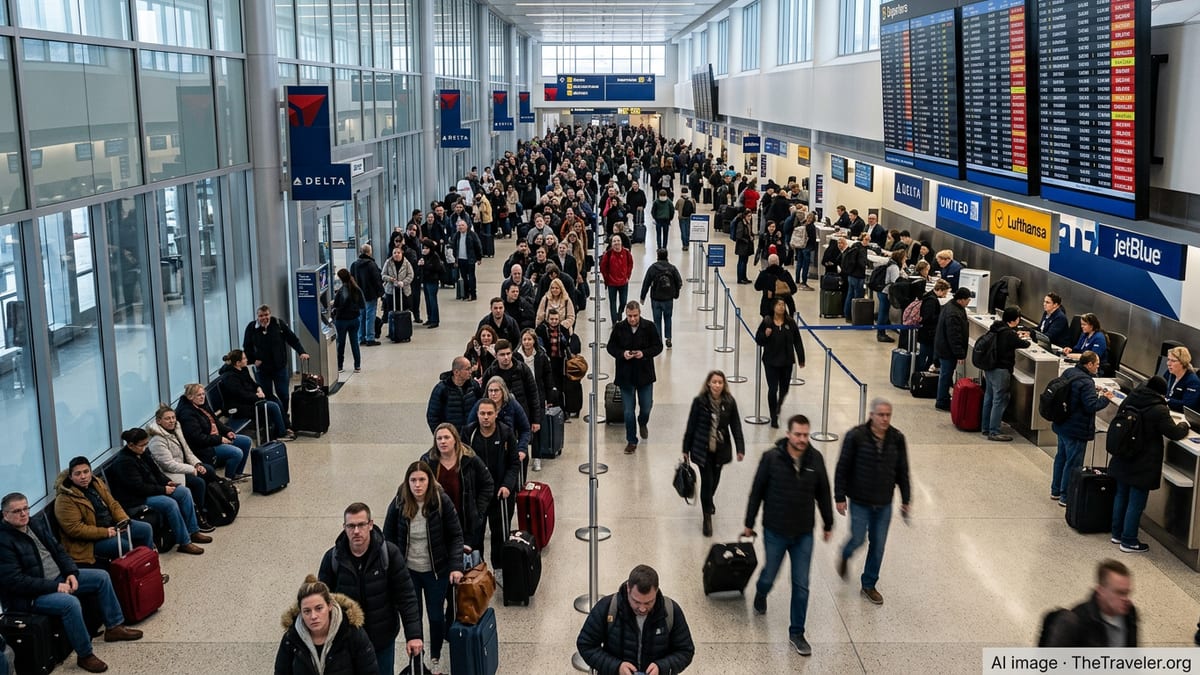
A marathon delay and a token payout
Reports emerging from recent European flights indicate that a group of Ryanair passengers endured an overnight disruption of about 15 hours, only to receive compensation of £3.38 per person once they were finally able to travel. The incident, discussed widely on social media and travel forums, has quickly become a flashpoint in the ongoing debate over low-cost airline practices.
Passengers describe being left in airport terminals for most of the day and into the night as their departure time slipped repeatedly. While staff provided basic delay notifications and limited refreshment vouchers, travelers say the eventual payout processed by the airline fell far short of what they believed they were due after such an extensive delay.
The reported £3.38 figure appears to relate to reimbursement for minimal refreshment or a residual balance after deductions, rather than the fixed-sum compensation many travelers associate with long delays in Europe. For affected passengers, the tiny payment has become a symbol of perceived indifference to customer experience.
The case has gained traction because of the stark contrast between the length of the delay and the sum paid, with many travelers sharing screenshots of their compensation notifications and using the episode to question how passenger rights rules are applied in practice.
How EU and UK rules are supposed to protect delayed passengers
Under European Union Regulation 261/2004 and equivalent post-Brexit rules in the United Kingdom, air travelers on eligible flights can be entitled to fixed-sum compensation when a delay on arrival exceeds three hours and the cause lies within the airline’s control. In theory, this framework can provide payouts ranging from around £220 to £520 per person, depending on distance and route.
In addition to cash compensation, the rules also establish a “right to care,” which includes meals, refreshments, hotel accommodation where necessary, and transport between the airport and accommodation during long delays. These provisions apply regardless of whether the disruption is considered extraordinary, although carriers can withhold the lump-sum compensation if they demonstrate that the delay was caused by events outside their control.
Publicly available documentation from Ryanair sets out these obligations, referencing both EU and UK versions of the regulation and describing when fixed compensation may be refused. The airline, like its competitors, retains the right to argue that certain operational problems qualify as extraordinary circumstances, such as severe weather, air traffic control restrictions, or security-related events.
Travel advocates note that this distinction between “duty of care” costs and lump-sum compensation is not always clear to passengers. Many expect substantial cash payments after long delays, only to discover that, in the airline’s view, they are entitled only to meal vouchers, basic reimbursements, or very small residual amounts.
Why some passengers receive only a few pounds
The £3.38 figure that has angered Ryanair passengers appears to illustrate how, in practice, compensation can fall far below expectations when delays are attributed to factors considered beyond the airline’s control. In such cases, travelers may only receive reimbursement for limited refreshments or the unused portion of fees, rather than the headline lump sums often quoted in media coverage of air passenger rights.
According to consumer-rights explainers and official guidance, airlines have substantial discretion when documenting the cause of a delay and calculating what is owed. If a carrier records the disruption as a result of air traffic restrictions, adverse weather, or other extraordinary circumstances, it can decline fixed cash payments while still offering modest care or vouchers.
Reports from frequent Ryanair customers suggest that these vouchers and reimbursements can amount to only a few euros or pounds per person, particularly when provided for a single meal or snack at an airport where prices are high. Once any earlier voucher value or partial refunds are netted off, the final amount transferred to a bank account can be as low as a few pounds.
For the passengers who waited roughly 15 hours, the £3.38 outcome has fuelled accusations that the regulatory system leaves too much room for interpretation. Travelers say that while regulations were intended to provide clear and predictable redress, the reality often depends on how airlines categorize events and how persistent passengers are in challenging initial decisions.
Growing frustration with low-cost disruption handling
Ryanair, one of Europe’s largest low-cost carriers, has built its business around high aircraft utilization, rapid turnarounds, and pared-back service levels. Travel industry analysis frequently notes that any disruption to this tight rotation model can quickly cascade into long waits for passengers, especially when spare aircraft and crew are limited.
In recent years, travelers across Europe have reported a rise in operational headaches, including weather-related disruption, air traffic control staff shortages, and knock-on delays from congested airports. Low-cost airlines, which typically operate dense flight schedules, can be especially exposed when multiple issues occur on the same day or at the same base.
Consumer groups and travel commentators argue that the combination of tight schedules and narrow margins encourages some carriers to take a restrictive view of compensation. Online discussions about Ryanair frequently reference disputes over whether delays stem from technical faults, staffing problems, or external restrictions, with the classification often determining whether passengers are offered hundreds of pounds or only a nominal amount.
The 15-hour delay case has become a rallying point for frustrated travelers who say the burden is too often placed on individuals to gather evidence, keep boarding passes, track arrival times, and pursue complaints through airline portals or alternative dispute resolution schemes.
What stranded travelers can realistically do next
For passengers caught in extreme delays, travel experts recommend documenting the disruption carefully, including taking time-stamped photos of departure boards and keeping receipts for food, drinks, and accommodation bought during the wait. Publicly available guidance from consumer agencies advises travelers to submit formal claims directly to the airline first, referencing the relevant EU or UK regulation.
If a claim is rejected or only minimal reimbursement is offered, travelers can escalate disputes to a national enforcement body or an approved alternative dispute resolution service where available. In some European jurisdictions, small-claims courts or specialized online procedures are also used to challenge airline decisions on compensation and reimbursement.
In practice, many delayed passengers choose not to pursue their case beyond the initial rejection, especially when the sums in question are modest or the process appears complex. Others turn to commercial claim-handling firms that take a percentage of any payout in exchange for managing the paperwork and, if necessary, legal action.
The Ryanair episode involving a 15-hour delay and a £3.38 payout is now circulating widely among travelers as a cautionary tale. For some, it serves as a reminder to understand the limits of regulatory protection before booking, while for others it has become a fresh call for tighter enforcement and clearer rules to ensure that long waits at the airport are met with more than a token payment.