


More news on this day
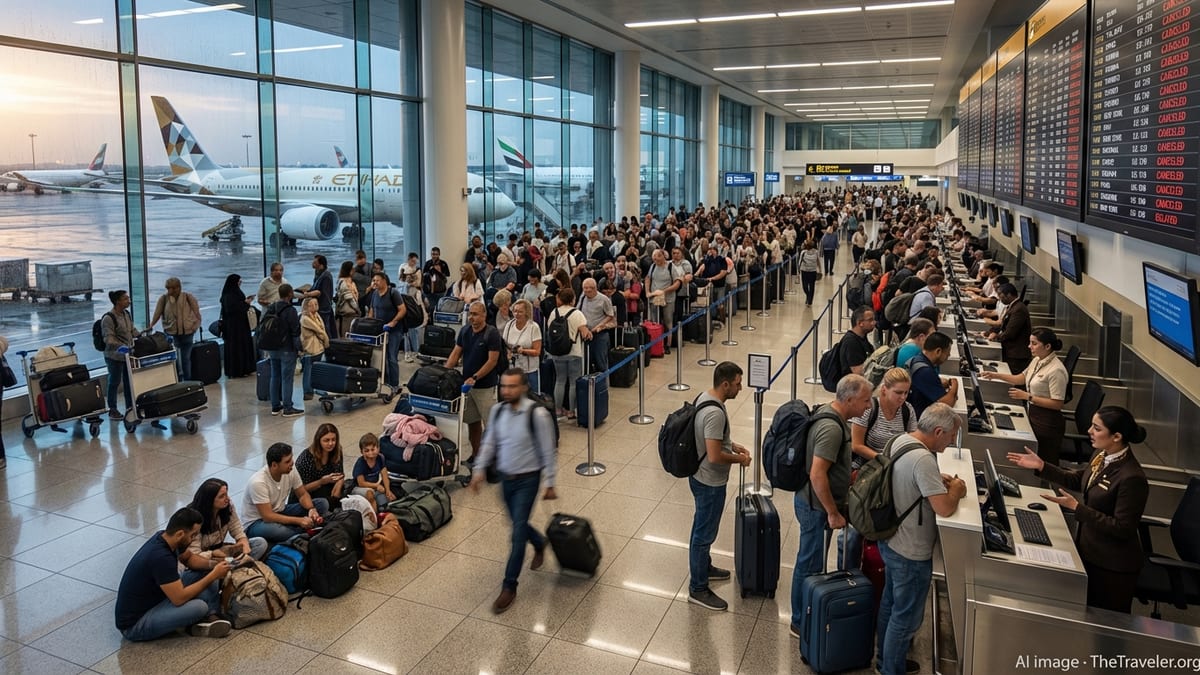
Air travelers moving through the Middle East faced another day of heavy disruption this weekend, with publicly available flight-tracking snapshots showing more than 60 cancellations and roughly 1,130 delays across major hubs as airlines managed constrained routings and knock-on congestion.
Get the latest news straight to your inbox!
Disruption concentrated at key connecting hubs
Published disruption roundups for September 2026 indicate that the region’s largest connecting airports, including Dubai International, Abu Dhabi’s Zayed International, and Doha’s Hamad International, have repeatedly recorded high delay totals during 24-hour windows when traffic is pushed into fewer usable corridors. Those hubs sit at the center of Europe to Asia and Africa to Asia itineraries, so even modest degradations in on-time performance can spread quickly across airline networks.
A separate disruption analysis dated September 18 and 19, 2026 described a single-day snapshot with 60 cancellations and 1,137 delays across airports spanning the United Arab Emirates, Saudi Arabia, Qatar, Oman, Kuwait, Bahrain, Jordan, Israel, Türkiye, and Syria. That breadth matters for travelers because itineraries often touch multiple flight information regions in one trip, increasing the chance that a delay in one airspace zone turns into missed connections later in the day.
Earlier published coverage from September 10, 2026 reported a similar pattern, citing 1,142 delays and 66 cancellations across major Middle East hubs. Taken together, the consecutive snapshots point to an elevated baseline of disruption in early-to-mid September, particularly during peak evening and overnight “connection banks” when widebody arrivals and departures cluster tightly.
Airspace constraints and rerouting continue to add friction
Operational reporting through September has emphasized that flight planning remains sensitive to sudden restrictions, corridor tightening, or risk-driven avoidance of certain routes. When airlines detour around constrained airspace, block times increase, and the extra minutes accumulate across an aircraft’s daily rotation, making later departures more vulnerable to delay even without weather or technical issues.
Logistics and operational advisories published in mid-September characterized regional operations as open but subject to short-notice delays and cancellations, with partial-capacity conditions and shifting assessments affecting schedules. The practical result for passengers is less schedule resilience: a late inbound aircraft, a crew duty-time constraint, or a gate occupancy conflict can cascade through the next departures at busy hubs.
Industry analysis earlier in 2026 also described how prolonged conflict-related restrictions forced traffic into narrower north-south corridors, increasing congestion and pushing delay risk onto already busy routes. This is especially significant for long-haul services connecting Europe with South Asia, Southeast Asia, and Australasia, where Gulf hubs handle large volumes of transfer passengers.
Airlines and routes most exposed to knock-on delays
In the most recent disruption snapshots, network carriers and high-frequency low-cost operators based in the Gulf appeared repeatedly among the most affected by delays, reflecting their dense schedules and reliance on connecting waves. Published data for September has pointed to elevated delay counts among carriers operating large hub banks at Dubai, Abu Dhabi, and Doha, with delays often outnumbering cancellations by a wide margin.
Route-level examples in UAE-focused travel coverage from early September described disrupted services spanning Europe, Asia, and the Middle East, including flights into and out of the UAE and connections onward to the wider region. When these services slip behind schedule, the impact is amplified at transfer airports where a single late widebody arrival can absorb scarce gate space and strain baggage and passenger processing during peak periods.
Some advisories also highlighted that select long-haul services have been suspended for extended periods, which can tighten seat availability on remaining flights and raise the stakes for misconnects. One operational update published September 16, 2026 listed a cancellation window for Singapore Airlines’ Singapore to Dubai flights through October 24, 2026, illustrating how longer-running adjustments can coexist with day-to-day delay spikes.
What travelers can do right now to reduce disruption risk
With delays outpacing cancellations in the latest snapshots, the biggest practical threat for many passengers is not a scrapped flight but a misconnection. Travelers connecting through Dubai, Doha, or Abu Dhabi may benefit from booking longer layovers than they might choose in a normal operating environment, particularly on itineraries that depend on tight late-night connection banks.
Flight-status tools that show rolling departure and arrival delays can help travelers make earlier decisions about when to leave for the airport, whether to switch to carry-on only, or whether to request proactive rebooking. Real-time dashboards vary by provider and airport, but the shared value is spotting developing congestion before it turns into a missed connection.
Passengers with flexible plans may also consider avoiding same-day, multi-stop itineraries that require multiple perfectly timed handoffs across different airspace zones. When the region is operating with reduced slack, one delay early in the journey can push travelers past minimum connection times, especially when immigration, security re-screening, or terminal transfers are involved.
For travelers already affected by a cancellation, airline policies commonly offer rebooking or refunds depending on fare rules and the nature of the disruption. Given the rapid pace of schedule changes in September, travelers may find it useful to confirm their flight status more than once, including the morning of travel and again before heading to the airport.