


More news on this day
Europe’s long planned Entry/Exit System is now fully operational at Schengen borders, and early evidence suggests it is reshaping global travel flows by making entry to Europe markedly more complex than to rival destinations.
Get the latest news straight to your inbox!
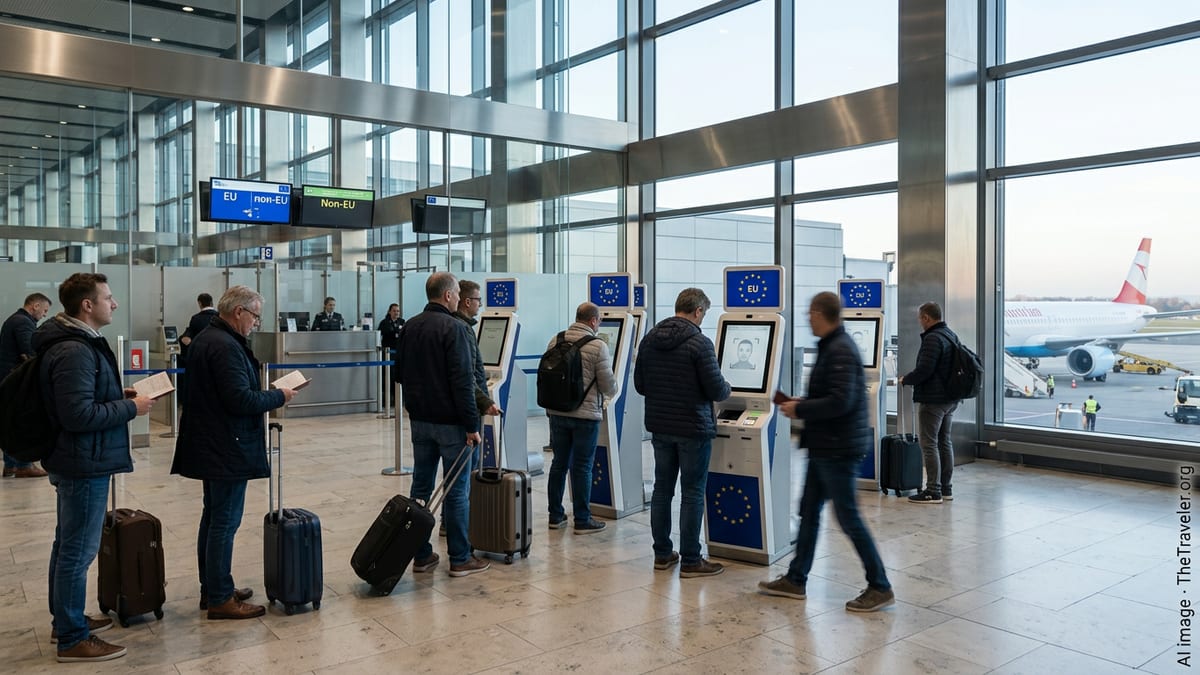
A Digital Border Wall Around Schengen
The European Union’s Entry/Exit System, or EES, went fully live on 10 April 2026 after a six month transition period that began in October 2025. The system replaces manual passport stamps for non EU nationals entering or leaving the Schengen Area with a centralised database that logs each crossing alongside biometric data such as fingerprints and facial images.
According to publicly available information from EU institutions, the scheme covers short stays of up to 90 days in any 180 day period across 29 participating European countries. Each first encounter with the system requires a full biometric enrolment at a staffed booth or kiosk, while subsequent trips are expected to be processed more quickly using the stored record.
European policymakers have framed EES as a security and migration management upgrade that will tighten enforcement of overstays and identity fraud. For travellers, however, the immediate reality is being felt less in policy terms and more in the length of queues at airports, ferry ports and road crossings from the United Kingdom and other neighbouring states.
The change comes ahead of the separate ETIAS travel authorisation, due later in 2026, which will add another layer of pre travel screening for many of the same non EU visitors. Together, the two systems mark a historic shift toward more digitally controlled frontiers around Schengen, even as other tourism driven regions market faster and more frictionless arrivals.
Hours Long Queues and Patchy Rollout
Reports from airports across Europe over the first days of full EES operation describe three hour lines at border control, missed flights and terminals struggling to absorb additional processing time per passenger. Coverage of the first post launch weekend highlights disruption at major hubs such as Vienna and Geneva, with some departures leaving behind travellers still stuck in passport queues.
Industry publications and national media in several member states have documented instances where border authorities temporarily suspended or scaled back biometric checks to clear backlogs. Airports in Portugal and Italy are among those reported as delaying full activation of the new technology in order to avoid gridlock during busy arrival waves.
Travel and aviation bodies had warned for months that the combination of new biometric steps, limited physical space and existing staffing constraints risked overwhelming border zones at peak times. Early evidence from the staggered introduction since late 2025 had already shown processing times increasing by as much as 70 percent at some locations, even before the system applied to all eligible passengers.
Land borders have not been spared. Motorists entering Schengen from neighbouring non EU states, including at the Channel ports, are facing slower car and coach processing as officials capture fingerprints and facial images from each traveller in a vehicle, often within facilities designed around much quicker passport stamping.
Europe vs the Rest: Diverging Visitor Experiences
The contrast with competing destinations is sharpening the perception that Europe is building a new kind of digital border wall around its prized tourism economies. Long haul travellers from markets such as the United States, Canada, the Gulf and parts of Asia now face more steps to enter Schengen than to visit many other regions that rely heavily on international tourism.
While biometric systems are expanding worldwide, major travel markets in the Americas and Asia Pacific often use them primarily to speed eligible visitors through e gates, with a clear focus on reducing wait times. In the Schengen case, the primary objective is the creation of an enforcement grade database, and travellers are discovering that initial enrolment can be significantly slower than legacy processes.
For frequent visitors, including business travellers and digital nomads, the up front burden may eventually be offset by smoother repeat crossings, but this promise depends on how quickly border posts can separate first time users from those already registered. In the early days of EES, many airports have been funnelling all non EU arrivals into the same queues, limiting any advantage for returning visitors.
The result is a growing divergence in perceived hassle between Europe and rival long haul destinations that continue to streamline entry or maintain relatively simple visa waiver schemes. Some analysts now expect a short term diversion of leisure demand to countries where queues and biometric procedures are lighter, especially for travellers considering multi stop itineraries that already involve long flight times and multiple border checks.
Tourism Sector Caught Between Security and Service
Europe’s tourism industry, which welcomed record numbers of international visitors in 2023 and 2024, is now facing a difficult balancing act. Trade associations for airports, airlines and tour operators have publicly warned that unmanaged congestion at border control risks eroding the region’s reputation for hassle free city breaks and beach holidays.
Airlines are reacting in practical ways: revising check in guidance, recommending earlier airport arrival for non EU passengers, and tweaking schedules where possible to give connecting travellers more time to clear control points. Some carriers have updated pre departure communications to highlight the new biometric requirement and to caution that no show and rebooking rules still apply, even when delays stem from border queues.
Destinations that rely heavily on visitors from neighbouring non Schengen countries are particularly exposed. Alpine resorts, Mediterranean ports and European capitals that have invested heavily in air connectivity with the United Kingdom and other third countries now depend on border processes that sit outside their direct control. Local tourism boards are attempting to reassure prospective guests while also pressing national authorities to use all available flexibilities in the rules to ease congestion during peak periods.
Within Europe, there is also concern about the system’s impact on more modest regional airports and land crossings that lack the physical space or staffing budgets of the largest hubs. If bottlenecks prove chronic in these locations, they could lose international routes and passenger traffic to better equipped competitors, further reshaping the continent’s tourism map.
What Travellers Are Doing Differently
In response to the early weeks of EES, travellers are already adjusting their behaviour. Travel forums and social media posts show non EU visitors padding their itineraries with extra time at departure and arrival airports, booking longer connections within Europe, and reconsidering tight back to back schedules that leave little margin for unexpected lines.
Some trip planners are advising first time visitors to route their initial entry into Schengen through less congested airports where possible, or to choose off peak flights to reduce the likelihood of encountering the longest queues. Others are suggesting that travellers combine several Schengen countries within a single trip to minimise the number of separate biometric enrolments and border encounters in the short term.
Outside Europe, tourism boards and airlines in the Americas, Middle East and parts of Asia are subtly highlighting their comparatively smoother border experiences in marketing campaigns, emphasising fast track options, streamlined e visa systems or simple visa waivers. For cost conscious leisure travellers choosing between long haul options, the prospect of shorter and more predictable immigration waits is becoming part of the value calculation alongside airfares and hotel prices.
For now, EES remains a work in progress, with technical refinements, staffing adjustments and infrastructure changes likely to shape how disruptive or manageable the system becomes. What is already clear is that Schengen’s new digital perimeter has changed the equation for entering Europe, and that tourists around the world are watching closely as the region’s high tech frontier takes shape.