


More news on this day
Amsterdam’s Schiphol Airport is facing a fresh bout of operational turmoil in 2026, with 313 delayed flights and 27 cancellations rippling across Europe’s already stretched aviation network and stranding thousands of passengers at the height of the summer travel season.
Get the latest news straight to your inbox!
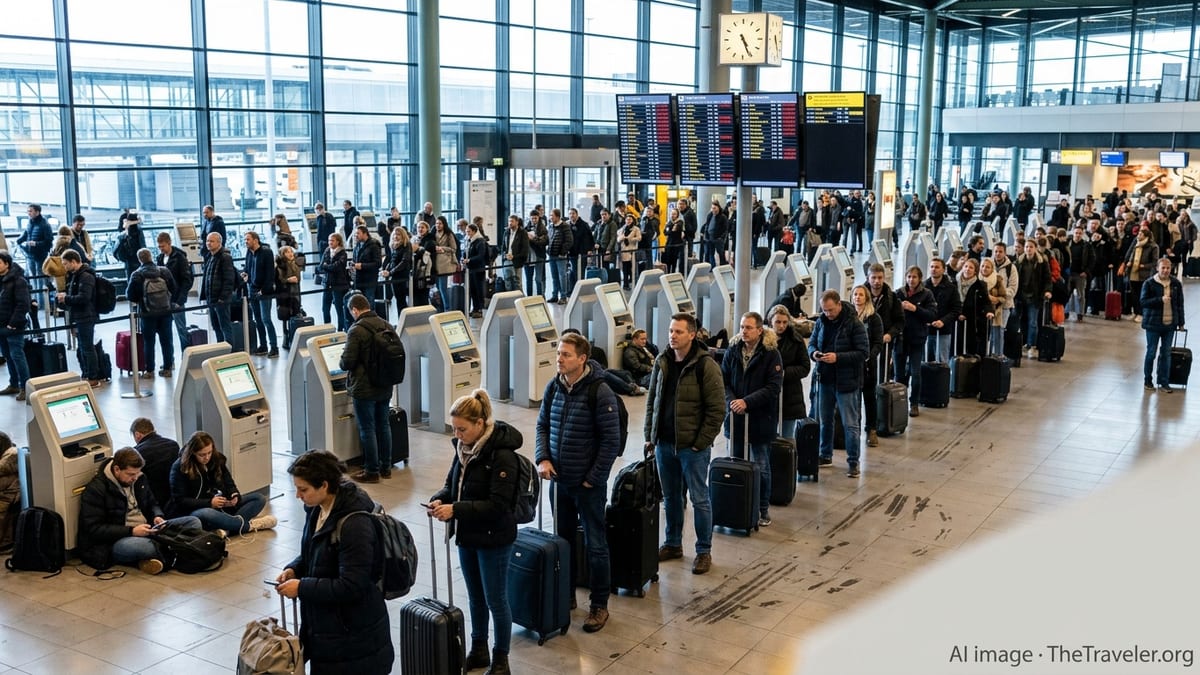
Fresh Turmoil at One of Europe’s Busiest Hubs
The latest disruption at Schiphol comes after a year marked by repeated operational strains at major European airports. Publicly available tracking data for recent weeks show patterns of heavy delay clusters at the Dutch hub, with several days recording triple-digit disruption as airlines struggle to keep schedules intact amid tight turnarounds and congested airspace.
The figure of 313 delayed flights combined with 27 outright cancellations highlights how even a relatively short period of instability at a large hub can create outsized consequences. With Amsterdam Schiphol typically handling well over a thousand flights a day, schedule slippage of this magnitude quickly cascades into missed connections, aircraft and crew out of position, and mounting queues in terminals across the continent.
Industry reports indicate that the latest wave of disruption has been felt not only on routes to and from Amsterdam, but also at secondary airports that rely on Schiphol as a primary connecting point. Travelers on short haul feeders from regional cities in Scandinavia, Germany, the United Kingdom, and southern Europe have reported missed long haul departures, overnight diversions, and last minute rebookings onto already crowded services.
For Schiphol, the episode adds to a recent history in which weather-related constraints, resource bottlenecks, and network congestion elsewhere in Europe have repeatedly translated into concentrated disruption at the Netherlands’ main gateway.
Knock-on Effects Across European Routes
When delays reach into the hundreds at a single hub, the impact is rarely confined to one airport. Data compiled by aviation analytics providers for June 2026 show that broader European operations were already under pressure, with some days seeing more than a thousand flights disrupted across the continent as airlines contended with staffing limits, slot constraints, and localized weather issues.
In this latest Schiphol episode, the 27 cancellations appear relatively modest when set against the 313 delayed movements, but the cancellations often hit critical feeder or long haul services. Even a small number of withdrawn rotations at a hub can leave entire banks of onward connections without viable same day alternatives, forcing passengers into unplanned hotel stays and rerouted itineraries that may add 24 hours or more to their journeys.
Reports from affected travelers across Europe describe congested transfer halls, long lines at service desks, and reliance on airline apps that have struggled to keep up with real time schedule changes. Those flying from London, Helsinki, Zurich, and key Spanish airports into Amsterdam have reported late operating aircraft, missed intercontinental departures, and baggage left behind as ground operations attempted to compress turnaround times.
The uneven spread of delays has also meant that some regional airports have served as pressure valves, taking on re-routed passengers or additional services to bypass the most affected hubs. However, this provides only partial relief when the core problem revolves around capacity and timing at one of Europe’s primary connecting nodes.
Weather, Staffing, and Structural Strain
While the precise combination of factors behind each disruption day differs, the broader context for Schiphol’s 2026 challenges is increasingly clear. Previous episodes this year have been linked to winter weather, including heavy snowfall and de-icing bottlenecks that forced large numbers of cancellations in January. More recently, operational data and industry commentary have pointed to a mix of staffing constraints, tight scheduling, and wider network congestion.
European network performance reports for early 2026 have documented rising air traffic flow management delays compared with the previous year, much of it tied to weather and high traffic volumes at large hubs like Amsterdam, Paris, and Madrid. For Schiphol, these pressures translate into reduced margins for recovery when a day starts badly, making it more likely that relatively minor issues will cascade into widespread disruption.
Airlines operating at Schiphol, including the Dutch flag carrier and its alliance partners, have been attempting to balance ambitious summer schedules with limited slack in aircraft and crew availability. When a late arrival undermines a carefully timed transfer bank, carriers may face difficult choices between operating heavily delayed departures or canceling selected flights to protect the rest of the program.
Observers note that this dynamic has become more visible in 2026 as travel demand remains strong while parts of the aviation ecosystem, from air traffic control staffing to ground handling, lag behind. The result is a system that remains vulnerable to days of concentrated disruption like the one now affecting 313 delayed flights and 27 cancellations at Schiphol.
Passenger Rights and Practical Options
The latest turmoil at Schiphol has again brought European air passenger rights into focus. Under EU and UK regulations, travelers departing from Amsterdam generally have access to a framework that can provide assistance such as meals, refreshments, and overnight accommodation in the event of significant delays or cancellations. In certain circumstances, passengers may also be eligible for fixed compensation, although this depends on the cause of the disruption and whether it was within the airline’s control.
Consumer advocates emphasize that passengers affected by delays or cancellations should retain boarding passes, booking confirmations, and receipts for essential expenses incurred while waiting for rebooking. Publicly available guidance from airlines highlights the importance of using official apps or websites to monitor re-routings, as automated rebooking systems may offer alternative itineraries that sell out quickly during peak disruption.
For travelers whose plans hinge on time-sensitive events, such as cruises, tours, or business meetings, the Schiphol disruption serves as another reminder of the value of building extra buffers into itineraries. Connecting via a single hub on tight margins, especially during high season, can be risky when Europe’s aviation system is operating near capacity.
Travel insurance, where purchased, may provide additional protection for missed connections, overnight stays, or lost pre-paid arrangements, though coverage varies and often depends on the specific reason for the disruption. Industry observers note that, as disruption days accumulate in 2026, more passengers are seeking clarity in advance on what their policies and tickets actually cover when flights do not operate as planned.
What the Schiphol Chaos Signals for Summer 2026
The scale of Schiphol’s latest disruption will likely reinforce concerns about the resilience of Europe’s air travel infrastructure during the busy summer period. Network statistics for the first half of 2026 already point to elevated levels of delay across the continent, and Amsterdam’s role as a key transfer point means that instability there can have outsized regional effects.
If patterns seen so far this year persist, travelers can expect further days on which weather events, airspace restrictions, or operational bottlenecks lead to concentrated disruptions at major hubs. For Schiphol, a repeat of the 313 delays and 27 cancellations now being reported would underline how quickly a single difficult day can overwhelm both passengers and operational teams.
Airlines and airports are under growing pressure from passengers, regulators, and industry partners to improve communication and contingency planning. Publicly available information from airport dashboards and flight tracking platforms is increasingly shaping traveler expectations, with many now checking performance trends for specific hubs before committing to itineraries.
For thousands of passengers caught up in the Schiphol chaos, the priority remains reaching their destinations, often via improvised routes across Europe. For the broader industry, however, the episode stands as another signal that the continent’s aviation network is still struggling to rebuild the resilience needed to absorb shocks without stranding large numbers of travelers.