


Driving to Incheon International Airport can be a smart choice, especially for early departures, late-night arrivals, or family trips with lots of luggage. But to avoid last-minute stress and unexpected costs, it helps to understand exactly how parking at Seoul Incheon Airport works in 2026, from short-term garages at Terminals 1 and 2 to the large long-term lots connected by shuttle.
Get the latest updates straight to your inbox!
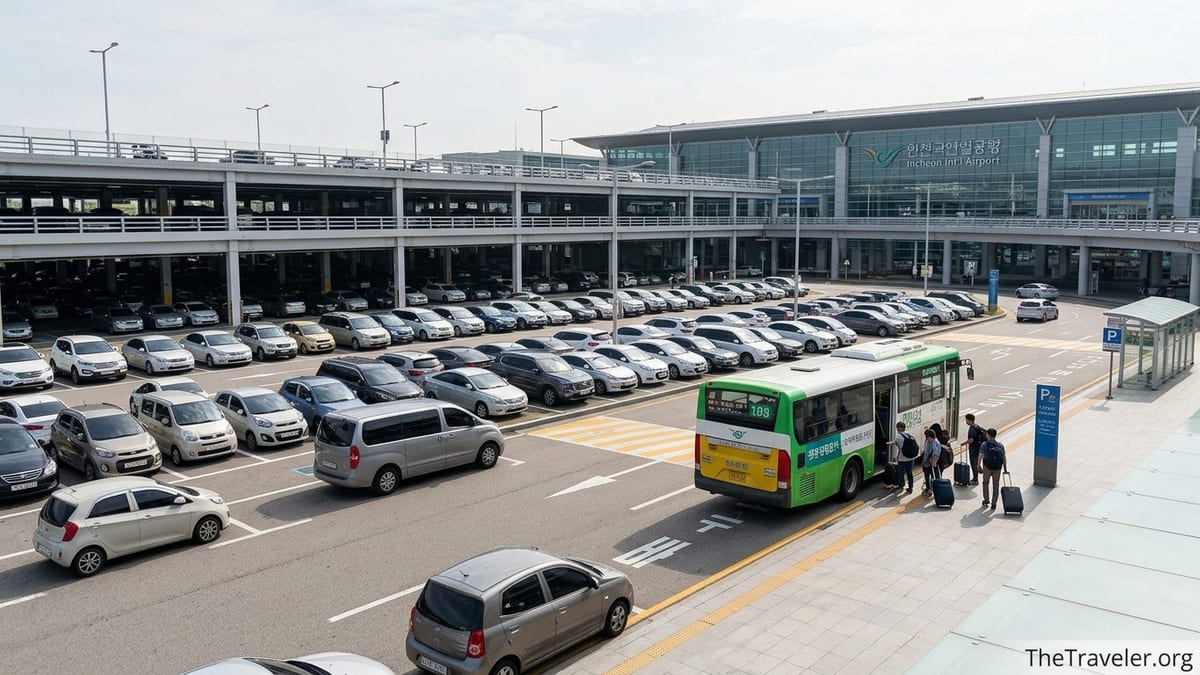
How Incheon Airport Parking Is Organized
Incheon International Airport serves tens of millions of passengers a year and sits on Yeongjong Island, roughly an hour from central Seoul by car. Because of the distance and the large catchment area around the capital, many travelers opt to drive and leave their car at the airport while they are away. To support this, the airport operates extensive parking facilities around both Terminal 1 and Terminal 2, plus large long-term lots set slightly away from the buildings and connected by shuttle buses.
For most travelers, parking falls into two broad categories: short-term parking in multi-story garages directly in front of the terminals, and long-term parking in surface lots and parking towers a few minutes away by shuttle. Short-term is best for pickups, drop-offs, or trips of one or two days when you want to be as close to the check-in counters as possible. Long-term is designed for multi-day and multi-week trips, trading a slightly longer transfer time for substantially lower daily caps.
It is also important to know that Incheon has two main passenger terminals. Terminal 1 handles a wide range of international airlines, while Terminal 2 is home to Korean Air and a group of partner carriers. Both terminals have their own short-term garages and access to long-term parking. Directional signs, usually in Korean and English, clearly distinguish between “Short-term Parking” and “Long-term Parking,” and between Terminal 1 and Terminal 2, as you approach the airport.
On top of the core options, Incheon also offers valet services at the terminals and reserved parking services, particularly around Terminal 2, which let you pre-book a space in designated areas. These premium choices cost more than general long-term parking but can make sense if you are traveling in peak holiday periods or want the fastest possible drop-and-go experience.
Short-Term Parking: Best for Pickups, Drop-Offs, and Quick Trips
Short-term parking at Incheon Airport is housed in large, multi-level garages directly in front of Terminal 1 and Terminal 2. These are the closest public parking options to the check-in desks and arrival halls. Drivers use them for everything from a 30-minute meet-and-greet at arrivals to overnight stays when convenience matters more than squeezing out the last bit of savings.
Typical 2026 pricing in these short-term areas is higher than in the long-term lots and is structured in small time blocks. You can expect to pay a base rate for the initial period and then an additional fee every 10 or 15 minutes, with a daily maximum that is noticeably above the long-term daily cap. This means a three- or four-hour stay to pick up family from a delayed flight can add up, while leaving the car there for several days will quickly become much more expensive than using the dedicated long-term facilities.
As a concrete example, a Seoul-based business traveler might drive to Terminal 2 for a same-day round trip to Tokyo. Parking for eight to ten hours in the short-term garage directly linked to the departures hall can be justified because it minimizes walking time with a laptop bag and carry-on luggage. In contrast, a family flying to Europe for seven nights would rarely choose short-term parking because the cumulative charges would far exceed the long-term daily cap.
Short-term garages are well signposted from the airport access roads, and electronic boards usually display available spaces per level. Many drivers prefer these garages when picking someone up late at night because the route from car to arrivals is fully covered and brightly lit, and there are elevators, escalators, and trolleys available throughout.
Long-Term Parking: Lowest Daily Caps for Multi-Day Trips
Long-term parking is where Incheon Airport becomes cost-effective for longer trips. Large surface lots and several parking towers near the airport provide thousands of spaces at lower hourly rates and with a daily maximum that is often around half or less of what you would pay in short-term parking. In 2026, typical posted long-term rates at Incheon mean you pay in small time blocks, but charges stop at a relatively modest daily cap, making week-long or even two-week stays realistic for many travelers.
To illustrate, a Korean resident leaving from Terminal 1 for a 10-day trip to North America could park in one of the long-term lots or towers connected to Terminal 1. With a daily cap roughly in the range of the low thousands of won per day, the total bill remains in a manageable band, especially when shared across several travelers in the same car. In contrast, keeping the vehicle in short-term parking for the same period would typically cost several times more and is rarely seen except in unusual situations.
These long-term facilities are not immediately adjacent to the terminal doors but are still integrated into the airport campus. Shuttle buses connect them to both Terminal 1 and Terminal 2, usually running at frequent intervals throughout the day. Even at busy times, most passengers report a transfer time of roughly 10 to 15 minutes from car park to terminal door, plus a few minutes of waiting time for the next shuttle. This trade-off is the core of the value: a few extra minutes in exchange for a much lower daily cost.
For added reassurance, Incheon’s long-term parking areas are equipped with CCTV coverage and standard security patrols, and lighting remains on overnight. Many regular travelers from cities like Suwon or Incheon itself treat the long-term lot as their default option, leaving the car for one or two weeks several times a year, especially during school holidays.
Shuttles, Maglev, and Getting From Car to Terminal
Navigating from your parked car to the correct terminal is straightforward once you know the options. The primary link between the long-term parking areas and the passenger terminals is a network of complimentary shuttle buses operated by the airport. In 2026, these shuttles run from early morning to late night at frequent intervals, with peak daytime frequencies typically every few minutes between the major long-term zones and Terminals 1 and 2.
On a typical morning, a traveler who has parked at a long-term surface lot will walk to the nearest shuttle stop, where digital boards show the route and approximate waiting time. The shuttle then makes a short loop, usually stopping first at Terminal 1 and then continuing to Terminal 2, or vice versa, depending on the specific line. Travel time from the furthest long-term lot to the terminal doors is usually about 10 to 15 minutes, even when traffic is moderate on the internal airport roads.
In addition to buses, Incheon’s airport maglev line includes a stop at or near the long-term parking area, linking it with the main Terminal 1 station. While most ordinary travelers rely on the shuttle buses because they are directly tailored to the car parks, the presence of the maglev highlights how integrated parking is with the broader transport system on Yeongjong Island. For those arriving by public transport to meet someone who has parked long-term, using the maglev to reach the parking area can occasionally be a convenient alternative.
Real-world experiences shared by frequent flyers suggest that you should add at least 20 to 30 minutes to your usual airport arrival buffer if you are using long-term parking instead of being dropped directly at departures. This extra time covers finding a space, walking to the shuttle stop, riding the shuttle, and then entering the terminal. Families traveling during major holidays like Chuseok or Lunar New Year often add even more buffer, as queues for the shuttle can lengthen during the busiest days.
Valet and Reserved Parking: Paying More for Maximum Convenience
For travelers who prioritize speed and convenience over cost, Incheon Airport offers valet parking services at the terminals and reserved parking options, particularly connected to Terminal 2. These services are aimed at business travelers on tight schedules, people traveling with mobility issues, and anyone wishing to minimize walking or waiting.
Valet parking typically works in a familiar way. You drive to a designated valet zone near the departures level, hand over your keys to authorized staff, complete a quick handover form, and head straight into the terminal with just your luggage. The car is then moved to a secure parking area, often one of the airport-managed long-term facilities. Pricing for valet tends to include a daily charge on top of standard parking fees, so using it for a single overnight can already cost significantly more than self-parking, but some travelers find the time savings well worth the premium.
Reserved parking, often linked to short-term or premium sections of the existing garages, allows you to pre-book a specific space or at least space within a designated area. This can be particularly useful if you know you will arrive at the airport during a peak travel period, such as the start of summer holidays, or at a traditionally busy time of day when short-term garages can approach capacity. Instead of circling multiple levels in search of a spot, you follow the signs to the reserved zone and park where indicated.
Consider the example of a family flying out of Terminal 2 for a four-day break over a national holiday. They might decide that paying for reserved parking in the Terminal 2 short-term or premium section is worth it to avoid the anxiety of full garages and long searches, especially if they are traveling with small children and multiple suitcases. Meanwhile, a business traveler attending an overseas meeting might opt for valet at Terminal 1 when leaving on an early morning flight, preferring the certainty of a quick drop and an equally quick pickup upon return.
Strategies to Save Money on Parking at Incheon
Even without resorting to off-site private lots, there are several practical ways to keep parking costs under control at Incheon. The simplest is to match the parking product to the length of your trip. As a rule of thumb, anything beyond roughly one full day tends to favor long-term parking, while very short stays of a few hours for pickups or drop-offs are more naturally suited to short-term garages. Many local drivers consciously switch to long-term lots once their trip exceeds two or three days.
Another common saving strategy is to check for promotional discounts or online tools provided by parking information services before you travel. Some platforms list current airport parking rates and occasionally highlight discounted packages or off-peak specials for long-term stays. While you should treat these as indicative rather than guaranteed, they help you estimate your likely total and compare against alternatives such as taking an airport limousine bus or the airport railway from Seoul Station.
Travelers based far from Incheon sometimes calculate whether the combined cost of fuel, tolls, and parking is still competitive with other options. For example, a couple driving from Daejeon for a nine-day trip might compare long-term parking plus expressway tolls to the price of intercity rail and the airport railroad. In many cases, driving and parking remains attractive when two or more people are traveling together, but solo travelers on longer trips sometimes find that public transport is cheaper overall, especially when factoring in overnight parking for more than a week.
Lastly, flexibility with timing can reduce stress and indirectly save money. Arriving at the airport very close to departure time leaves no margin if the long-term lots are busy and the next shuttle is crowded. Building in extra time means you are less likely to abandon the cheaper long-term option in a panic and switch to an expensive short-term space simply to make your flight. Many seasoned travelers who regularly use Incheon’s long-term facilities consider a 2.5 to 3-hour pre-departure arrival standard, accounting for parking, check-in, security, and potential queues.
Practical Tips for Driving and Parking at ICN
Beyond prices and categories, a few practical details can make the experience of parking at Incheon smoother. The first is to pay careful attention to signage as you approach the airport on the Incheon International Airport Expressway or from the Incheon Bridge. Lanes often split between Terminal 1 and Terminal 2 well before the buildings come into view, and the short-term and long-term options for each terminal may require you to be in the correct lane early. If you accidentally follow the signs for Terminal 1 short-term when you are flying from Terminal 2, you can still correct course, but it will cost you time.
Once in the parking facility, take a clear photo of your level, zone, and row, and consider noting the nearest elevator or pillar number. Incheon’s garages and long-term lots are large enough that returning after a two-week holiday to search for your car can be frustrating if you rely solely on memory. Many Korean drivers use messaging apps to send themselves a quick text with the parking information, ensuring it is easy to retrieve even after an overseas trip.
Payment is usually handled at automated machines before you exit the garage or lot. These machines typically accept Korean bank cards and cash, and some also support major international cards. You insert your parking ticket, review the calculated fee on-screen, pay, and then have a set period to drive through the exit barrier. At peak times, there can be short queues at payment kiosks, so allowing a few extra minutes when returning is sensible, especially if you are catching a domestic connection at Gimpo Airport later in the day.
Finally, think about weather and luggage. In winter, winds on Yeongjong Island can be strong and temperatures low, so parking in a covered garage or one of the parking towers may be more comfortable when loading or unloading bags, particularly if you are traveling with elderly relatives or young children. In summer, shaded or indoor parking also keeps the car cooler for your return, which can make a noticeable difference after a long-haul flight.
The Takeaway
Parking at Seoul Incheon International Airport in 2026 is flexible enough to suit most types of trips. Short-term garages at Terminals 1 and 2 put you as close as possible to the terminal doors, ideal for quick pickups, drop-offs, or same-day business journeys where convenience is the priority and costs stay contained because of the short duration.
For longer holidays and business trips, the airport’s extensive long-term facilities offer far better value, with capped daily rates that keep even week-long stays within reach for many households. Frequent shuttle buses and, in some cases, maglev or other internal connections ensure that the extra transfer time is manageable, provided you build it into your schedule.
Travelers who require maximum ease can turn to valet and reserved parking around the terminals, accepting higher charges in exchange for time savings and guaranteed spaces, especially during peak seasons. With a bit of advance planning, clear awareness of your terminal, and realistic arrival buffers, driving to Incheon and leaving your car there can be straightforward, predictable, and cost-effective.
FAQ
Q1. Is it worth driving and parking at Incheon Airport for a week-long trip?
For many travelers, yes. Long-term parking at Incheon is designed for multi-day stays, with capped daily rates that keep a seven-night trip within a reasonable budget, especially when the car is shared by two or more people. Compared with multiple airport bus tickets or taxis for a family, driving and using long-term parking can be competitive in total cost while offering more flexibility.
Q2. How early should I arrive at Incheon if I plan to use long-term parking?
It is sensible to arrive at least 2.5 to 3 hours before an international departure when using long-term parking. This buffer allows time to find a space, walk to the shuttle stop, ride the shuttle to your terminal, and then check in and clear security without rushing. During major holidays, adding extra time is wise because parking areas and shuttles can be busier.
Q3. Can I walk from long-term parking to the terminals instead of taking a shuttle?
In most cases, the distance from the main long-term lots to Terminals 1 and 2 is too great for a comfortable walk with luggage, and the internal roads are not designed for pedestrians. The complimentary shuttle buses are the standard and recommended way to travel between long-term parking and the terminals, and they run frequently enough that walking offers little advantage.
Q4. Is there a difference between parking at Terminal 1 and Terminal 2?
Both terminals have their own short-term garages and access to long-term parking, and pricing is broadly similar. The main difference is which airlines you are flying with and therefore which terminal you need. Terminal 1 serves many international carriers, while Terminal 2 is home to Korean Air and several partner airlines, so you should always follow the signs and parking guidance specific to your departure terminal.
Q5. Are there discounts or special rates for long-term parking at Incheon?
Discount structures can change over time, but it is common for long-term parking to feature lower hourly rates and daily caps compared with short-term garages. Occasionally, information services or airport promotions may highlight additional discounts for extended stays or specific user groups, such as registered residents or those using certain payment cards. It is best to check current details shortly before your trip and treat any online examples as approximate.
Q6. Is valet parking at Incheon safe for my car?
Valet services at Incheon Airport are operated under the supervision of the airport authorities and follow standard practices such as documented key handover, controlled parking zones, and CCTV monitoring. As with any valet service, you should avoid leaving valuables visible in the car and make sure you receive and keep the official claim ticket. For travelers prioritizing convenience, particularly on tight schedules, valet is generally regarded as a reliable option.
Q7. How do I pay for parking at Incheon Airport?
Payment is usually made at automated machines before exiting the car park. You insert your parking ticket, review the fee shown on screen, and pay using Korean bank cards, cash, or, at many machines, major international cards. Once payment is complete, you have a limited time window to drive through the exit barrier. Some drivers also use mobile payment options where supported, but availability can vary between facilities.
Q8. What if the short-term garage is full when I arrive?
At busy times, particularly during holiday periods, short-term garages can approach capacity. If electronic signs or staff indicate that no spaces are available, the usual fallback is to follow signs to alternative short-term levels or to the nearest long-term parking, then take a shuttle to your terminal. This may add time to your journey, which is another reason to avoid arriving at the airport at the last possible minute when driving.
Q9. Is it safe to leave a car in long-term parking for two weeks or more?
Incheon’s long-term parking areas are designed to accommodate extended stays and are equipped with lighting, CCTV, and routine security patrols. Many local residents regularly leave their vehicles there for 10 to 14 days while traveling abroad. While no large parking facility can be entirely risk-free, using official airport-managed long-term lots is generally considered safe for multi-week periods.
Q10. Are there off-site private parking lots near Incheon Airport that are cheaper?
Several private parking operators in the broader Incheon and Yeongjong Island area offer off-site parking with shuttle transfers to the terminals, sometimes at lower headline daily rates than the official airport lots. However, these services vary in quality and conditions, and may involve longer transfer times. Travelers who value predictability or are unfamiliar with the area often prefer to use the official airport parking first, comparing off-site options only after checking up-to-date reviews and exact terms.