


For many travelers, booking a private jet still feels mysterious, reserved for celebrities and CEOs with personal assistants and aviation lawyers. In reality, operators like GlobeAir have turned what used to be a complex, phone-based process into something closer to booking a boutique hotel stay: fast, transparent and highly personalized. This guide walks through, in practical detail, how GlobeAir’s private jet charter service works from the moment you start searching for a flight to the moment you step off the aircraft at your destination.
Get the latest updates straight to your inbox!
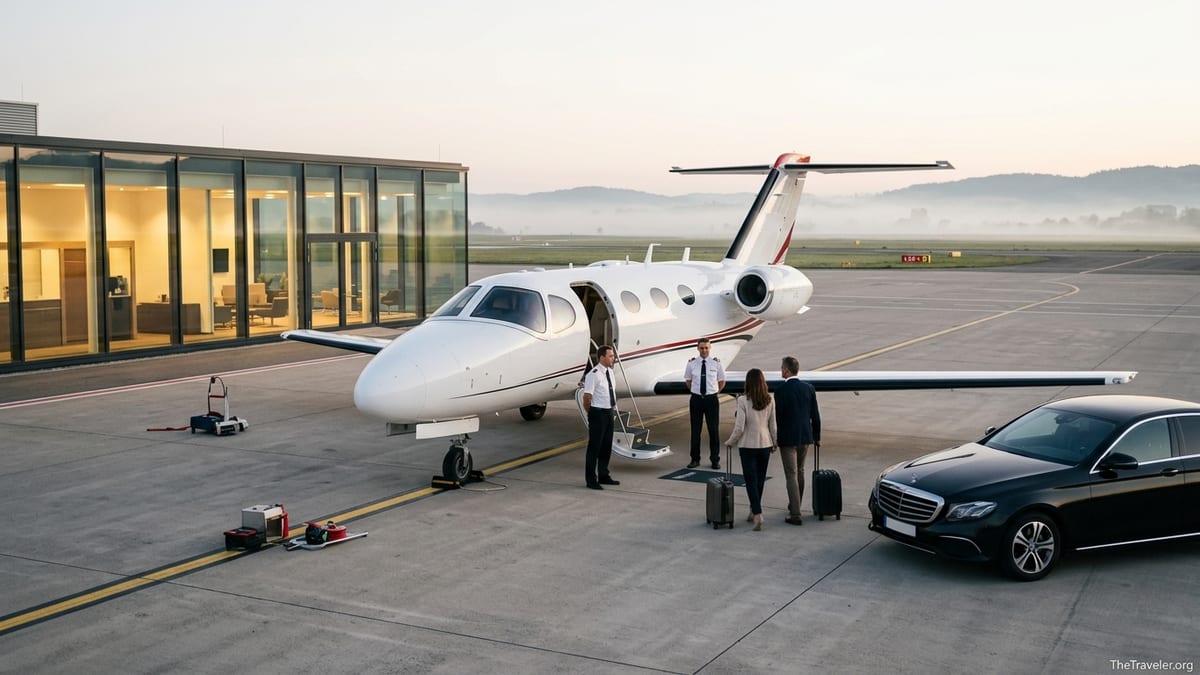
Who GlobeAir Serves and Where They Fly
GlobeAir is a European private jet operator founded in 2007 and based in Austria. The company focuses on short-haul business and leisure travel across Europe and nearby regions, rather than long-haul intercontinental routes. Industry publications list GlobeAir among Europe’s larger business jet operators by fleet size, with around 20 entry-level jets serving hundreds of airports across the continent. In practice, this means travelers can reach not only major hubs like London, Paris and Milan but also smaller airports closer to ski resorts, coastal retreats and secondary business centers.
The operator is known for specializing in the Cessna Citation Mustang, a compact four-passenger business jet that is efficient on short sectors such as Geneva to Nice or Milan to Zurich. These routes typically take under 90 minutes, making them popular with time-sensitive business travelers and weekend leisure passengers. Because the aircraft are smaller and optimized for short runways, GlobeAir can serve airports that many commercial airlines do not, such as Sion in Switzerland or Bolzano in Italy, which are convenient for Alpine resorts.
GlobeAir’s typical customer profile ranges from executives needing to visit multiple cities in a single day, to families heading to Mediterranean villas during peak summer weekends, to last-minute travelers filling empty legs when a jet needs to reposition. Many clients are based in financial centers such as London, Zurich, Frankfurt and Luxembourg, but the network extends to more than 900 accessible airports across Europe, depending on runway length and operating hours.
Importantly, GlobeAir is an operator rather than a pure broker. That means it owns and manages its core fleet, with consistent cabin layouts and service standards. For travelers, this translates into a more predictable onboard experience, especially if they fly repeatedly on similar routes. When larger aircraft or longer range is needed, GlobeAir can also arrange flights with partner operators, but the core proposition is built around its own Citation Mustang fleet.
From Idea to Instant Quote: How Booking Starts
For a first-time traveler, the process usually begins online. GlobeAir’s website and booking engine allow users to input departure and arrival airports, date, approximate time and passenger count to receive an instant price indication. For example, a traveler planning a same-day return from London Biggin Hill to Geneva for two passengers can enter both legs, see indicative timing and get a ballpark cost within seconds. Prices fluctuate based on demand, airport fees, positioning needs and peak periods, so quotes are indicative until confirmed by the sales team.
Behind the scenes, the system checks aircraft availability, estimated flight time, fuel, crew duty limits and airport restrictions. If a requested time conflicts with curfews at noise-sensitive airports, the quote tool may suggest alternative slots. On busy Fridays, a Geneva to Ibiza sector for a family of four in July will typically price higher than the same route on a Tuesday in May, reflecting seasonal demand and limited aircraft capacity.
Once a traveler is comfortable with the initial price, the next step is usually a callback or direct chat with a GlobeAir representative. At this stage, the discussion becomes more detailed: exact departure time, ground transfers, catering preferences and any special requests such as pets, sports equipment or child seats. A corporate client arranging a three-city roadshow, for example, might outline a schedule like Zurich to Paris, on to Amsterdam, then back to Zurich the same evening. The GlobeAir adviser will then propose a timed itinerary, check slot availability and confirm whether the plan fits within crew duty regulations.
For repeat travelers and jet card holders, the booking step is even simpler. With credit and identity details already on file, many regulars confirm flights via a brief email or phone call stating route, date and time. Because GlobeAir’s core fleet is standardized, a client booking a London to Milan trip knows exactly what cabin layout and service to expect without requesting aircraft photos for every flight.
Securing Your Flight: Payment, Jet Cards and Confirmation
Once the itinerary is agreed, GlobeAir issues a formal charter agreement and final price. The document outlines route, approximate flight time, aircraft type, departure and arrival airports, and key terms such as cancellation and delay conditions. For ad hoc charters, payment is generally required before departure, often via card or bank transfer. A business traveler booking a Vienna to Rome round-trip meeting might, for example, receive the agreement in the afternoon, sign electronically and settle payment the same day for a flight the next morning.
Frequent flyers often choose GlobeAir’s jet card product, which functions like a pre-paid balance of flight hours or credit. Under the jet card model described in GlobeAir’s own materials, members purchase a package that locks in hourly rates on the Citation Mustang and guarantees aircraft availability within a specified notice period, often 24 to 72 hours depending on the tier. For instance, a client who flies monthly between Munich and London may buy a jet card to secure more predictable pricing and priority access during busy seasons.
After payment or jet card authorization, the flight is confirmed, and GlobeAir’s operations team finalizes planning. This includes route selection, fuel planning, crew assignment and coordination with airports for handling and slots. The traveler receives a confirmation with departure time, airport details and the name of the fixed-base operator, or FBO, which is the private terminal they will use. On a London to Nice trip, the confirmation might specify London Luton Airport, Signature Flight Support FBO, with check-in requested 15 to 20 minutes before departure.
GlobeAir typically emphasizes a short arrival time before departure compared with commercial airlines. Instead of arriving two hours early, travelers are often asked to be at the FBO about 15 minutes before the scheduled takeoff. This is a key part of the value proposition, especially for executives moving between meetings, and it shapes the rest of the journey from ground access to security screening.
Before Takeoff: Airports, Private Terminals and Ground Experience
On the day of departure, the experience begins well before boarding. Rather than using a crowded airline terminal, GlobeAir passengers usually arrive at a dedicated FBO or private terminal. These facilities, operated by companies such as Signature, Jet Aviation or local handlers, provide discrete check-in desks, quiet lounges, meeting rooms and sometimes private parking directly adjacent to the building. A traveler departing from Zurich, for instance, might drive up to the general aviation terminal, leave the car with valet and be in the lounge within moments.
Check-in is typically straightforward. Passengers present identification, and staff verify names against the passenger manifest submitted earlier to GlobeAir. In Europe, passport and visa requirements remain in place even for private flights, so travelers flying from Paris to London still clear immigration, although the process is usually far faster than in commercial terminals. Security screening varies by airport. At some locations, passengers pass through a dedicated scanner inside the FBO; at others, security checks are conducted at the aircraft steps with manual bag inspections.
During this time, GlobeAir’s handling partners coordinate luggage loading, fueling and last-minute preparations. Because the Citation Mustang cabin is compact, weight and volume planning for luggage is carefully managed. In practice, a typical configuration accommodates about one medium suitcase and one small bag per passenger, suitable for a long weekend or short business trip. Travelers bringing bulky items such as golf bags or ski equipment are usually advised at booking to ensure space and weight limits are respected or to arrange courier services for oversize equipment.
Just before boarding, passengers receive a briefing on the expected flight time, weather en route and any turbulence. Unlike airline flights where passengers may feel disconnected from the crew, private jet captains often greet travelers personally in the lounge or at the aircraft door. On a Milan to Olbia holiday flight, for example, the pilot might introduce the co-pilot, confirm the arrival time in Sardinia and outline local weather conditions, giving passengers a sense of direct communication often missing from commercial travel.
On Board a GlobeAir Citation Mustang: Cabin and In‑Flight Service
GlobeAir’s fleet is built around the Cessna Citation Mustang, a very light jet with a four-seat club configuration in the main cabin. The layout places four leather seats facing each other around a small central space, which works particularly well for business discussions or family groups. The Mustang is designed for flights of around one to two hours, so the cabin focuses on comfort and practicality rather than long-haul amenities like flat beds. However, passengers benefit from generous legroom compared with most commercial business class seats, as well as a private, quiet environment.
In-flight service is tailored, but relatively informal compared with larger long-range private jets with dedicated flight attendants. On many GlobeAir flights, the two pilots handle passenger welcome and oversee catering, which is pre-loaded based on requests. A morning flight from Frankfurt to Paris might include freshly brewed coffee, juices and a light continental breakfast. An evening leisure flight to Palma de Mallorca might feature a chilled bottle of champagne, snacks and local delicacies arranged through catering partners at the departure airport.
Connectivity and entertainment are generally more limited than on wide-body airliners with full streaming Wi-Fi. The Mustang is optimized for efficiency and short hops, so some aircraft may not offer high-bandwidth internet on every route. Many business travelers treat this as focused work time, using laptops offline to prepare presentations and then reconnecting upon arrival. However, power outlets, adjustable lighting and individual air vents help create a comfortable work environment during the cruise phase.
Noise levels in the cabin are typically lower than on turboprop aircraft, though passengers will still hear the engines during takeoff and climb. Once at cruising altitude, conversation at normal volume is possible, which is particularly valuable for board members or legal teams who need to review confidential material. Curtains or doors between the cockpit and cabin provide additional privacy, although on smaller jets interaction with the crew remains easy and informal.
Behind the Scenes: Operations, Safety and Regulatory Oversight
From the traveler’s perspective, the flight may feel effortless, but GlobeAir’s operations team manages a complex set of technical and regulatory requirements in the background. As a licensed operator, GlobeAir must comply with European aviation regulations that govern aircraft maintenance, crew training, duty time limits and safety management systems. This regulatory framework is comparable in rigor to that faced by commercial airlines, although tailored to business aviation.
Before each flight, dispatchers review weather conditions, air traffic control constraints and alternate airports. A London to Geneva flight in winter, for example, may require contingency planning for snow at both departure and arrival, with alternates like Lyon or Basel identified in case of diversions. The company’s maintenance teams also track engine hours and component life cycles to ensure that each Mustang is scheduled for regular checks and inspections, often at specialized service centers.
Crew training is another critical element. Pilots typically hold airline transport or commercial licenses with type ratings specific to the Citation Mustang, and they undergo regular simulator checks to rehearse emergency procedures. Recurrent training covers scenarios such as engine failure after takeoff, rapid decompression and instrument approaches in poor visibility. Travelers do not see this work directly, but its impact is evident in consistent operational reliability and safety performance.
For multi-leg trips, operations staff monitor flight and duty time limitations to ensure pilots remain within legal and fatigue-safe limits. A corporate client wanting to visit four cities in one day may find that GlobeAir proposes an overnight stop or adjusted schedule to remain compliant. This sometimes surprises first-time private jet customers who assume a charter can operate without constraints, but the same safety principles that apply to airlines also govern private jet operations.
Arrival, Concierge Support and What Happens After Landing
One of the main advantages of private jet travel appears at the very end of the journey. Upon landing, GlobeAir’s aircraft usually taxi directly to a private apron or stand near the FBO. As soon as the engines shut down and the crew opens the door, passengers can step onto the tarmac and walk a few meters into the terminal, avoiding crowded buses or jet bridges. In destinations like Olbia, Ibiza or Nice during peak summer, this can save significant time compared with commercial arrivals.
Inside the private terminal, immigration and customs procedures are often handled at a dedicated desk. Passengers arriving from a non-Schengen country into the European Union, for example, present passports to border officers at the FBO rather than joining long queues in the main terminal. In many cases, luggage is unloaded directly to the passengers’ side within minutes. For a business traveler arriving in Geneva for a lunchtime meeting, the total time from touchdown to car door might be 10 to 15 minutes.
GlobeAir also promotes concierge-style services beyond the aircraft itself. Travelers can request hotel bookings, restaurant reservations or ground transfers as part of their flight planning. A client flying from London to Florence for an art weekend might ask GlobeAir to arrange a driver at Florence Airport, secure a table at a popular trattoria and coordinate a return transfer two days later. While such services may involve additional costs, they are integrated into the single point of contact provided by GlobeAir’s customer service team.
For frequent flyers, the post-flight phase is also when relationships deepen. Corporations often debrief with GlobeAir account managers about punctuality, ground handling quality and overall experience. Feedback from a series of flights, such as quarterly board meetings held alternately in Frankfurt, Milan and Vienna, may lead to refined preferences on catering, preferred FBOs or scheduled departure times for future charters. Over time, this relationship-building helps GlobeAir anticipate needs rather than simply respond to one-off requests.
The Takeaway
GlobeAir has built its business around making private jet charter feel approachable, especially for travelers focused on short European hops rather than ultra-long-haul luxury. The process from booking to landing is structured but straightforward: an online quote leads to a detailed conversation with a representative, a clear contract and payment, and then a highly streamlined airport and flight experience using efficient Citation Mustang jets. For time-poor executives, families seeking convenience, or travelers needing access to airports beyond airline networks, the value lies in flexibility and time saved rather than overt opulence.
At the same time, potential customers should understand that private jet travel operates within a serious regulatory and operational framework. Aircraft availability, crew duty limits, airport curfews and weather all influence what is realistically possible on any given day. Prices vary with demand, season and routing, and advance planning generally yields more options than last-minute requests. By approaching GlobeAir as a long-term partner rather than a one-off transport provider, frequent flyers can often secure more predictable pricing and a consistently tailored experience.
For travelers considering GlobeAir for the first time, a practical approach is to start with a simple route, such as a single-leg business trip between two European financial centers or a family weekend to a Mediterranean destination. Experiencing the full journey from private terminal check-in to quick arrival at a smaller regional airport helps clarify whether the time savings, privacy and flexibility justify the premium over commercial business class. For many who make that first trip, the combination of efficiency and personalized service quickly becomes part of their regular travel toolkit.
FAQ
Q1. How far in advance do I need to book a GlobeAir flight?
For ad hoc charters, many GlobeAir flights are booked a few days in advance, especially around busy periods such as summer weekends. However, same-day or next-day flights are often possible if an aircraft and crew are available. Jet card members typically benefit from guaranteed availability within a set notice period, such as 24 to 72 hours, which is specified in their contract.
Q2. How much does a typical GlobeAir flight cost?
Pricing depends on distance, date, time, airport fees and whether the aircraft needs to reposition. As a rough example, a one-way weekday flight for two to four passengers on a short European route like Geneva to Nice may cost in the low to mid five-figure range in euros, while longer or peak-season routes can be higher. Travelers receive a tailored quote for each itinerary rather than a fixed public price list.
Q3. How many people can travel on a GlobeAir jet?
GlobeAir’s core fleet of Citation Mustang aircraft seats up to four adult passengers in a club configuration. This makes the jets well suited for small executive teams, couples or families with one or two children. For larger groups, GlobeAir can help arrange flights on bigger aircraft through partner operators, although availability and pricing will differ from the standard Mustang offering.
Q4. Can I bring pets on board a GlobeAir flight?
In many cases, pets are allowed on GlobeAir flights, subject to prior agreement and adherence to destination regulations. Travelers must ensure that pet passports, vaccinations and any import paperwork are in order, particularly when crossing borders with strict animal health controls. It is important to mention pets at the time of booking so that the cabin can be prepared appropriately and any additional cleaning or handling arrangements can be made.
Q5. What kind of luggage can I bring on a Citation Mustang?
The Citation Mustang has limited but carefully planned luggage capacity, generally suitable for a medium suitcase and a small cabin bag per passenger on a full four-person flight. Bulky items like golf clubs or skis may fit only if the passenger load is lower or the bags are packed compactly. During the booking process, GlobeAir staff usually ask detailed questions about luggage to avoid surprises at the airport and may suggest courier services or alternative aircraft if space is an issue.
Q6. Is there Wi-Fi on GlobeAir flights?
Connectivity varies by aircraft and route. Some very light jets are not equipped with high-bandwidth internet, particularly on shorter European sectors where flight times are under two hours. Travelers requiring constant online access should raise this requirement when requesting a quote so GlobeAir can advise on the best solution, which may include using mobile networks near major urban areas or arranging an aircraft with installed connectivity where available.
Q7. How does security screening work for GlobeAir passengers?
Security depends on the airport but is generally more streamlined than in commercial terminals. At many European FBOs, passengers pass through a dedicated security checkpoint within the private terminal, with baggage scanning and personal screening conducted quickly and discreetly. In some smaller airports, checks may occur at the aircraft steps with manual inspection. Regardless of location, passengers must still comply with aviation security rules, though the experience is usually faster and more comfortable.
Q8. What happens if my schedule changes at the last minute?
One of the benefits of chartering with GlobeAir is flexibility. If a meeting runs late or an event is brought forward, departure times can often be shifted within the limits of crew duty time, airport opening hours and subsequent scheduling. Significant last-minute changes may incur additional costs, especially if they require overnighting the aircraft or altering positioning flights, so travelers are encouraged to communicate updates as early as possible.
Q9. How safe is flying with GlobeAir compared with commercial airlines?
As a regulated operator, GlobeAir must meet strict European safety standards covering pilot training, maintenance, operations and safety management. Pilots are type-rated on the Citation Mustang and undergo regular simulator checks and recurrent training. While no form of air travel is entirely without risk, the regulatory framework for business aviation in Europe is designed to provide a level of oversight and safety comparable in principle to that applied to commercial airlines.
Q10. Can GlobeAir help with hotels and ground transportation?
Yes, GlobeAir positions itself as more than just an aircraft provider and can arrange ground transfers, hotel bookings and restaurant reservations through its concierge-style services. For example, a traveler flying to a coastal resort can request a chauffeured car to meet the aircraft at the FBO and take them directly to their villa or hotel. These services are usually discussed and confirmed during the booking stage so that everything is coordinated by the time the aircraft lands.