

More news on this day
More than 70 flights at Sharjah International Airport have been cancelled or severely delayed after regional airspace closures linked to US and Israeli strikes on Iran, leaving hundreds of passengers stranded and rippling disruption across one of the world’s busiest aviation corridors.
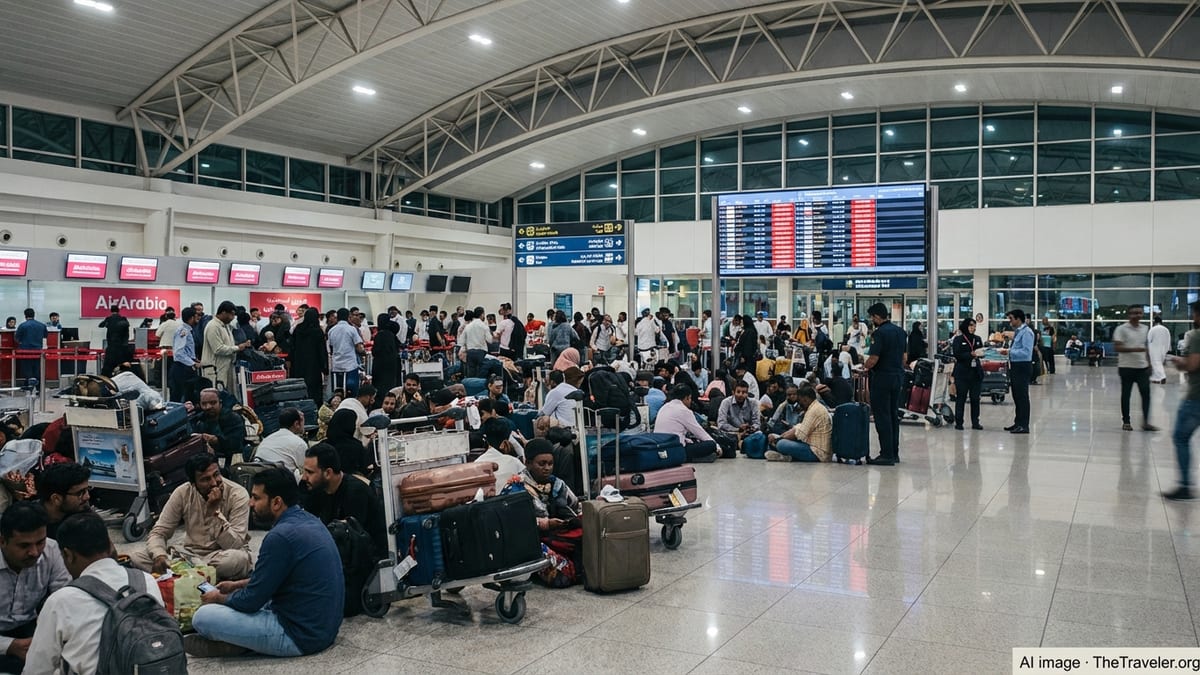
Sharjah Airport Brought to a Standstill
Sharjah International Airport, a key hub for low-cost and regional carriers in the United Arab Emirates, has seen its operations heavily curtailed since Saturday as authorities imposed a temporary and partial closure of UAE airspace. Airport officials confirmed that dozens of flights were cancelled or diverted over the weekend, with the tally now surpassing 70 affected services.
Terminal halls that normally hum with overnight traffic instead filled with confused and frustrated travellers sitting on the floor beside trolleys piled high with luggage. Airline desks reported lengthy queues as ground staff attempted to rebook passengers onto a limited number of future services or arrange hotel accommodation for those stuck overnight.
The disruption follows widespread missile and drone strikes in the Gulf region attributed to Iran’s retaliation for US and Israeli attacks, prompting aviation authorities across the Middle East to suspend or restrict flights over large swathes of airspace. With Dubai and Abu Dhabi also experiencing prolonged shutdowns, Sharjah’s role as an alternative gateway for budget-conscious travellers has been sharply constrained.
Sharjah Airport has urged travellers not to proceed to the terminal without first confirming their flight status directly with airlines. Officials stressed that safety of passengers and crew remains the overriding priority and said normal operations will resume only once authorities deem regional skies secure.
How Iran Strikes Led to Airspace Closures
The flight cancellations at Sharjah are part of a much broader aviation shock triggered by a sudden escalation in the Iran crisis. Following US and Israeli strikes on targets inside Iran late last week, Tehran launched waves of missiles toward key Gulf states, including the UAE, Kuwait, Qatar and Bahrain, as well as targets linked to Western military assets in the region.
In response, civil aviation authorities in Iran, Iraq, Israel, Jordan, Kuwait, Qatar and the UAE announced at least partial closure of their airspace to civilian traffic. Radar maps showed some of the world’s busiest flight corridors, which typically funnel Europe–Asia services through the Gulf, virtually empty as airlines scrambled to reroute or ground aircraft.
The UAE’s aviation regulator moved quickly to shut portions of the country’s skies on a temporary basis, citing “high risk” conditions for civil aviation. This decision forced airports in Dubai, Abu Dhabi and Sharjah to halt or sharply reduce operations, with carriers suspending departures and cancelling inbound flights that had not yet taken off.
Aviation safety agencies in Europe and elsewhere issued conflict-zone bulletins warning of heightened danger from potential missile activity, electronic interference and misidentification of civilian aircraft. Many airlines opted for conservative rerouting around the region, adding hours of flying time and forcing last-minute crew and fuel adjustments.
Airlines Suspend Services and Stranded Passengers Wait
Sharjah-based carrier Air Arabia has temporarily suspended many flights to and from the UAE, joining Emirates, Etihad Airways and Flydubai in announcing sweeping service halts or schedule reductions. International airlines from Europe and Asia have also cancelled or diverted flights that would normally pass through the Gulf, compounding the backlog.
For travellers, the result has been a wave of uncertainty. At Sharjah, families returning from school holidays, migrant workers heading back to jobs in the Gulf, and transit passengers en route between Asia and Africa all found themselves caught in limbo. Some waited through the night on terminal benches, clutching printed itineraries that were suddenly meaningless.
Airline staff reported difficulty in finding near-term alternatives, as seats on remaining long-haul services via alternative routings quickly sold out. With hotels in Sharjah and nearby Dubai filling up, some stranded passengers faced the prospect of sleeping at the airport while waiting for clarity on when flights might resume.
Travel insurers and consular services have been fielding a growing number of calls from affected customers and citizens. While many policies cover delays and cancellations due to security events, claims processes can be complex, and officials have cautioned that rapidly changing conditions may affect entitlements and timelines.
Regional and Global Ripple Effects on Air Travel
The shutdown at Sharjah forms part of a wider aviation gridlock across the Middle East. Data from flight tracking and analytics firms indicate that thousands of flights have been cancelled or delayed globally since the strikes, with hub airports in Dubai, Abu Dhabi and Doha among the hardest hit.
Because the Gulf region functions as a central junction between Europe, Asia, Africa and Australasia, disruption there quickly cascades through airline networks worldwide. Aircraft and crews are out of position, connecting passengers miss onward legs, and airlines are forced to run recovery flights or reposition empty aircraft to restart schedules once airspace reopens.
Industry analysts say that if airspace restrictions are lifted within days, most airlines can absorb the shock, albeit at considerable cost. Extended closures, however, would mean sustained detours around the Gulf, higher fuel burn, elevated insurance premiums and a tightening squeeze on already thin margins, especially for carriers reliant on high-frequency connections via Middle Eastern hubs.
The crisis also arrives at a time when some airlines are still rebuilding networks after the pandemic and grappling with aircraft delivery delays and crew shortages. Prolonged instability in the Gulf could force long-term schedule changes and trigger fare volatility on popular Europe–Asia and South Asia–North America routes.
What Sharjah Passengers Should Do Now
Travellers scheduled to fly into or out of Sharjah in the coming days are being advised to treat their itineraries as provisional. Airlines have urged customers to check flight status on official channels before leaving for the airport, and to ensure that contact details in bookings are up to date so they can receive rebooking options or notifications by text and email.
Passengers already stranded at Sharjah Airport are being directed to airline service desks for assistance with rebooking, meal vouchers and, where available, hotel accommodation. Capacity, however, is stretched, and priority is often being given to vulnerable travellers such as families with young children, the elderly and those with urgent medical or visa constraints.
Experts recommend that passengers keep receipts for any out-of-pocket expenses such as additional hotel nights or local transport, which may be needed for insurance claims later. Those travelling on tight schedules, including for work or study, are being encouraged to explore alternative routings that avoid the Gulf entirely, even if this involves longer journeys via Europe, Central Asia or Africa.
With no firm timeline yet for full restoration of normal air traffic across the region, aviation authorities and airlines are urging patience. For hundreds of travellers stuck in Sharjah’s terminal, however, the priority is far more immediate: finding a route home, or onward, as one of the world’s busiest air corridors remains partly closed above them.