


More news on this day
Sharjah International Airport is experiencing a fresh wave of operational disruption that has resulted in three flight cancellations and 67 delays, affecting regional passengers traveling on both low-cost and full-service airlines across the Middle East network.
Get the latest news straight to your inbox!
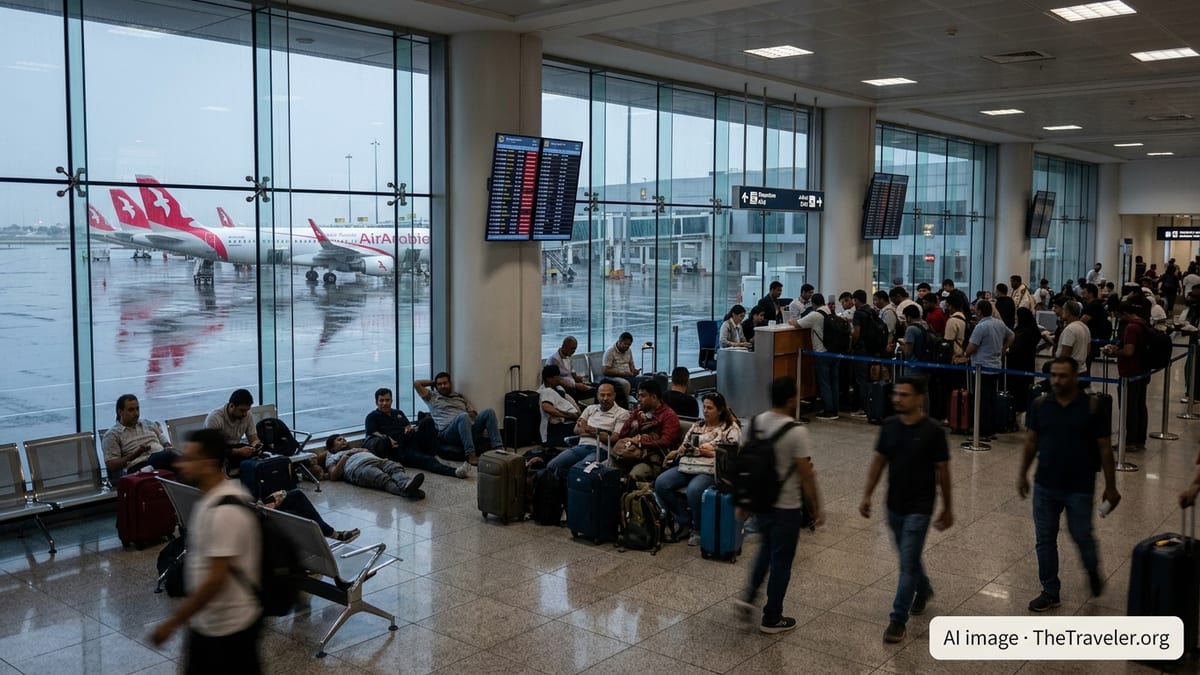
Operational strain during peak summer travel
The latest disruption has emerged just as Sharjah International Airport enters one of its busiest periods of the year, with peak summer traffic building across July and August. Publicly available planning data indicates the airport expects around three million passengers and some 19,000 flight movements over these two months, placing additional pressure on runway capacity, apron space, and terminal operations.
Against this backdrop, the three cancellations and 67 delays reported across the airport’s schedule underscore how tight operating margins can magnify even modest disruptions. When aircraft rotations are heavily optimized, a single late inbound arrival can ripple through the network, creating knock-on effects for subsequent departures.
Industry analysis of previous regional disruption patterns shows that Sharjah’s role as a secondary hub to nearby Dubai increases its exposure to wider Middle East airspace constraints. When routes are reconfigured or traffic stacks around congested corridors, network carriers often absorb schedule slippage at airports like Sharjah, where multiple narrowbody turnarounds are planned in quick succession.
The latest episode appears to follow a similar pattern, with a relatively small number of outright cancellations contrasted by a much larger volume of late departures and arrivals that signal system-wide congestion rather than isolated operational failures.
Budget and full-service carriers hit across multiple routes
Sharjah is a critical base for regional low-cost operators, particularly Air Arabia, and also serves as a spoke for full-service airlines such as Qatar Airways and other Gulf and South Asian carriers. Flight listings and recent schedule data show departures to key markets including India, Pakistan, the broader Gulf, and North and East Africa, all of which rely heavily on narrowbody aircraft operating tightly timed rotations.
The three cancellations are understood to be spread across regional routes linking Sharjah with neighboring hubs, where airlines enjoy the option to consolidate frequencies or reroute passengers through alternative gateways. By contrast, the 67 delays have been distributed more widely across the timetable, impacting a mix of early-morning departures, mid-day banks, and late-night return services commonly favored by migrant workers and price-sensitive leisure travelers.
For low-cost carriers, where aircraft utilization is maximized to contain fares, each delay can quickly consume built-in buffer time and prompt minor re-timings on subsequent sectors. Full-service airlines, while often operating fewer daily frequencies from Sharjah, face their own challenges when delays undermine connectivity at their home hubs, complicating onward connections and baggage transfers.
Recent monitoring of flight movements across the wider region also points to an environment already under strain from elevated traffic and lingering airspace restrictions. In this context, Sharjah’s disruption is part of a broader pattern that has seen several Middle Eastern gateways manage sporadic spikes in delays and schedule changes during 2026.
Knock-on impacts for passengers and regional connectivity
The immediate effect for travelers has been extended waiting times at departure gates, rescheduled boarding, and last-minute gate changes as airlines work to re-sequence aircraft and crews. Travel forums and publicly shared passenger accounts describe crowded holding areas and busy customer service desks as carriers adjust itineraries to accommodate missed or tightly timed connections.
For passengers using Sharjah as a stop on long itineraries between Europe, the Indian subcontinent, and Southeast Asia, even modest delays can result in overnight layovers or forced rebooking. Low-cost transfer passengers, who often construct their own itineraries using separate tickets, are particularly exposed, as they may not be automatically protected on the next available flight when a delay causes them to miss a connection.
From a broader network perspective, the episode illustrates how localized disruption can erode regional connectivity. When carriers trim frequencies or consolidate flights to recover punctuality, some smaller destinations can temporarily lose direct service, pushing travelers onto longer or more expensive routings via alternate hubs such as Dubai or Abu Dhabi.
Analysts note that Sharjah’s extensive point-to-point network, while efficient under normal conditions, offers fewer built-in redundancies than larger mega-hubs. Once disruptions cascade across multiple rotations, the airport’s airlines have limited spare capacity to absorb affected passengers without resorting to schedule reshuffles and selective cancellations.
Airport preparedness, resilience and passenger guidance
Sharjah International Airport has previously highlighted its focus on operational readiness for the 2026 summer peak, outlining measures such as enhanced terminal staffing, expanded self-service facilities, and close coordination with ground handlers to keep turnaround times as tight as possible. Recent public communications from airport and airline stakeholders across the UAE have also emphasized contingency planning in light of evolving regional airspace dynamics.
Aviation specialists point out that airports facing heavy seasonal surges increasingly rely on real-time data tools to track aircraft flows and predict delay propagation. By modeling how disruptions at one gateway can affect others, operators are able to preemptively adjust stand allocations, gate assignments, and runway use to minimize cascading knock-on effects.
Travel advisories focusing on the Middle East have for several months flagged the possibility of intermittent delay patterns across key hubs, including Sharjah, particularly during high-demand travel windows. Passengers are frequently encouraged in such guidance to monitor flight status regularly, arrive early at the airport, and build additional buffer time into tight connections, especially when traveling on separate tickets or mixing low-cost and full-service carriers.
The current wave of cancellations and delays at Sharjah offers a practical demonstration of why such precautions matter. With three flights removed from the schedule and 67 affected by timing changes, the episode serves as a reminder that even highly optimized airport operations remain vulnerable to external pressures and that individual travelers benefit from conservative planning when navigating the region’s busy skies.