


If you are planning a trip to Florence, chances are the Duomo is already on your must-see list. The striped marble facade, Brunelleschi’s dome and Giotto’s bell tower dominate almost every postcard of the city. Yet just behind the cathedral complex sits a quieter heavyweight: the Opera del Duomo Museum (Museo dell’Opera del Duomo). Many visitors skip it in favor of a quick walk through the cathedral or a dome climb. The question is whether you should carve out precious time in your Florence itinerary for this museum too.
Get the latest updates straight to your inbox!
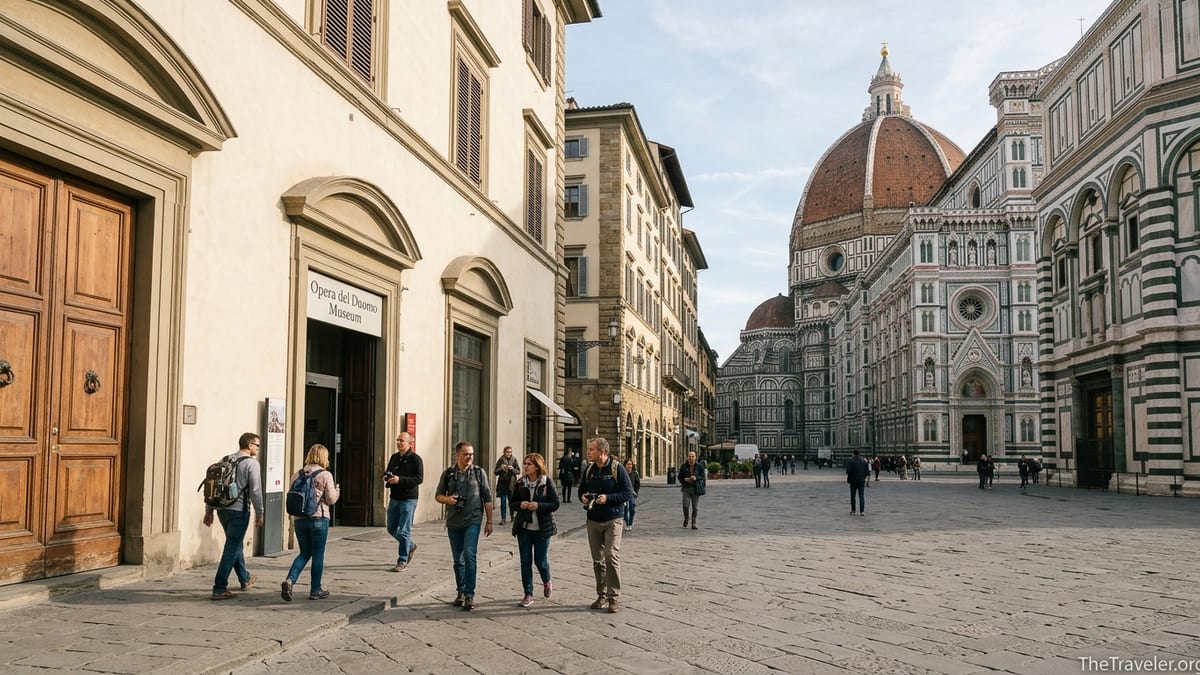
What Exactly Is the Opera del Duomo Museum?
The Opera del Duomo Museum is the museum of the Florence Cathedral complex. It holds the original sculptures, reliefs and architectural elements that were created over seven centuries for the Duomo, the Baptistery of San Giovanni and Giotto’s bell tower. Instead of leaving masterpieces outside in the weather, Florence gradually moved them indoors and replaced them with copies. The museum is where the real treasures live.
Completely renovated and expanded in 2015, the museum spreads over about 6,000 square meters and 28 rooms on three floors. The layout is designed as a narrative of how the cathedral precinct was conceived and built, from medieval foundations to Renaissance engineering. You do not need an art history degree to follow along; clear signage, models and panoramic displays make it approachable even if you are simply a curious traveler.
Practically speaking, the museum sits just behind the Duomo, on the east side of the piazza. Many visitors walk right past its understated entrance on Via della Canonica without realizing what is inside. If you already have a pass for the Duomo complex, visiting usually does not cost extra, but it does cost time and attention. That is what this article will help you decide how to invest.
In 2026 the museum typically opens daily around 8:30 am and closes around 7 pm, with last entry an hour before closing and a closure on the first Tuesday of each month. Hours can shift on religious holidays or for special events, so it is smart to double-check the current schedule just before your trip.
The Must-See Highlights Inside
What convinces many travelers to add the Opera del Duomo Museum is its concentration of world-class works in a calm environment. One of the showstoppers is the wall of monumental doors from the Baptistery, including Lorenzo Ghiberti’s famous gilded "Gates of Paradise." Up close, you can see details of the Old Testament scenes that are impossible to appreciate when you are in a crowded piazza, staring at weathered copies several meters away.
Another emotional high point is Michelangelo’s unfinished Bandini Pietà, a large marble group in which the sculptor depicted himself as the bearded figure supporting Christ. According to many historians, Michelangelo attempted to destroy this work in frustration, and the visible fractures and rough surfaces convey that tension. Seeing it from just a few steps away in the museum has a very different impact than ticking off the more famous David at the Accademia in a packed gallery.
The museum also houses Donatello’s haunting wooden "Penitent Magdalene" and his vibrant marble and bronze reliefs from the bell tower. Nearby you can compare Donatello’s choir loft panels with those by Luca della Robbia, a side-by-side encounter that brings Renaissance innovation into focus. Travelers who might find the Uffizi’s endless sequence of paintings overwhelming often appreciate that the Opera del Duomo’s collection is more focused and three-dimensional.
One of the most impressive spaces is a huge hall containing a full-scale reconstruction of the cathedral’s original medieval facade, which no longer exists outside. Statues of prophets, saints and Madonna figures stand in the niches they once occupied on the front of the Duomo. If you have just walked around the present-day facade in Piazza del Duomo, stepping into this room feels like time travel. It is a tangible demonstration of how Florence repeatedly reimagined its cathedral to reflect shifting tastes and politics.
How Much Time and Money Will It Add?
On the financial side, the Opera del Duomo Museum is rarely a budget-breaker if you are already planning to visit other parts of the cathedral complex. In 2026, single-admission tickets are less common; instead, most visitors buy one of three passes: the Brunelleschi Pass (which includes all sites plus the dome climb), the Giotto Pass (all main sites except the dome) or the Ghiberti Pass (museum, Baptistery and cathedral crypt, with no climbs). Typical adult prices range roughly from the mid-teens in euros for the Ghiberti Pass up to around 30 euros for the Brunelleschi Pass.
If you choose any of these passes, you will not pay extra at the door to enter the museum. The real cost is time. A focused visit can be done in 60 to 90 minutes if you concentrate on the major highlights and keep a steady pace. Travelers who enjoy reading detailed panels or using audio guides may easily spend two hours or more. Compared with a dome climb that can take 90 minutes door to door in high season, the museum is a relatively efficient use of your ticket.
One factor to consider is value per site. Many visitors who buy a Duomo complex pass end up skipping at least one included attraction, either because they run out of energy or because time slots fill up. The museum is fully flexible within your pass validity period and rarely has long lines, so it is more likely you will use that portion of your ticket. In contrast, missing your reserved dome climb time slot can mean losing a substantial part of what you paid for.
For comparison, an independent traveler in 2026 might pay around 25 to 30 euros for timed Brunelleschi Pass access to the dome, bell tower, Baptistery, museum and crypt. A one-hour small-group dome climb tour sold by private operators will often cost at least that much by itself, sometimes significantly more. If you are already paying for the pass, skipping the museum means leaving part of that investment on the table.
Who Will Love the Opera del Duomo Museum Most?
Art and history enthusiasts are the most obvious candidates. If you have ever wanted to understand how Brunelleschi built his dome without modern scaffolding, the museum’s scale models, drawings and tools turn that engineering puzzle into something you can visualize. Travelers who enjoyed the Uffizi or Bargello often describe the Opera del Duomo as the missing piece that helps tie Florence’s artistic story together.
However, you do not have to be a museum person to appreciate it. Couples on a short city break, for example, often split their time so that one day is dedicated to the Duomo area and the other to the Oltrarno or Santa Croce. Spending the hottest mid-afternoon hours inside this air-conditioned space can be both a practical and pleasant way to avoid the sun while still sightseeing. Families with teens who might be impatient in queues find that the museum offers more immediate visual impact than standing in line for the cathedral interior.
Travelers who dislike crowds may actually enjoy the museum more than the cathedral itself. Entry to the cathedral nave is free, which means long security lines and a slow-moving stream of people through the interior. By contrast, access to the museum is controlled through ticketing. Even in peak summer, rooms often feel calm enough that you can stand in front of a particular sculpture for several minutes without being jostled.
Finally, the museum is particularly rewarding if you are staying in Florence for more than one full day. Someone on a single day trip from Rome or a cruise ship may reasonably prioritize just walking the piazza, visiting the Baptistery and, if possible, climbing the dome. Once you have three nights or more in the city, though, the museum becomes one of the highest value additions to the classic itinerary.
Practical Tips for Fitting It Into Your Day
The easiest way to include the Opera del Duomo Museum is to cluster it with your other Duomo-related activities in a single morning or afternoon. For example, many travelers book the earliest possible dome climb or bell tower slot, then recover from the stairs over a leisurely coffee in a nearby bar before continuing to the Baptistery and finally the museum. This approach keeps you in one compact area and minimizes backtracking across town.
Another strategy is to schedule the museum for the hottest part of the day. Summer afternoon temperatures in Florence often push well above 30 degrees Celsius, and the stone piazzas amplify that heat. Stepping into a well-lit, climate-controlled gallery around 2 pm can be a relief. Because the museum usually admits visitors continuously rather than with strict time slots, you have more flexibility than with the dome or tower.
If your pass is valid for multiple days, you do not have to do everything in one go. Some travelers will climb the dome or bell tower and see the Baptistery on the first day, then return late the next afternoon just for the museum. This can make the experience feel less rushed. Before separating your visits, though, check the official calendar for any days when the museum might close earlier than the rest of the complex, such as religious celebrations or maintenance days.
One detail worth noting is logistics around bags. Larger backpacks and suitcases are not allowed inside the monuments, and there is a cloakroom on or near Piazza del Duomo used for the complex. Because that cloakroom sits close to the museum entrance, it can be convenient to plan your museum visit either just after dropping bags or just before picking them up if you are arriving or departing by train the same day.
Comparing It to Florence’s Other Big Museums
Travelers often ask whether, if they already have the Uffizi and Accademia on their list, they really need another museum. The answer depends on what you want from your Florence experience. The Uffizi is the place for paintings: Botticelli’s "Birth of Venus" and "Primavera," works by Leonardo and Raphael, and corridor after corridor of canvases. The Accademia’s main draw is Michelangelo’s David, with a supporting cast of unfinished "Prisoners" and some medieval art.
The Opera del Duomo Museum fills a different niche. Its pieces were created specifically for the architecture you see outside. When you stand under Brunelleschi’s dome and later see the wooden models and original tools in the museum, the building stops being just a pretty backdrop and becomes a feat of human problem-solving. Likewise, recognizing a saint’s statue in a museum display and then spotting its weathered copy on the cathedral facade turns the whole piazza into a kind of open-air gallery.
If your time is short and you must make cuts, you might consider your priorities. A first-time visitor who has just one full day may decide that the Uffizi and a dome climb offer enough art and views. But once you have two or three days, the museum often outranks secondary attractions like the Medici chapels or smaller churches in terms of how much it deepens your understanding of the Duomo, which you will see constantly anyway.
Real-world itineraries reflect this. Many people now structure three-day Florence stays with one day focused on the Duomo and its museum, one day for the Uffizi and a stroll across the Ponte Vecchio, and one day mixing the Accademia with quieter neighborhoods like the Oltrarno. In those plans, the Opera del Duomo Museum is not an extra; it is one of the anchors.
When It Might Not Be Worth Your Time
There are situations in which skipping the Opera del Duomo Museum is a reasonable choice. If you are overnighting in Florence only because your train or flight connection demands it, and you have just a few free hours, you may prefer to simply walk the historic center, grab a gelato near Piazza della Signoria and enjoy the Duomo from outside. In that case, waiting in line to enter the cathedral or booking a dome climb might also be unrealistic, and a museum visit could feel rushed.
Visitors traveling with young children who have limited patience for galleries may also decide to prioritize more open-air experiences. For a toddler or very young child, spotting the Duomo from Piazzale Michelangelo at sunset, or running around Piazza Santa Croce, is often more memorable than quietly viewing sculpture indoors. Some families report that their children lasted happily in the museum for only about 30 to 45 minutes before losing interest.
If your budget allows for only one or two paid attractions in Florence, you might reasonably place the Accademia or Uffizi ahead of the Opera del Duomo Museum. While the Duomo museum is excellent, the city’s identity in global imagination is heavily tied to paintings like "The Birth of Venus" and to the statue of David. If you leave Florence without having seen either, you might feel you have missed something uniquely associated with the city.
Finally, if you have a strong fear of missing out on viewpoints, and the only way to secure a dome or tower climb for your dates is to buy a more expensive guided tour that already includes a brief museum stop, it can make sense to rely on that bundled visit rather than planning a separate, longer exploration. Your goal in that case is the climb and the panoramas rather than a deep dive into the collection.
The Takeaway
For most travelers spending at least two full days in Florence, the Opera del Duomo Museum deserves a firm place on the itinerary. It gives you close, uncrowded access to masterpieces that you only glimpse from afar in the piazza, and it turns the cathedral complex from a scenic backdrop into a story you can follow. Because entry is typically included in the main Duomo passes, the added cost is measured in time and attention, not in extra euros at the door.
If you deeply value understanding the places you visit, or if you simply prefer art experiences that are less congested than Florence’s blockbuster museums, the Opera del Duomo Museum will likely be one of your Florence highlights. On the other hand, travelers with very limited time, small children or a strong preference for outdoor experiences may reasonably choose to admire the Duomo from the square and reserve their museum energy for the Uffizi or the Accademia.
As you shape your own itinerary, look at when you will already be in the Duomo area and where the hottest or most crowded parts of your day will fall. Often, you will find that setting aside 60 to 90 minutes for the Opera del Duomo Museum is an easy adjustment that pays off disproportionately in insight and enjoyment.
FAQ
Q1. Is the Opera del Duomo Museum included in Duomo tickets or passes?
The museum is generally included in the main Duomo complex passes such as the Brunelleschi, Giotto and Ghiberti passes, so most visitors do not pay extra at the door.
Q2. How long should I plan for a visit to the Opera del Duomo Museum?
Most travelers should allow at least 60 to 90 minutes. Art lovers who like to read labels or use an audio guide may want up to two hours.
Q3. Is the Opera del Duomo Museum suitable for children?
It can be, especially for older children and teens interested in art or history, but younger kids may tire after 30 to 45 minutes, so plan a shorter, highlight-focused visit.
Q4. Can I visit the museum without seeing the rest of the Duomo complex?
In practice most visitors purchase a pass that covers several sites, but if you are short on time you can concentrate your use of the pass on the museum and one or two other monuments.
Q5. What is the best time of day to visit the Opera del Duomo Museum?
Late morning and mid-afternoon are often comfortable times. Many travelers prefer mid-afternoon in summer to escape the heat and crowds in the piazza outside.
Q6. Do I need to book a time slot specifically for the museum?
The Duomo passes usually require time slots for climbs like the dome or bell tower, but the museum itself often operates with more flexible entry. Always check the current rules when you buy your pass.
Q7. Is the museum accessible for visitors with limited mobility?
The redeveloped museum was designed with accessibility in mind and offers elevators and step-free routes to most galleries, though it is wise to confirm details close to your visit.
Q8. Will I see different things in the museum compared with inside the cathedral?
Yes. The cathedral interior offers the vast space and frescoed dome, while the museum displays many of the original sculptures, doors and reliefs that were removed for protection.
Q9. If I have only one day in Florence, should I prioritize the Opera del Duomo Museum?
With just one day, many visitors prioritize a dome or tower climb, a walk around the historic center and possibly one major museum. The Opera del Duomo Museum is a worthwhile addition if you can spare 60 to 90 minutes.
Q10. Is there an audio guide or tour available inside the museum?
The museum typically offers audio guides and is frequently included in small-group Duomo complex tours, which can help you make sense of the highlights in limited time.