


More news on this day
Travelers using New York’s LaGuardia Airport are facing hours-long disruptions after a sinkhole discovered near a main runway forced operations onto a single strip, triggering widespread delays and cancellations across one of the region’s busiest domestic hubs.
Get the latest news straight to your inbox!
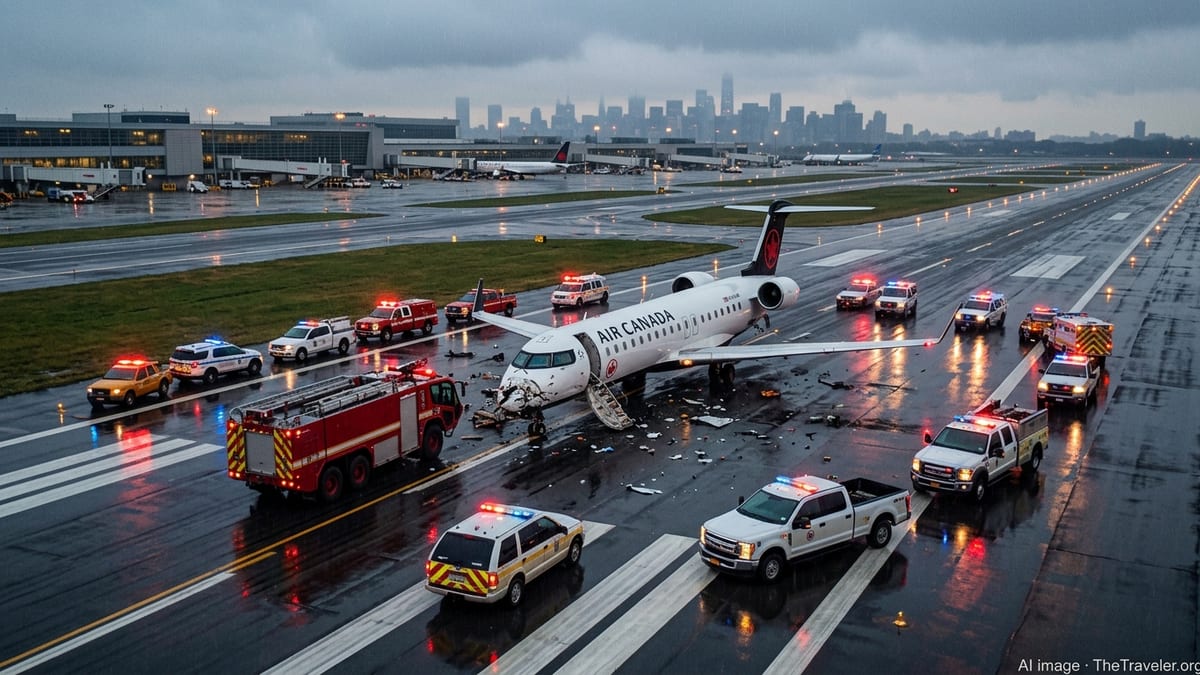
Runway 4/22 Closure Cuts Capacity and Strands Travelers
Publicly available information indicates that the sinkhole was identified late Wednesday morning near Runway 4/22 during a routine airfield inspection, prompting an immediate closure of the runway. LaGuardia operates with just two runways, so the shutdown effectively cut the airport’s capacity roughly in half at the height of a busy travel period.
Reports from flight-tracking services show that hundreds of flights were affected as operations were consolidated onto Runway 13/31. Some carriers shifted departure times, while others canceled services outright, leading to crowded terminals and long lines at rebooking counters as passengers scrambled for alternate routes into and out of New York City.
Data compiled by aviation outlets and flight-monitoring platforms on Wednesday and Thursday point to delays frequently stretching well past an hour, with some departures held on the ground at origin airports under a formal ground delay program. The disruption rippled across airline networks, with knock-on delays reported at major connecting hubs throughout the United States and Canada.
For travelers, the operational constraints translated into missed connections, extended tarmac waits, and overnight stays as airlines worked through backlogs. Social media posts from passengers described extended gate holds and rolling departure times while crews waited for clearance into the restricted LaGuardia arrival flow.
Repairs Underway as Cause of Sinkhole Investigated
According to published coverage, construction and engineering teams were dispatched to the affected area shortly after the sinkhole was found. Heavy equipment and repair crews have been working along the taxiway and runway shoulder adjacent to 4/22, removing damaged pavement and stabilizing the underlying ground to make the surface safe for aircraft operations.
Airport operator updates indicate that emergency repairs were prioritized in order to reopen the runway as quickly as conditions safely allow. Early timelines suggested that at least one full day of curtailed capacity was expected, with the prospect that some restrictions could extend into the following morning while inspections and testing continued.
The precise cause of the sinkhole has not yet been detailed in official public documents. Infrastructure experts note that sinkholes at airports can be linked to a range of issues, including subsurface erosion, aging drainage systems, or voids created by water main breaks or utility work beneath the pavement. Recent reports highlight that the New York City area did not experience significant heavy rain in the days immediately preceding the incident, suggesting that factors other than short-term weather may be under review.
Until the investigation determines the source of the ground failure, engineers are expected to focus on reinforcing the affected section and conducting detailed surveys to ensure there are no additional weak spots near active movement areas used by aircraft.
Stormy Weather Compounds Flight Disruptions
The sinkhole’s impact on LaGuardia’s schedules coincided with unsettled weather in the New York region, a combination that significantly complicated air traffic management. Based on Federal Aviation Administration advisories summarized in media reports, thunderstorms in the area led to additional spacing between flights, reducing the rate at which aircraft could safely land and depart.
With only one runway accepting traffic and weather periodically closing arrival and departure windows, airlines had limited flexibility to recover delayed flights. Some carriers proactively scrubbed later departures, while others held aircraft on the ground at origin cities until slots into LaGuardia became available, a process that further extended delays for travelers already en route.
Industry analysts note that LaGuardia is particularly vulnerable to operational shocks due to its compact layout and dense schedule. Even minor disruptions can quickly cascade through daily operations, and a structural issue affecting a runway or taxiway can take far longer to resolve than a routine weather delay. The timing of this sinkhole, on the cusp of the busy summer travel period and ahead of major events in the city, has heightened attention on the airport’s resilience.
Airline schedule data show that flights between LaGuardia and major Canadian gateways, including Toronto and Montreal, experienced especially notable disruptions, illustrating the airport’s importance not only for domestic U.S. traffic but also for short-haul transborder routes.
What Travelers Can Expect in the Coming Days
As repairs proceed, publicly available advisories emphasize that travelers heading to or from LaGuardia should prepare for continued schedule adjustments, even after Runway 4/22 returns to service. Residual delays are likely while airlines reposition aircraft and crews and work through passengers affected by the initial wave of cancellations.
Travel publications and consumer advocates recommend that passengers monitor their flight status closely through airline apps, sign up for mobile alerts, and build extra time into connections involving LaGuardia. Same-day standby options, rebooking through alternative New York area airports, and flexible work or event plans may help mitigate the disruption for those with time-sensitive trips.
Airport contingency planning documents indicate that carriers at LaGuardia typically coordinate gate use and share facilities during major events that constrain runway availability. That coordination appears to be in effect as airlines shuffle aircraft between gates, extend boarding times, and adjust turnarounds to match available runway slots.
For now, the sinkhole has brought renewed attention to the aging but heavily traveled airfield, underscoring how a localized pavement failure can trigger systemwide impacts on air travel. Travelers heading through LaGuardia over the next several days are being urged, through airline advisories and news reports, to remain flexible and to check their itineraries frequently.