

More news on this day
A sinkhole discovered beside a key runway at New York’s LaGuardia Airport has forced its closure, triggering widespread delays and cancellations just as the busy spring travel period intensifies.
Get the latest news straight to your inbox!
Runway 4/22 taken out of service after routine inspection
Publicly available information indicates that the disruption began late Wednesday morning, when airfield crews conducting a standard daily inspection around 11 a.m. identified a depression near Runway 4/22, one of LaGuardia’s two runways. The affected area was close enough to the pavement used for takeoffs and landings that airport operators ordered the runway shut while engineers assessed the damage.
Reports describe the problem as a sinkhole adjacent to the runway, rather than a simple surface pothole, prompting emergency construction activity and the deployment of heavy equipment to expose and stabilize the underlying ground. Images shared by local media show excavation work underway near the runway edge as crews remove damaged material and prepare the site for repairs.
According to published coverage, the closure effectively cut LaGuardia’s capacity roughly in half during one of the busiest travel weeks of late May. With only a single runway available, air traffic into and out of the land-constrained airport had to be tightly metered, immediately slowing operations and pushing flights into holding patterns or onto longer taxi queues on the ground.
Airport statements cited in local and national reports indicate that the runway is expected to remain closed for at least several days while work continues, with reopening targeted once engineers are satisfied that the subgrade is stable and the pavement can safely handle aircraft loads.
Hundreds of flights delayed or canceled at New York hub
The runway shutdown quickly cascaded into a major operational disruption across LaGuardia’s network. Flight-tracking data summarized in multiple news reports show that by late Wednesday and into Thursday, hundreds of flights had been delayed or canceled as airlines adjusted schedules to reflect the reduced capacity.
Reports from aviation data services suggest that the number of cancellations and significant delays climbed into the high hundreds once the combined impact of the sinkhole and passing thunderstorms was fully felt. Carriers consolidated frequencies, rerouted some services to other New York–area airports, and in some cases preemptively scrubbed flights to avoid stranding crews and aircraft.
Travelers connecting through LaGuardia experienced some of the sharpest impacts, as missed connections and tighter arrival windows left little slack in airline networks. Social media posts highlighted passengers spending hours on board waiting for takeoff or at the terminal as new departure times repeatedly slipped.
Federal air-traffic management programs compounded the slowdown but were widely described as necessary. Publicly available information from aviation authorities indicates that a formal arrival metering program was put in place, spacing flights more widely and limiting the number allowed to depart for LaGuardia during peak periods in order to avoid gridlock in the skies above New York.
Weather and recent safety concerns add to disruption
The sinkhole emerged against a backdrop of unsettled weather and heightened scrutiny of LaGuardia’s airfield. Thunderstorms moving through the New York region on Wednesday and Thursday already threatened to slow operations, and the loss of a runway sharply reduced the airport’s ability to absorb those weather-related constraints.
Analysts note that even modest storms can severely limit how many flights a tightly packed airport such as LaGuardia can handle at once. With only one runway available, controllers had fewer options for sequencing arrivals and departures, magnifying the impact of each storm cell and lengthening the time needed to clear backlogs once heavy rain and low clouds passed.
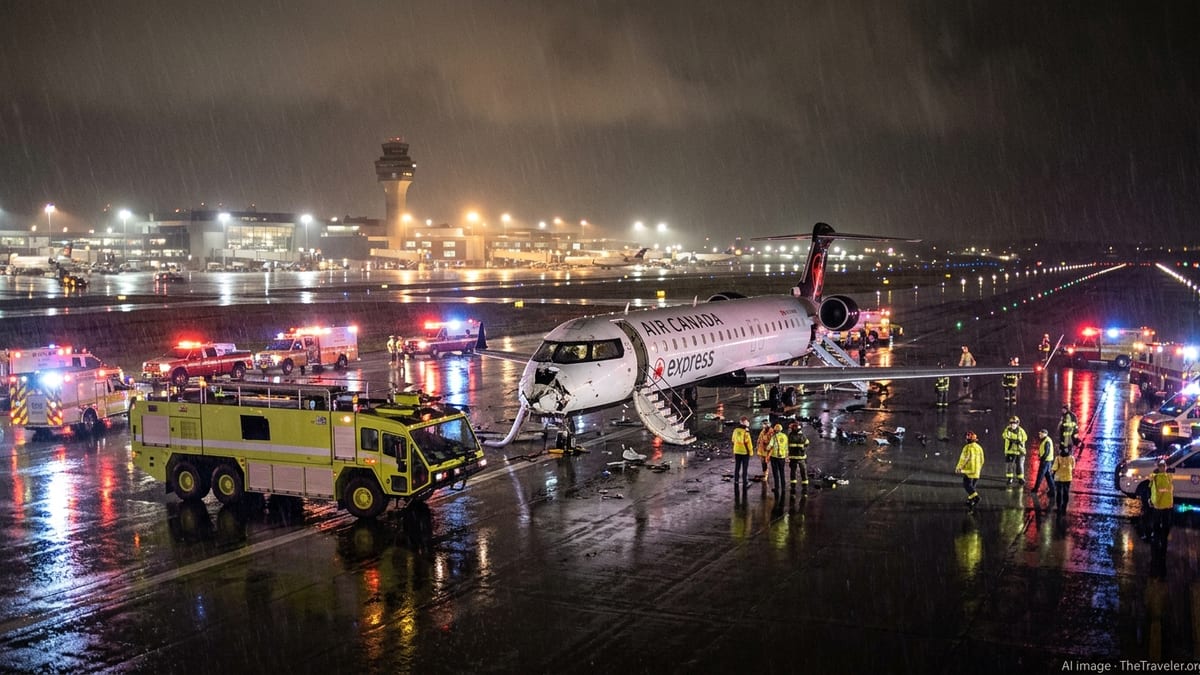
The closure also comes only two months after a high-profile crash on the same runway, when an Air Canada Express flight collided with a Port Authority fire truck, resulting in fatalities among emergency personnel and temporarily shutting the airfield. While that incident is unrelated to the sinkhole, the proximity in time has renewed public attention on the resilience and safety of LaGuardia’s infrastructure.
Published commentary from aviation observers points out that LaGuardia’s coastal location and history of land reclamation can complicate ground stability, drainage and long-term pavement performance. The discovery of a sinkhole near an active runway has fueled fresh debate over how aggressively aging airfields should be inspected and reinforced in an era of increasingly intense weather and heavy traffic.
Advice for travelers navigating the LaGuardia disruption
Airlines are urging passengers booked to or from LaGuardia over the coming days to build in extra time and to assume that schedules may change on short notice. Based on public advisories, many carriers have issued flexible travel waivers, allowing affected customers to rebook trips without change fees, shift to alternative airports in the region, or move travel to later dates when operations are expected to stabilize.
Travel experts interviewed in media coverage recommend that passengers monitor their flight status frequently, ideally through airline apps that push real-time notifications of delays, gate changes and cancellations. For those with tight connections, rebooking to direct flights or to routes through less constrained hubs can reduce the risk of being stranded mid-journey.
At the terminals, reports indicate that lines at customer service desks and rebooking counters have grown quickly at peak times, particularly in the late afternoon and evening bank of departures. Travelers who are able to resolve changes through digital channels, or who proactively contact airlines as soon as disruption notices appear, are more likely to secure scarce seats on alternative flights.
Ground transportation in and out of the airport has also felt the impact, with ride-hail queues and taxi stands periodically crowded as passengers abandon delayed flights or reroute to other airports. Regional rail and intercity bus services into New York have reported additional demand from travelers seeking last-minute alternatives.
Spotlight on infrastructure resilience at major U.S. airports
The LaGuardia sinkhole is drawing renewed attention to the vulnerability of key transportation hubs to localized infrastructure failures. While the damaged area at Runway 4/22 appears limited, the decision to close the strip illustrates how even a relatively small problem in the wrong place can sharply constrain a complex airport system.
Aviation and infrastructure analysts cited in recent coverage note that many U.S. airports are managing heavier traffic on infrastructure originally built for smaller aircraft and fewer flights. Subsurface erosion, aging utilities, and drainage challenges can all contribute to sudden failures that are difficult to predict, particularly at coastal or low-lying fields.
Recent federal and state funding packages have directed billions of dollars toward airport modernization, including runway rehabilitation, improved stormwater systems and upgraded monitoring technologies. The situation at LaGuardia is likely to feature in ongoing discussions about how those funds are prioritized, especially for airports with limited space to build redundancy into their runway layouts.
For travelers, the incident serves as a reminder that disruption at a single critical node can rapidly ripple across the national air network. As LaGuardia works to repair the damaged ground and restore full operations, airlines and planners are again confronting how to balance efficiency with resilience at one of the country’s most constrained and strategically important airports.