


More news on this day
A new “Destination Climate RiskScan” report released on 18 November 2026 to coincide with tourism discussions at COP31 in Antalya concludes that rising extreme heat and wildfire risks are already reshaping where and when people travel in Europe, with Greece highlighted as a frontline case for Mediterranean tourism under climate stress.
Get the latest news straight to your inbox!
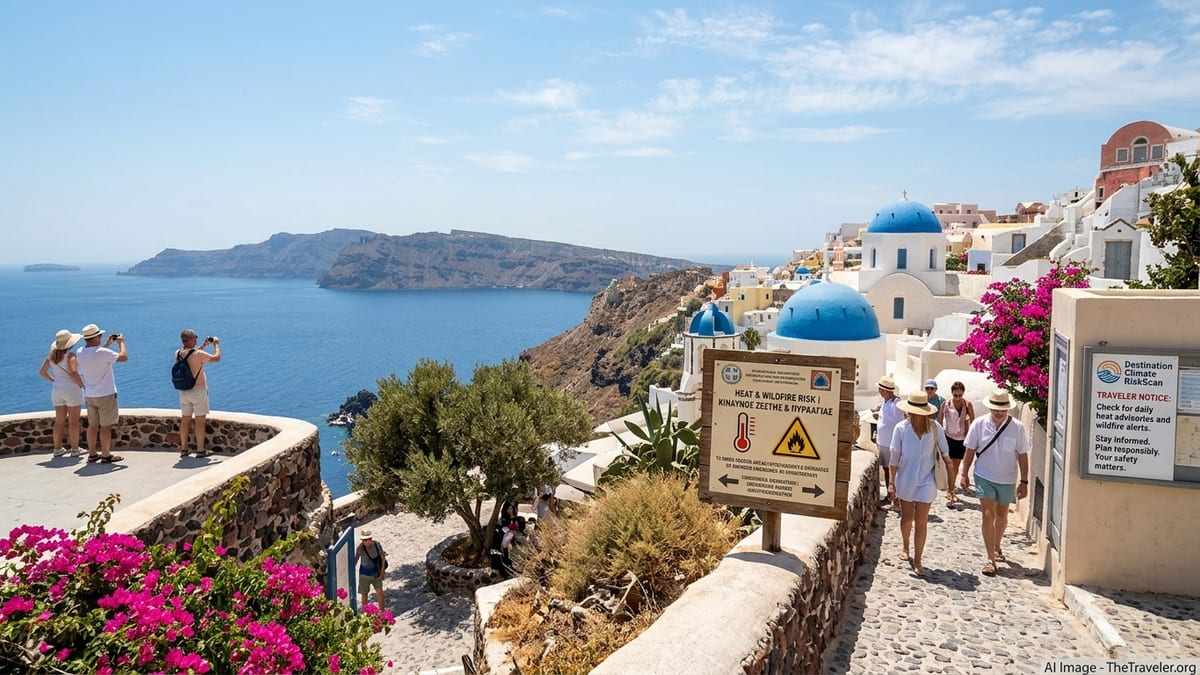
Fresh global assessment links climate risk and tourism decisions
The Destination Climate RiskScan initiative is a joint project between NGO Travel Forward, risk science firm Risklayer and the Centre of Expertise Leisure, Tourism & Hospitality, which brings together Dutch academic institutions focused on tourism and sustainability. The partners describe it as a global, evidence-based assessment of destinations’ exposure to climate hazards and their readiness to adapt, with a specific focus on tourism suitability.
The report, published on 18 November 2026 alongside COP31’s tourism day, presents first global results and an online platform where destinations can explore climate exposure indicators such as extreme heat, wildfire probability, flooding and sea-level rise. The authors emphasise that the work builds on existing climate science but translates it into metrics and scenarios designed for tourism planners, tour operators and destination managers rather than climate specialists.
RiskScan does not offer league tables of “safest” and “riskiest” destinations, but instead combines hazard projections with vulnerability and adaptive capacity indicators to show how risk profiles differ between regions and over seasons. The project team notes that the methodology is undergoing independent scientific review, and the current release is described as an early global overview ahead of a fuller platform launch expected in 2027.
Greece in focus as peak-summer heat and fire risk intensify
Within Europe, the report points to Greece as a prominent example of how repeated heatwaves and wildfire seasons are influencing tourism planning. Greece experienced its longest recorded heatwave in July 2024, with 16 consecutive days of extreme heat, according to the National Observatory of Athens, and has since seen further intense summers with wildfire outbreaks affecting several islands and mainland regions.
Drawing on interviews and case material, RiskScan cites some tour operators that have already stopped offering package holidays to parts of Greece in August, explicitly linking these choices to guest comfort during extreme heat and perceived wildfire risk. The report does not state that this applies across the sector, but uses these examples to illustrate how climate exposure is beginning to affect commercial scheduling and product design in specific markets.
The authors stress that overall visitor numbers to Greece remain high and that coastal and island destinations continue to attract strong demand. However, they argue that the combination of hotter peak months, longer fire seasons and pressure on emergency services means that both public authorities and private operators are increasingly treating climate as a central operational risk, from evacuation planning to heat-health messaging for tourists.
Pattern changes across Mediterranean Europe, not a collapse
The RiskScan findings are set against wider European evidence that extreme heat and wildfires are altering travel patterns rather than ending demand for traditional sun-and-sea holidays. Recent reports from the European Commission, the Copernicus climate services and the Joint Research Centre show that Mediterranean regions have experienced record sea and air temperatures, an expansion of heatwave days and above-average burned areas in multiple recent summers.
Tourism-focused analysis by the OECD and others has highlighted that heatwaves, drought and wildfires are disrupting tourism operations while also encouraging some travellers to re-time their trips away from the hottest weeks or to consider cooler coastal and northern destinations. A 2024 survey by the European Travel Commission found that a majority of European respondents reported adjusting their travel behaviour in response to climate change, with a notable minority saying they would avoid destinations during periods of extreme temperatures.
RiskScan situates Greece alongside Mediterranean peers such as Spain and Portugal, where wildfire seasons in recent years have affected resort areas and rural tourism zones. The report notes growing concern among travel businesses about wildfire exposure in parts of these countries and links this to increased interest in shoulder-season marketing, earlier booking windows outside August and contingency plans for high-risk periods.
What the shift means for travellers and tour operators
For travellers, the main practical implication highlighted by the new report is a gradual shift in the “safe and comfortable” peak season, especially for heat-sensitive visitors. Instead of assuming that July and August are default months for Mediterranean holidays, RiskScan suggests that more travellers are considering June, September and October, or opting for northern and higher-altitude destinations in mid-summer, particularly when travelling with children or older relatives.
Tour operators and destination managers cited in the study are responding in several ways, including experimenting with earlier or later charter schedules, revising excursion timetables to avoid midday heat, updating pre-travel information on heat and smoke, and mapping out evacuation and communication protocols for wildfire events. Some businesses are also looking at diversifying products geographically, adding cooler coastal or inland options alongside traditional island packages during the hottest weeks.
The report underlines that these developments represent risk management and adaptation within a still-growing tourism economy rather than an abrupt retreat from Mediterranean travel. Greece, Spain and Portugal continue to feature among Europe’s most visited destinations, but the timing, marketing and on-the-ground management of trips are evolving as operators respond to the realities of a warming climate.
Next steps: data, adaptation planning and what travellers should check
The Destination Climate RiskScan team plans to expand its destination coverage and refine indicators ahead of a fuller public platform launch in 2027, while seeking feedback from tourism authorities and industry groups on how best to integrate climate risk data into planning and investment decisions. The methodology is expected to be updated as new climate observations and models become available and as more evidence emerges on how tourists and businesses adapt in practice.
In the meantime, the authors encourage destinations to use emerging climate risk information to review peak-season capacity, shade and cooling infrastructure, fire management strategies and communication with visitors. They point to recent EU climate resilience reporting, which shows sharp increases in burned area and heat extremes in 2025 and 2026, as a reminder that past norms may no longer be a reliable guide for future summers.
For individual travellers planning European holidays, the practical takeaway is to pay close attention to travel dates, local heat and fire advisories and any updated safety guidance from tour operators or accommodation providers, particularly for August trips to Mediterranean destinations. Checking flexible booking options, understanding cancellation and disruption policies related to extreme weather, and considering shoulder-season alternatives are among the steps that can help align holiday plans with a rapidly changing climate risk landscape.