


More news on this day
Spain is moving into the front line of Europe’s new biometric border controls, joining Romania, Greece, Hungary, Italy, the Netherlands, Poland and other Schengen states in rolling out the Entry Exit System that is transforming how non-EU travelers are processed at airports and other external borders.
Get the latest news straight to your inbox!
A New Phase For Schengen Travel
The European Union’s Entry Exit System, or EES, is being introduced in stages across the Schengen Area, replacing traditional passport stamps for most non-EU visitors with a centralised biometric database. Publicly available information shows that the system formally entered into operation on 12 October 2025, with member states given several months to progressively activate it at all external border crossing points.
The EES is designed to record each entry and exit of so-called third-country nationals using fingerprints and a facial image alongside passport details and travel dates. European Commission material describes it as part of the broader Smart Borders package, intended to tighten migration management, improve security checks and automate the calculation of permitted short stays within the bloc.
According to legislative summaries and national guidance, the aim is that by April 2026 all air, sea and land external borders of the Schengen zone will routinely register eligible travelers through the system. This includes not only long-established Schengen states, but also newer members such as Romania and Bulgaria, as well as countries closely integrated with Schengen rules.
Airports have emerged as the main testing ground, with many states opting to start with automated kiosks and upgraded e-gates at major hubs before extending the technology to ferry ports, international rail stations and road checkpoints.
Spain’s Airports Join The Biometric Border Network
Spain is now among the countries moving from pilot testing to wider operational use of the EES at key entry points. Technical notices and government publications from neighbouring administrations indicate that Spanish authorities have initially concentrated on Madrid Barajas Adolfo Suárez Airport, where EES processes have been trialled ahead of broader deployment.
Reports from aviation groups and passenger organisations describe a growing network of EES kiosks and adapted e-gates in Spanish terminals, configured to capture fingerprints and facial images from non-EU travelers on their first post-implementation visit. Subsequent trips are expected to be quicker, as biometric and identity data will already be stored in the shared system.
Spain’s position as one of Europe’s top tourist destinations means its experience is being closely watched. Industry analyses highlight that Spanish airports handle high volumes of visitors from the United Kingdom, the Americas, North Africa and Asia, all of whom fall within the primary target group for EES registration.
Local travel and airport associations have warned that peak-season congestion is likely until passengers and border staff adapt to the new routines. However, they also point to long-term benefits, including faster automated processing once initial enrollment is complete and better tools for identifying overstays and forged documents.
How Romania, Greece, Hungary, Italy, The Netherlands And Poland Are Implementing EES
Spain is not alone in this transition. Romania and Bulgaria, which became full Schengen members for all modes of travel in 2025 after air and sea border checks were lifted earlier, are required to operate the EES at their external borders. Coverage from European institutions notes that their airports have been integrating the system as part of a broader shift from national to Schengen-level border databases.
Southern Schengen states including Greece and Italy, heavily reliant on tourism and with extensive maritime borders, are focusing first on major international airports before expanding to busy ferry ports serving non-Schengen routes. Public guidance from consular and transport authorities describes the rollout as progressive, allowing infrastructure upgrades and staff training to be phased in over several months.
In Central and Eastern Europe, Hungary and Poland are adapting land and air border crossings where they handle significant flows from neighbouring non-EU states. Industry and government information indicates that new EES kiosks and biometric capture points are being installed alongside existing manual booths, with some crossings configured in a hybrid mode to manage both enrolled and not-yet-enrolled travelers during the transition period.
The Netherlands has moved particularly quickly at its main hub, Amsterdam Schiphol. Official Dutch guidance states that entry and exit checks at the border are now recorded digitally and that, for many passengers, passport stamping has already been replaced by EES registration. Similar patterns are emerging in other Northern and Western European states, leading to a patchwork of early adopters and slower movers within the common framework.
Biometric Borders And The Risk Of Longer Queues
While European agencies promote the EES as a way to streamline checks, early experience suggests that the initial impact for travelers is often the opposite. Airport associations have reported significant increases in processing times where full biometric capture is required, especially during busy periods when many passengers are enrolling for the first time.
Analyses from aviation industry bodies describe scenarios of queues stretching through terminal corridors, with some travelers facing waiting times of more than an hour at peak. The need to capture fingerprints from multiple fingers and obtain a usable facial image for each traveler, sometimes repeated when the first attempt fails, has added extra steps compared with traditional visual passport inspections.
The situation is particularly sensitive at major tourist gateways in Spain, Italy and Greece, where seasonal surges coincide with higher shares of non-EU holidaymakers. Travel trade groups and consumer organisations have raised concerns that, without further investment in staff, equipment and clear passenger information, the system could undermine the region’s reputation for easy, friction-light travel.
European-level assessments point out that the EES is also a prerequisite for the separate European Travel Information and Authorisation System, or ETIAS, which is expected to start later in 2026. The combination of pre-travel authorization and on-arrival biometric checks is intended to create a more controlled entry pipeline but may add additional layers of complexity for infrequent visitors.
What Non-EU Travelers Should Expect At Schengen Airports
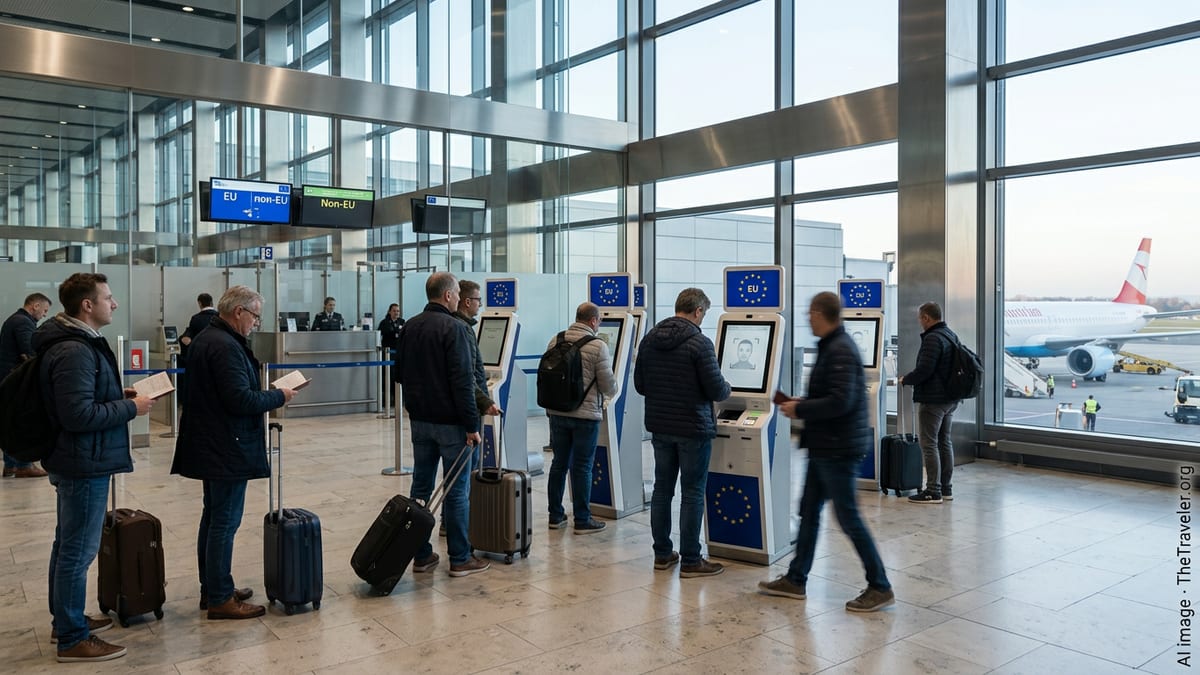
For visitors arriving in Spain and other Schengen states operating the EES, the most visible change is likely to be at the first border checkpoint. Instead of proceeding directly to a staffed booth, passengers may be directed to self-service kiosks where they scan their passport, have their face photographed and place their fingers on a reader.
Travel advice circulated by governments and expatriate organisations stresses that this process is mandatory for most non-EU, non-Schengen nationals who are not holders of long-term residence permits. Once registered, their movements in and out of the Schengen Area will be recorded automatically, and the system will use these records to calculate whether they respect the standard 90 days in any 180-day rule for short stays.
At airports in Spain, the Netherlands, Italy, Greece, Hungary and Poland, border lines may be split between passengers who must enroll in EES and those who are already in the database. Industry guidance suggests that people should allow extra time for border formalities, particularly during the early months of the rollout, and follow local signage, which may differ between terminals and countries.
Commentary from aviation and tourism groups indicates that, over time, the EES could enable more widespread use of fully automated e-gates and risk-based screening, potentially restoring or even improving throughput compared with the pre-biometric era. For the moment, however, Spain’s decision to move forward alongside a growing group of European partners signals that travelers should be prepared for a period in which crossing Schengen’s external borders becomes more high-tech, but also more time-consuming.