


More news on this day
Dozens of passengers traveling between Buenos Aires and northeastern Argentina faced hours of disruption this weekend as widespread delays and cancellations rippled through Aeroparque Jorge Newbery, Ministro Pistarini International Airport, and Libertador General José de San Martín Airport, with reports indicating at least 43 delayed services and 13 cancellations affecting Aerolíneas Argentinas and low-cost carrier Flybondi.
Get the latest news straight to your inbox!
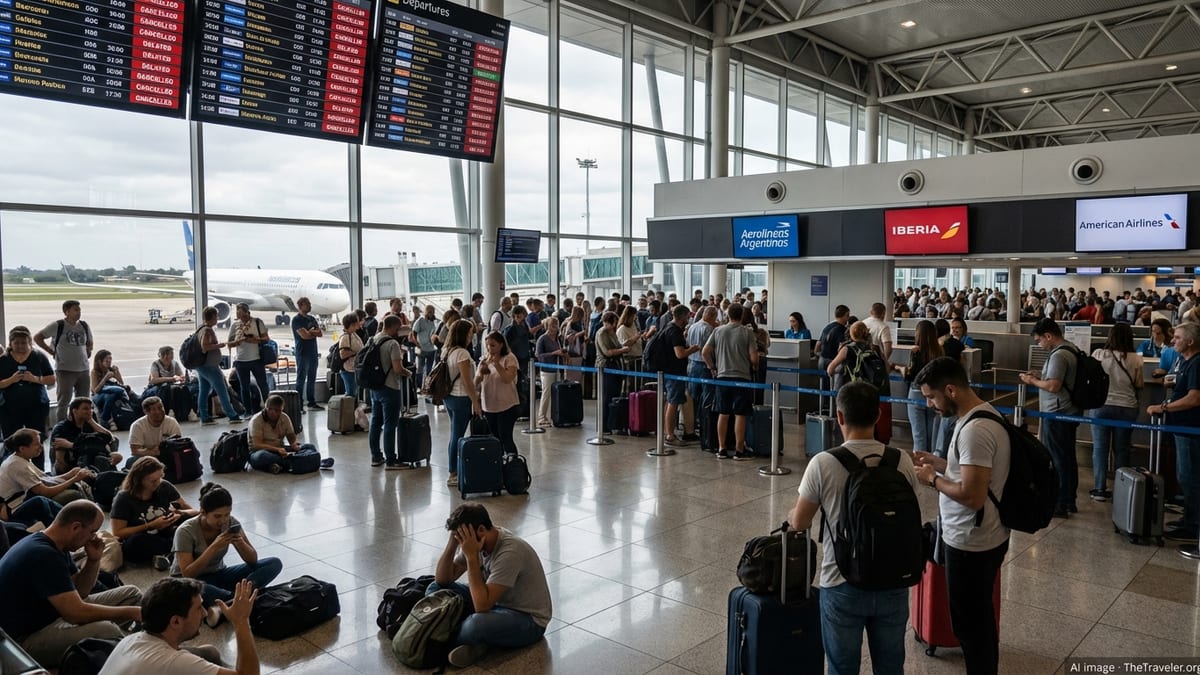
Disruptions Hit Key Buenos Aires and Northeast Corrientes Routes
According to live flight tracking data and local coverage on Sunday, May 17, extensive disruptions affected domestic services linking Buenos Aires with cities across Argentina, including routes serving Corrientes and Posadas. Aeroparque Jorge Newbery and Ezeiza’s Ministro Pistarini, the country’s two main hubs for Aerolíneas Argentinas and Flybondi, registered clusters of delayed departures as the day progressed, with schedules showing pushed-back departure slots and rolling knock-on effects on later services.
Flights operating between Aeroparque and northeastern destinations such as Corrientes and Posadas, which is served by Libertador General José de San Martín Airport, were among those impacted. Publicly available flight-status boards showed Buenos Aires departures to the region leaving behind schedule and some return legs either retimed or removed from the schedule entirely. The pattern mirrored wider operational strain across the domestic network, with delays often exceeding an hour.
At the regional end, passengers at Libertador General José de San Martín Airport and other northeastern gateways experienced corresponding disruption as incoming aircraft from Buenos Aires failed to arrive on time. With many services structured as out-and-back rotations from the capital, a single delayed departure from Aeroparque or Ezeiza often translated into late-night or canceled returns further north.
While the specific causes varied by flight, the concentration of delays and cancellations over a relatively short window created a ripple effect that left travelers struggling to rebook and rearrange onward plans, particularly those using Buenos Aires as a domestic connection point following or preceding long-haul international flights.
Aerolíneas Argentinas and Flybondi Bear the Brunt
Aerolíneas Argentinas, which operates dual hubs at Aeroparque Jorge Newbery and Ministro Pistarini International Airport, accounted for a large share of the affected services, based on real-time tracking for flights scheduled between Saturday evening and Sunday. Several Aerolíneas Argentinas flights into and out of Aeroparque showed departure and arrival times slipping well beyond their original slots, aligning with a broader pattern of operational congestion on busy weekend travel days.
Flybondi, Argentina’s largest low-cost carrier and a significant operator on domestic routes from both Aeroparque and Ezeiza, was also prominently affected. Recent months have seen increased scrutiny of the airline’s reliability, with publicly available statistics and passenger reports highlighting elevated rates of schedule changes, cancellations, and extended delays across parts of its network. Those issues appeared to intersect with Sunday’s disruptions, with multiple Flybondi services on key trunk routes from Buenos Aires showing altered timings or canceled sectors.
Industry data and previous regulatory notices indicate that both carriers are operating in a challenging environment, with tight aircraft utilization and limited spare capacity. Under those conditions, even minor technical checks, crew-rotation issues, or congested airspace can cascade quickly through the day’s roster, especially when fleets are heavily committed on high-demand domestic corridors such as Buenos Aires to the northeast.
For travelers, the combination of flag carrier and low-cost disruptions meant fewer alternative options, particularly on short-notice same-day rebooking. With both Aerolíneas Argentinas and Flybondi central to domestic connectivity, many passengers found themselves competing for limited seats on the remaining on-time services or being moved to flights late in the evening or the following day.
Passengers Confront Long Waits and Uncertain Connections
The immediate impact for those on the ground at Aeroparque, Ezeiza, and Libertador General José de San Martín Airport was a familiar one: crowded boarding areas, growing queues at service desks, and departure boards dominated by red "demorado" and "cancelado" notices. Travelers attempting to reach Corrientes and surrounding provinces faced particularly acute uncertainty, as a canceled outbound sector often eliminated the day’s only convenient non-stop option.
Public comments and social media posts on Sunday described families with children waiting for hours for updated departure times, business travelers attempting to salvage same-day meetings, and international passengers concerned about missing long-haul connections. Many turned to airline apps and third-party flight trackers to monitor moving departure estimates as official boards refreshed only periodically.
The knock-on effects extended beyond the airports themselves. Ground transportation operators reported higher-than-usual late-night demand as disrupted travelers sought last-minute accommodation or attempted to reach alternative airports by road. In some cases, passengers opted to abandon their original itineraries altogether, purchasing same-day bus tickets for overnight journeys to Corrientes and other northeastern destinations rather than waiting for a new flight.
Uncertainty over compensation and rebooking policies added another layer of frustration. While Argentina’s aviation regulations outline passenger rights in cases of significant delay or cancellation, understanding the specific entitlements and navigating online claim processes can be complex, especially for foreign visitors with limited Spanish-language proficiency.
Operational Strain Highlights Structural Challenges
The wave of delays and cancellations underscored structural pressures in Argentina’s domestic aviation market, particularly on routes radiating from Buenos Aires. Aeroparque Jorge Newbery has expanded its list of national and regional destinations in recent years, while Ezeiza maintains a heavy mix of international and domestic operations. This densification has improved connectivity but also left carriers vulnerable to disruption when fleet or staffing constraints arise.
Public reports and previous analyses of airline performance in the country have pointed to high utilization of narrowbody fleets, limited slack in daily schedules, and a dependence on a small number of aircraft to maintain busy route maps. For low-cost carriers like Flybondi, the business model hinges on keeping jets flying as many hours as possible, which can limit flexibility to absorb unforeseen delays without cascading impacts.
Weather also remains a recurring risk factor, particularly in shoulder seasons when fast-changing conditions can restrict operations at one airport while leaving others unaffected. Although Sunday’s disruption pattern appeared primarily operational rather than meteorological, aviation analysts have long argued that layers of vulnerability frequently intersect on Argentina’s most heavily traveled corridors, amplifying the consequences for passengers when several issues occur simultaneously.
Regulatory bodies have in recent years taken a closer interest in service reliability and passenger treatment, issuing notices that clarify airlines’ obligations around cancellations, rerouting, and assistance. However, the persistence of large-scale disruption events suggests that deeper changes in fleet planning, scheduling buffers, and contingency resources may be required if domestic carriers are to offer a consistently resilient service on critical links such as Buenos Aires to Corrientes.
What Travelers Should Watch in the Coming Days
For those planning travel through Aeroparque Jorge Newbery, Ministro Pistarini International Airport, or Libertador General José de San Martín Airport in the coming days, aviation observers recommend close monitoring of flight status and allowing extra time for connections. With some aircraft and crews out of position following Sunday’s irregular operations, residual delays are possible as airlines work to realign schedules.
Travelers connecting from international long-haul services into domestic flights to Corrientes and neighboring provinces may be particularly exposed. Industry experience suggests that after a day of heavy disruption, early-morning rotations on Monday can proceed relatively smoothly, but mid-morning and afternoon waves sometimes see renewed delays if overnight recovery has been incomplete.
Those with flexible plans are increasingly advised by travel agents and consumer advocates to consider slightly longer layovers between international arrivals and domestic connections within Argentina, especially when traveling during busy weekends or regional holiday periods. Alternative routings, including flying into Buenos Aires a day earlier than strictly necessary or using overland connections when schedules appear fragile, can provide a margin of safety for time-sensitive trips.
While Sunday’s episode again highlighted the vulnerability of Argentina’s domestic air network to concentrated disruption, it also reaffirmed the central role of Buenos Aires and key northeastern gateways in the country’s mobility. With demand for travel to and from Corrientes and surrounding regions remaining strong, attention in the days ahead is likely to focus on how effectively Aerolíneas Argentinas, Flybondi, and other operators restore confidence by stabilizing punctuality on these strategically important routes.