


More news on this day
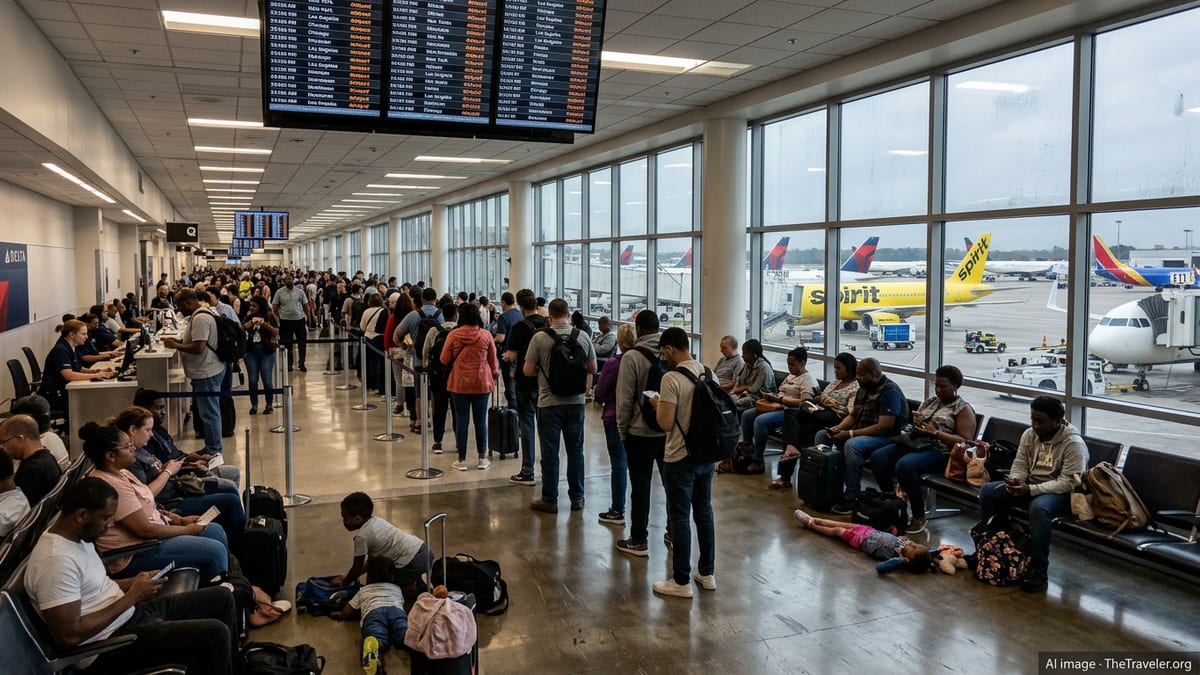
Delta Air Lines is facing a fresh operational crisis after a Federal Aviation Administration ground stop triggered mass cancellations at its primary hub in Atlanta, where more than half of scheduled departures were reportedly scrubbed in a matter of hours.
Get the latest news straight to your inbox!
Ground Stop Brings Nation’s Busiest Hub to a Standstill
Publicly available flight-tracking data and airline status boards show that Hartsfield-Jackson Atlanta International Airport, Delta’s largest hub and one of the world’s busiest airports by passenger volume, experienced an abrupt collapse in normal operations following the latest ground stop order. The restriction, issued by the Federal Aviation Administration to halt or severely limit departures, led to hundreds of Delta flights being canceled or significantly delayed over a short window.
Reports indicate that more than half of Delta’s scheduled operations at Atlanta were canceled during the height of the disruption, effectively turning the carrier’s premier connecting complex into a sprawling waiting room. Passengers described concourses packed with travelers seeking rebooking options, with many facing overnight delays as outbound aircraft remained parked at gates or in remote stands.
The FAA uses ground stops as a traffic-management tool when airspace, safety or system-capacity issues make it impossible to continue normal flows of aircraft. In this case, the halt in departures quickly cascaded through Delta’s tightly timed “banked” schedule at Atlanta, where waves of arrivals and departures are designed to connect passengers across the United States and to international destinations.
Delta’s Network Vulnerability Exposed at its Atlanta Hub
Industry data and recent transportation analyses show that Delta has long relied on Atlanta as the backbone of its hub-and-spoke system, concentrating a large share of its domestic and international flying through the airport. This strategy maximizes connectivity and aircraft utilization in normal conditions but can magnify disruption when a central node is constrained by air traffic limits or ground stops.
The latest ground stop highlighted how dependent Delta’s broader network remains on Atlanta. When departures there were curtailed, aircraft and crews could not move to their next scheduled routes, prompting a rapid series of rolling delays and cancellations that spread to other key Delta cities such as New York, Detroit, Minneapolis and Salt Lake City. Passengers on flights that did operate often faced tight or missed connections as downline aircraft were out of position.
Operational studies of major U.S. carriers have noted that large hub complexes can experience “meltdown” dynamics when too many flights are interrupted simultaneously. Once a ground stop disrupts one or two peak “banks” of flights at a hub, subsequent waves may no longer align with crew work rules, aircraft maintenance windows and airport curfews, forcing airlines to cancel large portions of their schedules while they rebuild the operation.
Echoes of Previous Technology and System Crises
The latest wave of cancellations at Delta’s Atlanta hub is drawing comparisons to past system shocks that crippled airline operations nationwide. In July 2024, a faulty software update from cybersecurity firm CrowdStrike caused widespread failures on Microsoft Windows systems, leading to a global disruption in which U.S. carriers, including Delta, briefly instituted a ground stop while they worked to restore critical IT functions.
Public reporting from that episode shows that Delta was among the hardest-hit carriers, with thousands of flights canceled over several days and significant financial losses recorded in subsequent disclosures. Analysts at the time pointed to the airline’s heavy reliance on Atlanta and its complex scheduling patterns as factors that made recovery more difficult once aircraft and crews were out of position.
The current disruption has revived questions about resilience in airline operations when confronted with sudden system or infrastructure constraints. While the most recent event has centered on FAA traffic management rather than a global IT outage, the result for travelers in Atlanta has been similar: long lines, limited seats on alternative flights and mounting frustration as cancellations accumulate.
Passengers Face Crowded Concourses and Limited Options
Passengers connecting through or originating in Atlanta have reported extensive waits at customer service counters and crowded gate areas as they seek rerouting options. Because the ground stop affected a large share of departures in a concentrated time frame, many travelers were competing for a limited pool of remaining seats on later flights or on other hubs in Delta’s network.
According to publicly available booking and schedule information, re-accommodating passengers after a major hub disruption is especially challenging during peak summer travel periods when load factors are already high. With aircraft operating near capacity, the number of available open seats to absorb disrupted travelers is often small, leaving many to accept next-day departures or entirely different routings.
Reports from recent operational disruptions also suggest that when crew and aircraft end up in the wrong cities after a ground stop, airlines may be forced to cancel additional flights even after the FAA lifts restrictions, simply to reposition resources. Travelers in Atlanta and across the network therefore may continue to see residual delays and cancellations for at least a day after the initial shock.
What Travelers Can Do in the Wake of a Ground Stop
Consumer advocates and travel analysts generally recommend that passengers caught in a mass cancellation event act quickly to secure alternative arrangements. Public guidance from airlines and government transportation resources notes that travelers should monitor flight status through official airline channels, use mobile apps to request same-day changes where available and consider nearby airports if reasonable surface connections exist.
For disruptions involving a major hub such as Atlanta, rebooking onto connecting itineraries that bypass the most congested airports may improve the odds of departure, even if it means a longer journey. Some travelers may also find limited options on other carriers operating from the same airport, though availability can disappear quickly once cancellations mount.
Regulatory and consumer information published by U.S. transportation authorities emphasizes that compensation, refunds and accommodations vary based on the cause of a disruption and individual airline policies. When cancellations are driven by broader air traffic or safety constraints, travelers are generally entitled to a refund if they choose not to travel, while additional vouchers or hotel coverage may depend on carrier-specific commitments. In large-scale events, the most immediate priority for many passengers remains simply finding a way out of the gridlocked hub.