


More news on this day
Severe summer storms sweeping across South Florida have disrupted operations at Miami International Airport, with 304 flights reported delayed across major U.S. and international carriers and knock-on impacts stretching into key routes across the Americas and Europe.
Get the latest news straight to your inbox!
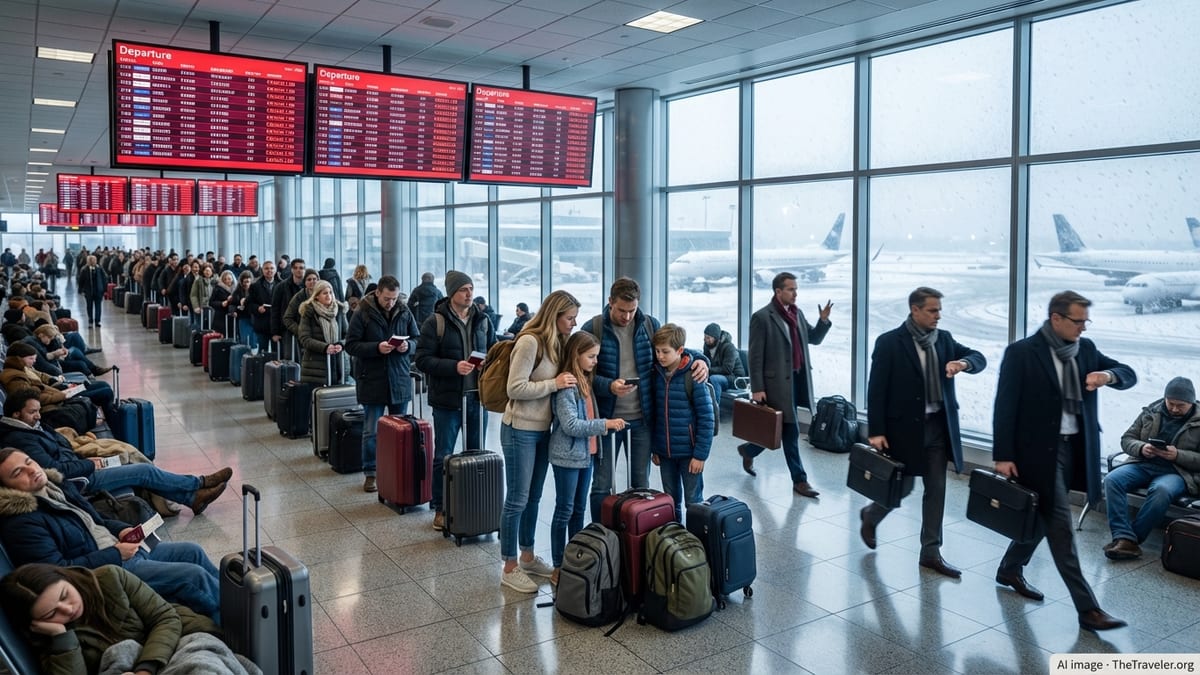
Storm Cells Stall Departures and Arrivals
Publicly available flight-tracking and airport operations data for July 3 indicate that a cluster of slow-moving thunderstorms around South Florida forced repeated holds on both departures and arrivals at Miami International Airport. Convective weather in the region led to temporary pauses in takeoffs and approaches, contributing to rolling ground delays that built steadily through the afternoon peak.
Information compiled from real-time departure and arrival boards shows that flights were frequently pushed back in short increments as storm cells moved through the airspace feeding into Miami’s primary approach corridors. This pattern of incremental delays is consistent with how U.S. airports typically manage traffic when thunderstorms restrict the usable airspace but do not require a full airport closure.
Operational summaries point to a mismatch between scheduled capacity and what the airspace could safely accommodate while storms were active. As aircraft waited on the ground for release times or circled in holding patterns, the backlog translated into late arrivals that, in turn, forced outbound flights to depart behind schedule.
Weather outlooks for the Miami area on Friday already highlighted a high probability of afternoon thunderstorms, a recurring feature of the region’s summer climate. Travel analysts note that when storms align with the busiest departure banks, even short pauses can quickly cascade into widespread network disruption.
Major Airlines Hit as Delays Reach 304 Flights
Data reviewed from flight-tracking dashboards and aggregated airport statistics indicate that a total of 304 flights linked to major carriers were recorded as delayed at Miami International Airport over the course of the day. The disruptions affected a mix of domestic and international services operated by large network airlines and their regional partners.
Among the hardest hit were routes operated by American Airlines, Delta Air Lines and regional affiliates such as Envoy, which collectively account for a substantial share of Miami’s daily schedule. The delays were not confined to a single destination or corridor, instead appearing across multiple markets as aircraft and crews fell out of position.
While only a relatively small number of outright cancellations were logged compared with the overall schedule, the volume of delays significantly extended travel times for thousands of passengers. Many services departed more than an hour behind schedule, and some aircraft were reassigned or swapped to cover gaps created by late inbound flights.
Industry observers point out that airlines now routinely prioritize avoiding cancellations where possible by accepting extended delays, particularly on days when connecting traffic is heavy and rebooking options are limited. That approach can keep more itineraries technically intact, but it also increases the likelihood of missed onward connections once delays exceed a certain threshold.
Ripple Effects Across North and South America and Europe
Miami’s role as a major intercontinental and hemispheric hub amplified the impact of Friday’s storm-related disruption. Tracking data shows delayed departures and late arrivals on services linking Miami with key cities in Canada, Venezuela, Colombia, the United Kingdom and multiple U.S. domestic hubs including New York, Atlanta and Austin.
Because many of these routes feed large connecting banks, delays on flights into Miami often translated into missed or compressed connection windows for onward journeys. Passengers heading to secondary destinations in Latin America and the Caribbean were particularly exposed, as those markets are heavily reliant on timed connections through Miami.
European services also felt the strain. When afternoon and evening transatlantic departures push back behind schedule, aircraft frequently arrive late into Europe the following morning, carrying the disruption into the next day’s rotations. That dynamic can constrain available aircraft for return services and limit the flexibility airlines have to recover their schedules quickly.
Travel operations specialists note that such ripple effects are a hallmark of weather-related events at large hubs. Even when the local weather improves within a few hours, equipment and crews displaced by earlier delays may remain out of sync with published schedules for several cycles.
Weather, Ground Programs and Peak Demand Create a "Perfect Storm"
Operational summaries and air traffic management notices for the region indicate that the disruption was driven by a combination of intense convective weather, targeted ground delay measures and elevated summer travel demand. Rather than a single nationwide air traffic initiative or system failure, a series of overlapping constraints gradually reduced Miami’s effective capacity.
When thunderstorms approach South Florida’s busy airspace, air traffic managers often apply spacing programs that limit the number of aircraft allowed to depart for, or arrive into, impacted airports within a given time window. On days with high passenger volumes, these measures can quickly fill to the point where flights are assigned extended departure slots, especially during afternoon peaks.
The same publicly available data sets show that airlines were also contending with the knock-on effects of earlier delays at other airports feeding Miami. Late departures from origin cities can cause inbound aircraft to miss their planned arrival slots, further complicating efforts to keep the schedule moving when weather shortens usable windows of time.
High seasonal demand added another layer of complexity. With many flights close to or fully booked, re-accommodating disrupted passengers on alternative services becomes increasingly difficult, reducing options for quick recovery even after the weather improves.
What Travelers Through Miami Should Expect Next
Based on typical recovery patterns after major weather events at large hubs, residual disruption at Miami International Airport is likely to persist into the late evening and potentially into early departures the following day. Aircraft and cabin crews that ended the day out of position may require schedule adjustments before normal operations can resume.
Travel experts recommend that passengers scheduled to fly through Miami in the near term allow extra time for connections and closely monitor their flight status through airline channels and airport information displays. Same-day schedule changes remain common in the aftermath of large delay events, especially on complex itineraries involving multiple carriers or tight transfer windows.
Those whose trips were affected on Friday may see their rebooked journeys routed through alternative hubs if space allows. Airlines sometimes use secondary connecting points, such as Dallas-Fort Worth, Charlotte or Atlanta, to bypass temporarily congested airports while still preserving onward connections.
Looking ahead through the remainder of the summer, forecasters expect the familiar pattern of hot, humid conditions and near-daily thunderstorms across South Florida to continue. For travelers using Miami International Airport, that means factoring in a higher baseline risk of afternoon and evening delays, particularly on days when storm activity overlaps with peak travel periods.