


More news on this day
Less than two years after choosing Lakeland International Airport as its Central Florida base, Avelo Airlines has already turned a long-quiet field into one of the country’s more closely watched low-cost experiments. Rapid route additions, a second based aircraft and hundreds of thousands of passengers suggest early momentum, but evolving schedules and broader network changes show the carrier is still fine-tuning what works from Lakeland.
Get the latest news straight to your inbox!
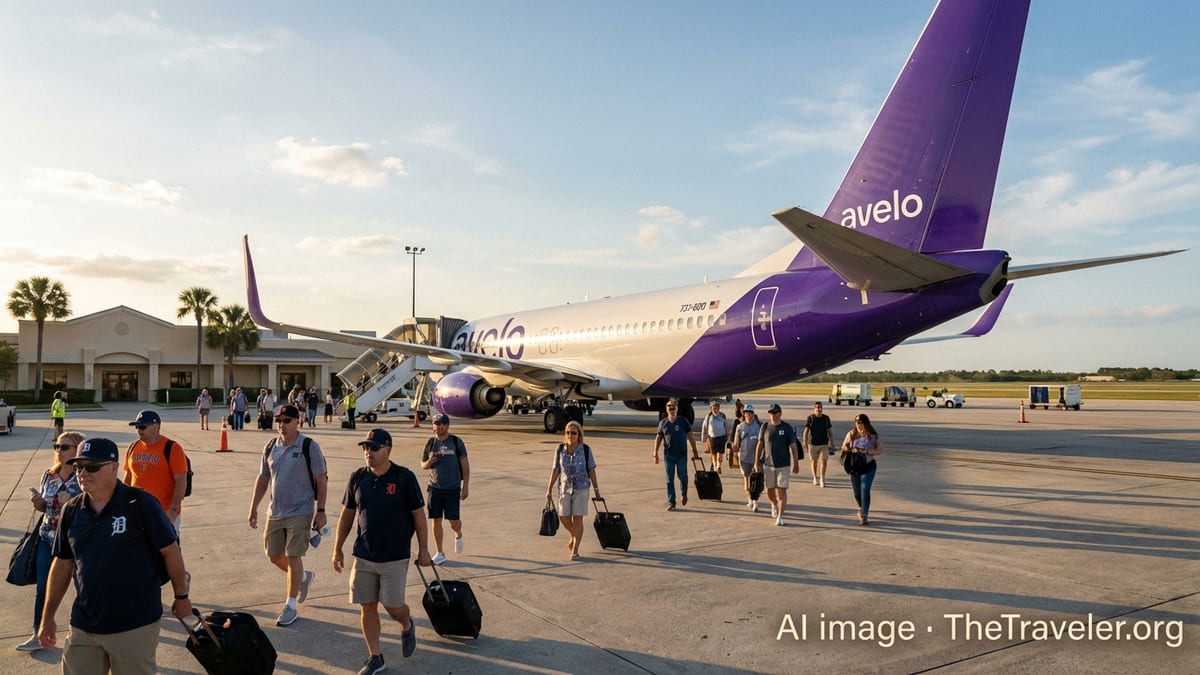
From Single Route to Full-Fledged Base
Avelo’s entry into Lakeland began in mid-2024 with service from New Haven, Connecticut, testing demand for an alternative gateway to Central Florida that sits roughly between Tampa and Orlando. Publicly available schedules and airport documents show that the route quickly became the anchor for a broader strategy built around smaller, less congested airports.
By late 2024, Avelo had formally designated Lakeland as its Central Florida base, initially positioning one Boeing 737 there and announcing seven nonstop routes that connected the city to markets such as Atlanta, Boston–Manchester, Philadelphia–Wilmington, Rochester and San Juan. The move marked one of the airline’s largest single expansions and signaled a long-term bet on the airport’s ability to draw travelers from across Polk County and the wider Interstate 4 corridor.
Since then, company announcements and local tourism updates indicate that Lakeland’s schedule has continued to thicken. Additional flights to East Coast cities and seasonal tweaks have turned the airport from a one-route outpost into a modest but diversified operation that now features both leisure-focused flights and connections aimed at visiting friends and relatives traffic.
Local government summaries of airport activity describe Avelo’s arrival as a turning point for Lakeland, which had gone years without sustained commercial service. The establishment of a crew base, along with ground and customer service staffing, has embedded the airline in the region’s aviation and employment landscape.
Passenger Milestones and Local Impact
A key indicator of how Avelo has fared in Lakeland is the volume of travelers passing through the airport. Company updates earlier this year highlighted a major milestone of roughly 300,000 customers carried to and from Lakeland, a significant figure for a market that had only recently returned to scheduled passenger service.
City news releases and tourism board coverage note that Avelo has grown from a single route to a double-digit portfolio of nonstop destinations, while also adding a second Boeing 737-800 permanently based at Lakeland. That step typically reflects confidence in local demand, because an additional aircraft increases the number of flights and requires more crews, maintenance capacity and operational support.
Beyond raw passenger counts, regional business and travel groups point to knock-on effects. Easier access to cities like New Haven, Nashville, Atlanta and northeastern markets has opened new options for both inbound visitors and local residents, helping Polk County position itself as a more accessible destination without forcing travelers through the congestion of Orlando or Tampa.
At the same time, various public documents and community discussions show that Lakeland’s success is still being watched closely. Incentive agreements, marketing partnerships and airport capital planning are being shaped around Avelo’s performance, underscoring how dependent the airport’s commercial future is on the airline’s ability to maintain and grow its network.
Network Adjustments Show a Work in Progress
Avelo’s Lakeland story is not one of uninterrupted expansion. Timetables and independent route-tracking coverage show that some early routes have seen frequency shifts, seasonal pauses or schedule refinements as the carrier responds to booking patterns and broader fleet changes.
In early 2026, Avelo outlined a plan to simplify its network and fleet as part of a balance sheet overhaul, noting that Lakeland would remain one of its core bases even as some other cities lost service. That decision effectively elevated Lakeland’s strategic importance, but it also highlighted that individual routes would be subject to ongoing review based on performance.
Route announcements over the past year illustrate this dynamic. Service to markets such as Atlanta has been adjusted at times, with limited weekly frequencies aligned to peak leisure demand. Other destinations, including connections into the Northeast and Mid-Atlantic, have seen added capacity, reflecting stronger-than-expected uptake among travelers seeking alternatives to larger Florida hubs.
Analysts following the ultra-low-cost and value-carrier segment note that this pattern is typical for young networks. New bases often launch with a flurry of routes, followed by a period of pruning and shifting as the airline identifies which city pairs deliver sustainable year-round demand and which work best as seasonal or limited-frequency offerings.
Clues to What Routes Might Be Next
As travelers and local officials speculate about new destinations from Lakeland, recent Avelo announcements provide some hints. The airline’s broader expansion has emphasized medium-sized cities, secondary airports near major metros and strong leisure or visiting-friends-and-relatives corridors, particularly those linking Florida with the Northeast, Mid-Atlantic and Caribbean.
From Lakeland specifically, Avelo has already leaned into this formula by adding routes such as Nashville and San Juan, alongside connections to New England and the Mid-Atlantic. City communications from June 2026 highlighting new service to Aguadilla, Puerto Rico, suggest that Puerto Rico and other Caribbean-adjacent markets are a growing focus, especially where there are established community ties to Central Florida.
Looking at Avelo’s existing network, aviation observers point to several logical next steps that would fit the pattern without overextending the base. Additional northeastern points reachable with a single aircraft rotation, or more Midwestern cities with strong Florida demand, could be candidates if current routes continue to perform well. Secondary airports that mirror Lakeland’s low-congestion profile are especially likely to be considered.
However, public information makes clear that any new route decisions will be shaped by the carrier’s ongoing financial restructuring and fleet utilization plans. That means Lakeland’s next additions are more likely to be targeted, high-confidence city pairs rather than another wave of broad-brush expansion.
A Test Case for Alternative Florida Gateways
Beyond individual routes, Lakeland has become a test case for whether travelers will embrace smaller, less crowded gateways into Florida’s theme parks and beaches. Avelo’s marketing materials promote the airport’s proximity to major attractions and its relatively quick curb-to-gate experience compared with larger hubs.
Early demand indicators and continued investment suggest that this message is resonating with at least a segment of travelers, particularly those who prioritize simplicity and lower fares over a wide range of daily flight times. The stationing of a second aircraft, sustained service to multiple mainland markets and the addition of Puerto Rican destinations all point to a base that is performing well enough to justify growth.
Still, the next phase of Avelo’s Lakeland experiment will likely be more measured. With the airline refining its national footprint, each new Lakeland route will have to earn its place in a tighter network. The airport’s long-term role as a Central Florida alternative may ultimately hinge on how consistently those flights can fill seats outside holiday peaks and promotion-driven surges.
For now, Lakeland stands as one of Avelo’s more ambitious bets: a once-quiet airport transformed into a busy niche gateway, and a laboratory for how far an upstart carrier can push the appeal of smaller-city flying in America’s most competitive leisure market.