


More news on this day
Hundreds of travelers were left isolated at Chicago O’Hare International Airport after severe storms in the Midwest triggered 635 delays and 267 cancellations, disrupting flight schedules for American, United, Delta, Envoy, SkyWest, GoJet, JetBlue and multiple regional carriers across the United States and Canada.
Get the latest news straight to your inbox!
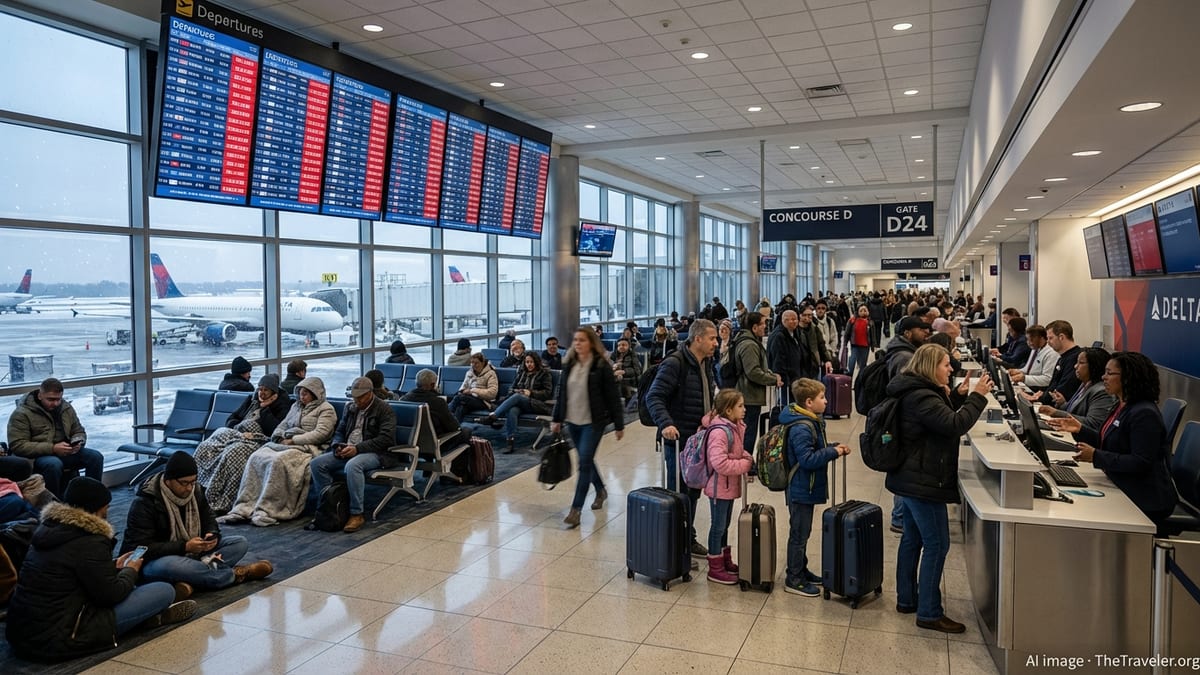
Midwest Storms Turn O’Hare Into a Bottleneck
Publicly available weather and aviation data show that intense thunderstorms swept through the Midwest late Wednesday, forcing temporary ground stops at both Chicago O’Hare International Airport and Chicago Midway International Airport. Those holds, combined with reduced arrival and departure rates, quickly pushed O’Hare’s already busy operation into significant disruption.
O’Hare’s role as a major hub for United Airlines and American Airlines meant that any reduction in capacity had an outsized impact on national schedules. Delta Air Lines and JetBlue, which operate a mix of mainline and partner services at the airport, also saw flights pushed back or scrubbed, contributing to the mounting total of 635 delays and 267 cancellations linked to the Chicago storms.
Reports from flight-tracking platforms indicate that the problems were not confined to departures. Arrivals into O’Hare were held in extended airborne queues or diverted when storm cells moved directly over approach paths, adding further strain on airlines working to reposition crews and aircraft.
By late evening, terminal concourses at O’Hare were crowded with travelers facing missed connections, uncertain rebooking timelines and difficulty reaching customer service, a familiar pattern during recent periods of severe weather affecting the Midwest.
Major Airlines and Regional Partners Share the Impact
Operational data reviewed across multiple aviation tracking services suggest that no single airline carried the entire burden of the disruption. United and American, O’Hare’s dominant carriers, recorded the largest block of delays and cancellations, but partner airlines Envoy Air, SkyWest Airlines and GoJet also showed a pronounced spike in schedule changes as the day progressed.
These regional operators are embedded in the networks of the large carriers, flying under brands such as American Eagle and United Express. When storms slow departures out of a hub like Chicago, these carriers struggle to complete tightly timed rotations serving smaller cities in the Midwest, Great Lakes region and cross-border markets in Canada.
Delta Air Lines and JetBlue, while less prominent at O’Hare than United and American, operate key connecting services that rely on predictable slot availability and gate access. As the backlog of delayed flights grew, aircraft arriving from other U.S. and Canadian cities were often held awaiting space at congested gates, adding secondary delays far from the original weather system.
Industry reports describing recent months note that such multi-carrier disruptions have become increasingly common as airlines run complex, high-utilization schedules that leave little slack when storms, air traffic control restrictions or ground holds occur at a major hub.
Ripple Effects Across the U.S. and Canada
According to publicly available flight-tracking data, the disruption radiated outward from Chicago into dozens of domestic and cross-border routes. Aircraft that were due to depart O’Hare for destinations including Toronto, Montreal, Vancouver and Calgary left late or were canceled altogether, affecting passengers who never set foot in Illinois.
In the United States, schedules at airports such as New York LaGuardia, Newark, Boston Logan, Denver, Dallas Fort Worth and smaller regional fields in Wisconsin, Iowa and Michigan reflected the knock-on effects as delayed aircraft and crews failed to arrive on time from Chicago. Some departures remained listed as “awaiting inbound aircraft” for extended periods, a standard sign that earlier segments had been disrupted.
Travel industry coverage of similar events this spring noted that a single day of heavy delays at a major hub can continue to affect operations for 24 to 48 hours, as airlines reposition aircraft and reassign crews to restore normal patterns. The scale of Wednesday’s O’Hare disruption suggests that some lingering delays and isolated cancellations are likely on follow-on days, especially on routes where regional carriers operate infrequent services.
Canadian airports tied closely to U.S. hubs through regional feeders appeared particularly vulnerable, with passengers on evening departures reporting rolling delay estimates as crews waited for weather and traffic conditions in Chicago to improve enough to release their aircraft.
Travelers Face Long Waits, Limited Rebooking Options
For passengers trapped in the middle of the disruption at O’Hare, the practical consequences were immediate. Crowded gate areas, long lines at service desks and limited same-day rebooking options became a defining feature of the evening as airlines prioritized safety and operational constraints over schedule integrity.
Publicly available guidance from both airlines and federal transportation agencies encourages passengers in such situations to use mobile apps, text alerts and online rebooking tools rather than relying solely on in-person assistance at the airport. During high-impact events, digital channels are often updated more quickly than physical departure boards and can offer alternative routings through other hubs.
However, when thunderstorms and ground stops hit multiple busy corridors simultaneously, the pool of available seats narrows quickly. Travelers with connections through O’Hare to smaller markets, or to late-night departures to Canada, faced particular challenges as the number of remaining flights in the schedule dwindled and overnight stays became more likely.
Consumer advocates regularly highlight the importance of understanding airline policies on meal vouchers, hotel accommodation and compensation in the event of significant disruption. Weather-related problems are often categorized differently from carrier-controlled issues, affecting what assistance passengers can expect at the counter.
Storm Season Meets a Stressed Aviation System
Recent federal data on on-time performance and cancellations show that major U.S. airlines and their regional partners continue to operate close to pre-pandemic volume, with high aircraft utilization and tight turnaround times at many hubs. While efficiency gains have allowed carriers to handle strong demand, these same efficiencies reduce flexibility when severe weather strikes a key node like Chicago.
Transportation statistics for the past year indicate that carriers such as United, American, Delta, JetBlue, Envoy, SkyWest and other partners already manage complex networks that span dense domestic corridors, long-haul routes and regional spokes. Under normal conditions, this connectivity offers passengers a wide array of routing options. Under storm conditions, it amplifies the spread of delays and cancellations as every missed connection cascades into further schedule changes.
Analysts tracking recent disruption patterns have noted that hubs including Chicago, Atlanta, Dallas and New York have experienced repeated bouts of storm-related irregular operations in 2026. Each episode underscores the vulnerability of high-density air travel networks to weather and airspace constraints, even as carriers and airports invest in technology and infrastructure intended to improve resilience.
For travelers planning itineraries in the coming weeks, aviation experts and consumer groups alike recommend building additional time into connections through storm-prone hubs, monitoring forecasts along the entire route and staying alert to schedule changes that can originate hundreds of miles away but still determine whether a journey proceeds as planned.