


More news on this day
Ben Gurion Airport, Israel’s main international gateway, is experiencing its most turbulent period in years as growing reports indicate that only about one in three flights is departing on time, with delays and cancellations mounting amid security-driven capacity cuts and a strained summer schedule.
Get the latest news straight to your inbox!
Security crisis reshapes airport operations
The current disruption at Ben Gurion follows months of heightened regional tension and direct strikes on Israeli territory that have reshaped how the airport operates. Publicly available information on March 2026 missile attacks on Israel shows that several private aircraft were damaged at Ben Gurion, prompting a rapid review of flight handling, apron use and runway procedures. In the months since, the focus on security and aircraft protection has increasingly collided with routine commercial operations.
Network and regulatory documents for late 2025 and early 2026 describe Ben Gurion as operating close to normal volumes, but with airlines still running thinner schedules than before the crisis and with added routing and airspace constraints. These measures, designed to keep traffic safely away from sensitive zones, have reduced flexibility in how departures and arrivals are sequenced. As summer demand surged, the remaining buffers in the system have begun to erode, exposing passengers to growing disruption.
At the same time, Israeli airports data for early 2026 highlight that total passenger volumes have recovered strongly from previous lows, even as the airport remains subject to special security and operational procedures. The combination of high demand and constrained infrastructure has created the conditions for cascading delay, where even minor glitches can ripple through the departure bank and into the evening peak.
Capacity cuts, packed schedules and slipping punctuality
Reports from aviation analysts and local media indicate that one structural driver of the current chaos is deliberate reduction in per-flight passenger loads and an overall cut in available capacity on key long haul routes. Following the Iranian strikes in March 2026, publicly available coverage notes that Israel sharply reduced the number of passengers allowed on outbound flights, particularly to North America and parts of Europe. Although this measure was framed as temporary, the adjustment has left airlines juggling aircraft rotations and seat allocations well into the busy summer season.
Industry network assessments for the wider region show that movements at Ben Gurion have moved back toward normal levels, yet on-time performance has deteriorated markedly. With fewer spare aircraft and crews positioned in Tel Aviv, carriers have less resilience when a single rotation goes off schedule. Once one morning flight departs late, the same aircraft often runs behind for the rest of the day, contributing to the pattern passengers are now reporting of rolling delays that lengthen as the evening approaches.
Travel data specialists note that in such constrained environments a roughly one-third on-time departure rate is a sign of systemic strain rather than isolated operational lapses. When two out of three flights push back late or see last minute retiming, it typically reflects a schedule that no longer matches the true capacity of runways, taxiways, gates and airspace. Ben Gurion now appears to be in this zone, with airlines, ground handlers and air traffic managers all trying to operate close to theoretical maximums under more complex security rules.
Passenger experience: long queues and shifting departure boards
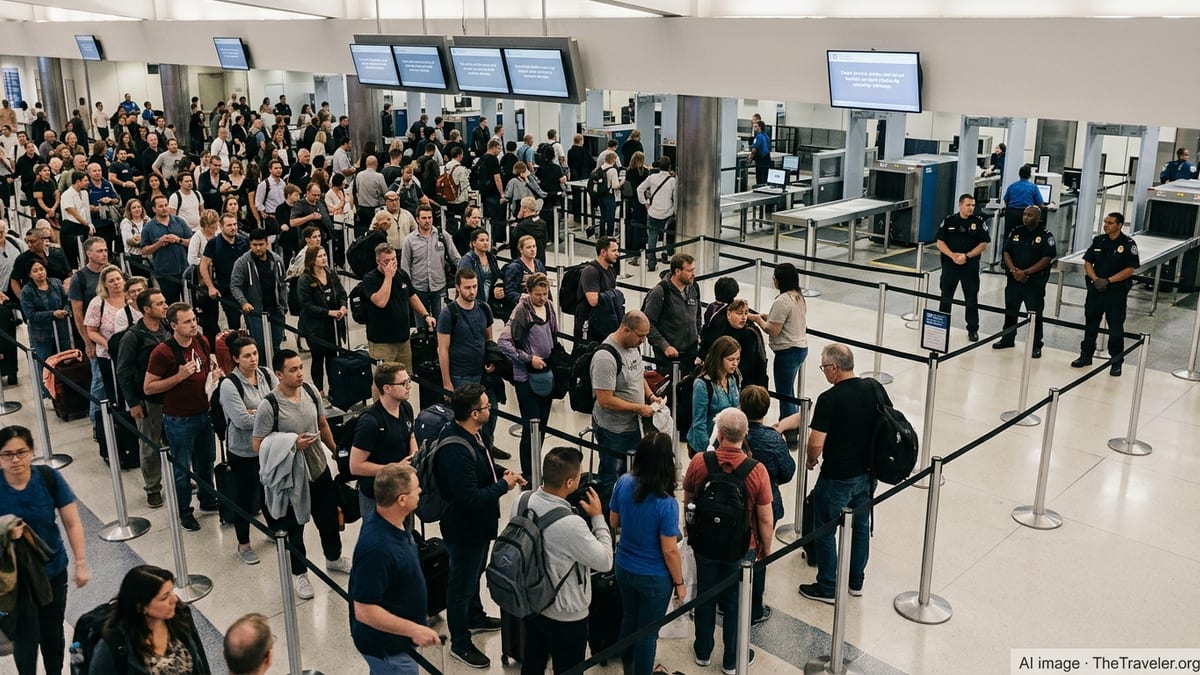
For travelers, the operational pressures translate into crowded terminals, long security lines and departure boards filled with yellow and red delay markers. Social media posts and forum discussions from July 2026 show passengers at Ben Gurion sharing images and accounts of waits stretching well beyond scheduled departure times, as well as last minute gate changes and unscheduled technical holds.
Many of these accounts describe a pattern where flights initially appear on time, then move through a series of small delays of 20 to 40 minutes before tipping into multi hour waits or outright cancellation. Aviation researchers have long highlighted how delay propagation works in hub style networks: once the early wave is disrupted, aircraft and crews arrive late for their next legs, turning a local punctuality problem into a network wide issue. That dynamic is increasingly visible at Ben Gurion, especially on days with strong outbound demand to Europe and North America.
Constraints at security checkpoints and immigration counters are adding another layer of congestion. With enhanced screening protocols still in place, processing each passenger can take longer than under pre crisis conditions. Even when aircraft and crews are ready, boarding can be delayed by passengers stuck in upstream bottlenecks. The result is a feedback loop in which operational caution and security imperatives, while understandable, act as additional drag on on-time performance.
Airlines retime and trim networks as disruption mounts
Airlines serving Ben Gurion have begun to adjust their schedules in an effort to cope with the chaos. According to published timetables and route updates, some carriers have shifted flights away from the already congested late evening departure wave, while others have consolidated frequencies or temporarily suspended marginal routes. Low cost operators in particular appear to be rebalancing capacity toward nearby Mediterranean and European airports where operational predictability is higher.
These moves, however, bring their own challenges. Cutting frequencies or rerouting flights can concentrate demand onto fewer services, filling remaining departures to capacity and reducing the ability to rebook disrupted passengers. Travelers with cancelled flights out of Tel Aviv increasingly report being offered alternative itineraries involving lengthy layovers or indirect routings, as traditional spare seats disappear.
Network level analyses of airport performance suggest that when schedule reductions are not matched with deeper structural changes, such as additional runway capacity or new operating windows, punctuality gains can be limited. At Ben Gurion, where airspace and security constraints are largely external to airline control, trimming flights has so far not been enough to restore stable on time performance across the day.
What passengers should expect in the coming weeks
With regional security tensions still unresolved and summer holiday traffic at its peak, there is little indication that Ben Gurion’s disruption will ease immediately. Air traffic flow management reports for Europe and the eastern Mediterranean point to continued congestion on key air corridors that connect Israel with major hubs, raising the risk of further knock on delays when weather or military activity forces rerouting.
Industry observers suggest that on time departure rates are likely to remain depressed as long as airlines and airport managers are required to operate under the current combination of security restrictions and high demand. Even incremental improvements, such as slight increases in permitted passenger loads or more predictable use of military airspace, may take time to translate into visible gains for travelers.
For now, the practical reality for passengers using Ben Gurion is a higher probability of disruption than in previous summers. Flexible itineraries, longer connection windows and contingency plans for overnight delays are becoming essential tools for anyone planning to fly into or out of Tel Aviv. Until the underlying operational pressures ease, the airport is expected to remain a case study in how quickly a major hub’s punctuality can unravel when security, capacity and demand collide.