


More news on this day
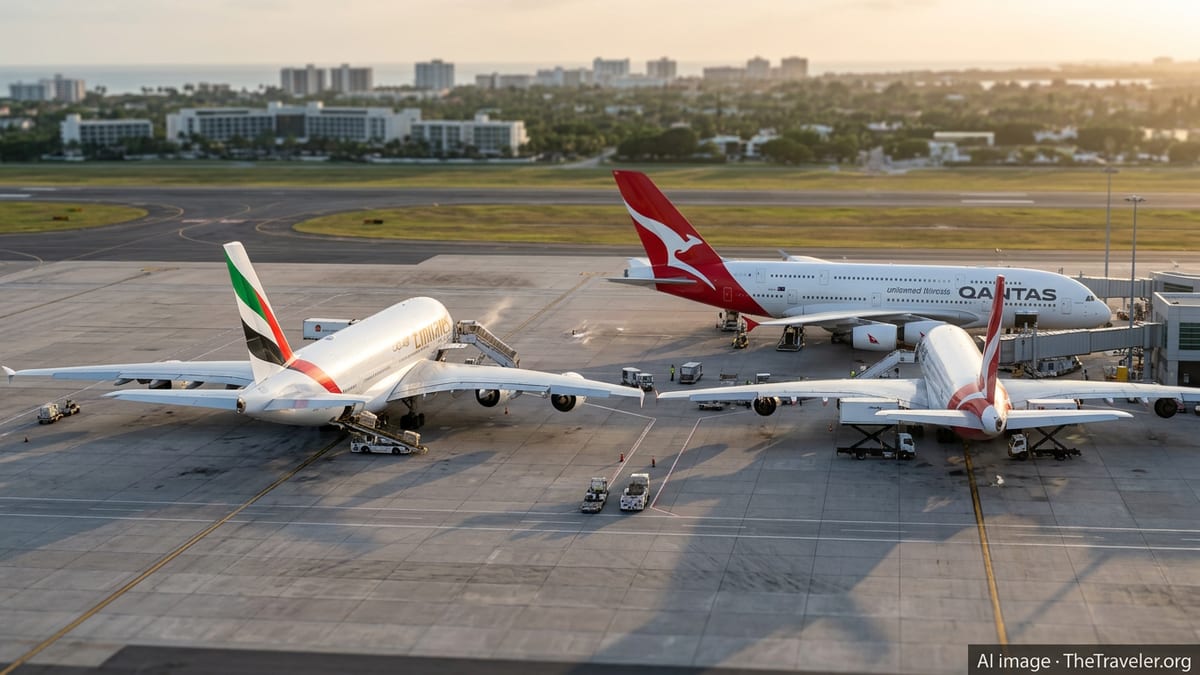
An Emirates Airbus A380 flight operating between Dubai and an Asian destination has drawn global attention after a diversion and lengthy ground delay left hundreds of passengers confined to the double decker jet for roughly 17 hours, according to multiple media and social media reports.
Get the latest news straight to your inbox!
Long diversion turns routine A380 flight into overnight ordeal
Published coverage indicates the incident involved an Emirates superjumbo that diverted to Hangzhou Xiaoshan International Airport in eastern China after encountering operational issues en route. Chinese business outlet reports describe the aircraft, an A380 configured for more than 500 passengers, parking on a remote stand at the cargo apron rather than at a regular passenger gate.
According to those accounts, around 373 travelers remained on board for more than 10 hours after landing while airport staff and the airline attempted to resolve technical and logistical challenges. Including the original flight time before the diversion and the extended delay on the ground, several passengers said they ultimately spent about 17 hours inside the aircraft.
Social media posts from those on board, later echoed in Chinese and European news reports, describe an increasingly tense atmosphere as the hours passed. Travelers reported feeling uncertain about when they would be allowed to disembark, with some posts mentioning passengers feeling unwell and at least one person fainting during the extended wait.
The A380, the world’s largest passenger airliner, is ordinarily marketed for comfort on long haul routes. In this case, the very size of the aircraft appears to have complicated handling after the diversion, as only certain stands and facilities at regional airports can accommodate the double decker jet.
Reports describe medical concerns and limited information on board
Passenger accounts compiled in regional media describe rising frustration with limited information during the hours on the tarmac. Some travelers said cabin temperatures became uncomfortable at times, while others reported difficulty accessing food and water as onboard catering supplies dwindled.
Several posts on Chinese social platforms referenced elderly travelers and families with children struggling during the overnight delay. Local media summaries of those posts indicate that some passengers experienced dizziness or faintness, prompting calls on board for medical assistance. There have been no public reports of serious long term health consequences.
Publicly available coverage explains that ground handling for a wide body aircraft of this size can be challenging at an airport not regularly served by the A380. Getting suitable stairs, buses, immigration processing and baggage handling aligned for hundreds of travelers in the middle of the night can take considerable time, particularly if the aircraft is parked on a cargo stand rather than at a passenger terminal.
Commentary from aviation analysts quoted across several outlets notes that, while extended tarmac waits remain relatively rare in Asia, they can be particularly disruptive on ultra large aircraft where any delay affects a very high number of travelers at once.
Emirates issues apology and arranges accommodation and onward travel
Regional business media report that Emirates later issued a public apology in Chinese, acknowledging the disruption to passengers and stating that all travelers were eventually allowed to leave the aircraft. According to those reports, the airline said it had arranged hotel accommodation, meals and later onward flights for those affected.
Coverage indicates that passengers were eventually transported by bus from the remote stand to the terminal, where they completed entry formalities before being taken to local hotels. Some travelers posting online confirmed they received meal vouchers and overnight lodging, although several criticized the length of the delay before being allowed to disembark.
The airline has not publicly released a detailed technical explanation of the diversion. Aviation commentators observing flight tracking data suggested that a combination of weather and operational considerations in the original destination region may have influenced the decision to divert to Hangzhou, which is able to receive very large aircraft on its main runway.
Despite the disruption, available information shows that the A380 was not involved in any safety critical incident, and there are no published reports of injuries resulting directly from the diversion itself. The focus of public debate has instead centered on how the extended time in the cabin was managed and communicated to those on board.
Spotlight on ultra long flights and passenger rights
The episode has sharpened discussion around what responsibilities airlines have when ultra long range flights run into cascading delays. The A380 frequently operates sectors of 13 to 17 hours, allowing nonstop links such as Dubai to Auckland and Sydney to Dallas. While such routes are popular for eliminating connections, they reduce the margin for diversions and can leave aircraft far from their usual hubs when problems arise.
Consumer advocates point out that many jurisdictions, including the United States and the European Union, now have specific tarmac delay rules that limit how long passengers can be kept on board without being allowed to deplane, with additional requirements for food, water and working lavatories once certain thresholds are reached. In parts of Asia and the Middle East, comparable regulations are still developing and can vary widely by country.
Aviation law specialists quoted in international coverage note that, although these rules were originally framed with smaller jets in mind, the issues are amplified when a diversions involves very large aircraft like the A380. Managing several hundred travelers at an airport that does not regularly handle such aircraft can quickly overwhelm local ground resources.
The Emirates incident has therefore become a reference point in a broader global conversation about harmonizing passenger protections, particularly for long haul and ultra long haul operations that cross multiple regulatory regimes in a single journey.
Operational lessons for mega-hubs and secondary airports
The disruption has also prompted questions about how airlines and airports plan contingencies for very large aircraft. Industry analysts note that as A380s return to service on busy trunk routes, more secondary airports are again seeing the superjumbo occasionally divert for weather, fuel or technical reasons.
Airport planners interviewed in trade publications have previously highlighted the need for clear procedures covering everything from compatible jet bridges and stairs to bus capacity, security screening and immigration staffing when an A380 arrives unexpectedly. Without such plans, even a routine diversion can turn into an overnight ordeal for passengers.
For Emirates and other operators of the A380, the incident underscores the importance of real time communication with passengers, both on board and via digital channels, when irregular operations stretch far beyond scheduled block times. Travel industry observers suggest that transparent updates and early decisions on whether to deplane or continue to wait on board can significantly influence how such events are perceived long after the aircraft has parked.
As peak summer travel continues across the northern hemisphere and airlines operate at or near full capacity, the Hangzhou diversion is serving as a vivid reminder of how quickly a flagship long haul experience can unravel when multiple systems on the ground and in the air fail to align.