


More news on this day
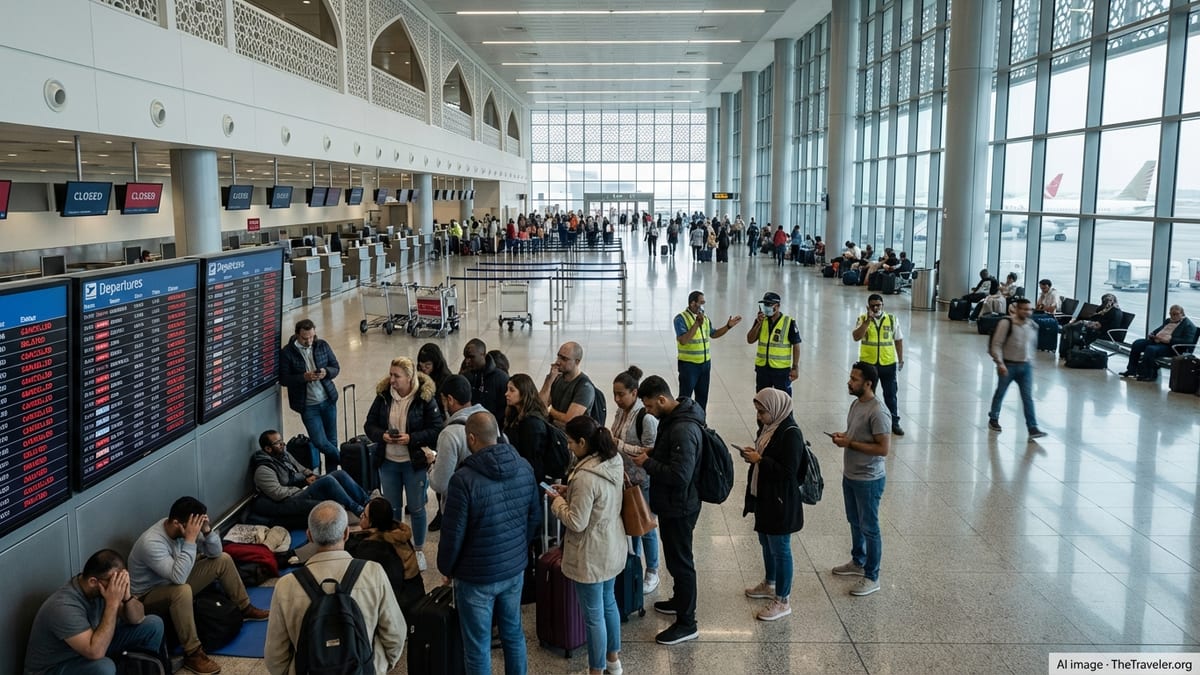
Travel across the Middle East, Europe and Africa is facing cascading disruption as the United Arab Emirates joins Oman, Qatar, Saudi Arabia, Bahrain and Kuwait at the center of a widening crisis around the U.S. naval blockade and effective closure of the Strait of Hormuz, with knock on effects now reaching major hubs in Iran, Jordan, Israel, Egypt, Germany, the UK, France, Italy and beyond.
Get the latest news straight to your inbox!
Blockade Tightens Around Hormuz as Gulf States Align
The Strait of Hormuz has been at the heart of the regional shock since early March, when Iranian actions and security threats sharply reduced shipping activity, followed by an effective shutdown of commercial transits. Publicly available shipping data and port circulars show tanker movements collapsing from late February, with many vessels diverting to alternative routes or waiting offshore as risk levels rose.
On April 13 the United States began enforcing a naval blockade targeting vessels entering or leaving Iranian ports and coastal areas, adding a new layer of control around an already paralysed chokepoint. Reports indicate that U.S. warships and aircraft are patrolling the Gulf of Oman and approaches to the Strait, turning back or inspecting ships perceived to be linked to Iranian trade.
Gulf Cooperation Council states, including the UAE, Oman, Qatar, Saudi Arabia, Bahrain and Kuwait, are now effectively part of a shared security and disruption zone. While their ports remain technically open in many cases, insurers, shipping lines and airlines have imposed their own restrictions, leaving the region’s role as a global transport and energy hub severely curtailed.
Analysts note that the Iranian side of the Strait is theoretically avoidable through territorial waters controlled by Oman and the UAE, but the combination of Iranian threats, past attacks on commercial ships and the new U.S. blockade has created conditions that most operators view as commercially and operationally prohibitive.
Airspace Closures and Rerouting Hit Global Aviation
The aviation sector has been among the hardest hit. From early March, airspace closures and flight suspensions spread across the Gulf as missile and drone strikes escalated. Regional advisories cited temporary or rolling shutdowns over the UAE, Bahrain, Kuwait, Qatar and parts of Saudi Arabia and Oman, prompting carriers to cancel or reroute services.
By mid March, publicly available industry updates indicated that flights to and from Syria, Iraq, the UAE, Bahrain, Kuwait and Qatar were widely suspended, forcing long haul airlines to redesign routes linking Europe and Africa with South and East Asia. Many operators have shifted to longer detours over the eastern Mediterranean, the Red Sea or Central Asia, adding hours to journey times and triggering schedule knock ons worldwide.
Major Gulf carriers that typically rely on Dubai, Abu Dhabi and Doha as mega hubs have faced repeated operational pauses and capacity cuts due to airspace restrictions and security concerns around aircraft on the ground. While some flights continue using carefully defined corridors, the hub and spoke model that underpins much of the world’s intercontinental traffic has been severely weakened.
Travelers connecting between Europe, Africa, India and Southeast Asia via the Gulf are reporting widespread last minute itinerary changes, extended layovers and, in some cases, forced overnights in secondary hubs. Published travel advisories now routinely urge passengers to verify the status of flights on the day of departure and to allow additional time for security screening and potential diversions.
Cruise Ships Stranded and Itineraries Scrapped
The cruise industry has also been drawn directly into the crisis. As missile and drone incidents mounted in late February and early March, cruise lines began withdrawing ships from the Gulf and cancelling port calls that required transiting the Strait of Hormuz. Maritime and travel trade coverage records at least six large cruise vessels stranded or redeployed after the effective closure.
Several ships based in Dubai, Doha and other Gulf ports were forced to end voyages early or keep passengers onboard while plans were reworked. One Saudi based cruise line cancelled its entire 2026 Gulf season after disembarking guests in early March, illustrating the scale of the commercial reset. Others have repositioned vessels to the Mediterranean or Indian Ocean, avoiding the Strait entirely for the rest of the northern winter and early summer seasons.
For passengers, the result has been a wave of itinerary changes, refunds and future cruise credits. Consumer facing guidance from agencies and insurers points out that many standard travel insurance policies exclude disruption linked to war, blockades and attacks, leaving some travelers dependent on goodwill policies from the cruise lines themselves.
Looking ahead, industry analysts expect the Gulf to lose a full season of cruise tourism even if tensions ease, as brands seek to rebuild confidence and redeploy ships to more predictable markets. That pullback will also be felt in regional tourism economies in the UAE, Oman, Qatar and Bahrain, which have invested heavily in new terminals and shore infrastructure.
Ripple Effects from the Gulf to Europe and Africa
While the epicenter of the crisis sits around the Strait of Hormuz and neighboring Gulf states, the disruption is radiating along air and sea corridors that connect Europe and Africa to Asia. Airlines serving hubs in Germany, the UK, France and Italy have adjusted routes to avoid high risk airspace, sometimes operating longer polar or Mediterranean detours that increase fuel burn and narrow scheduling margins.
North African and Levant countries, including Egypt, Jordan and Israel, have emerged as critical overflight and diversion points. Carriers are using Cairo, Amman and Tel Aviv more heavily as waypoints or emergency alternates for flights originally planned through Gulf air corridors. This has led to busier skies over the eastern Mediterranean and the Red Sea, along with new air traffic management challenges in an already congested region.
On the maritime side, congestion is building at alternative ports such as Sohar in Oman and eastern UAE facilities like Fujairah and Khor Fakkan, as container and tanker traffic that would normally pass through the Strait seeks safer anchorages and new loading points. European and African importers reliant on Gulf energy and petrochemical products are watching schedules closely, with some cargoes delayed or rerouted around the Cape of Good Hope.
For travelers, these shifts can translate into indirect impacts: higher airfares on certain long haul routes, reduced capacity on popular Europe to Asia services, and occasional knock on delays at airports far from the Gulf as aircraft and crews fall out of position.
What Travelers Should Do Now
With conditions shifting daily, travel experts emphasize preparation and flexibility for anyone planning journeys that normally rely on Gulf hubs or cross Middle Eastern airspace. The most consistent guidance in public advisories is to book with airlines and cruise lines that offer flexible change policies, and to monitor booking portals and carrier announcements closely in the days and hours before departure.
Travelers connecting through Dubai, Abu Dhabi, Doha, Muscat, Manama or Kuwait City should be prepared for sudden rerouting via alternative hubs in Europe, the Levant or South Asia. Allowing longer connection windows, carrying essential medication and valuables in hand luggage, and keeping accommodation plans flexible at the final destination can help mitigate stress if schedules shift.
Specialists also recommend checking the fine print of travel insurance policies, paying particular attention to exclusions related to war, blockades, terrorism and government ordered airspace closures. Where standard coverage is limited, some providers are offering enhanced policies that explicitly address geopolitical disruption, though these often come at higher premiums.
Above all, travelers are advised to treat the Strait of Hormuz situation as a medium term disruption rather than a short lived incident. Even if the current ceasefire between Iran and its adversaries holds, it may take weeks or months for airlines, cruise operators and shipping lines to fully restore schedules and for confidence to return across the wider Middle East travel network.