


More news on this day
Residents of a residential world cruise marketed as a never ending or endless voyage are speaking out after being told to leave the ship in Cambodia, abruptly ending what many had come to see as a magical way to live at sea.
Get the latest news straight to your inbox!
A Perpetual Voyage Cut Short in Cambodia
The residential ship involved, operated by United States based company Villa Vie Residences, had been promoted as a long term, even open ended, way to live aboard while slowly circling the globe. Publicly available information shows that the vessel, the Villa Vie Odyssey, was originally refitted in Belfast and began taking residents in 2024 on itineraries designed to span years rather than weeks.
Reports from international outlets and cruise focused publications indicate that the model was simple but ambitious. Travelers could purchase or long lease cabins essentially as floating apartments, often after selling homes or ending long term rentals on land. The promise was a rolling schedule of ports across multiple continents, packaged as a lifestyle rather than a typical holiday.
That promise unraveled in late October 2026 in Sihanoukville, on Cambodia’s southern coast, when the company halted operations and residents were instructed to disembark with their belongings. News agency coverage and local reporting describe about 200 people effectively stranded after being told the cruise could not continue, following what the operator called extraordinary increases in fuel costs and financial pressures linked to wider geopolitical tensions.
Some of those on board have nonetheless described their months at sea as a rare experience. In interviews cited across multiple news stories, residents said life on the ship felt communal and almost village like, with routines built around shared meals, port calls and onboard activities. One resident quoted in coverage reflected that despite the outcome, it had been a magical way to live.
How the ‘Never Ending’ Cruise Model Worked
The Odyssey was part of a growing niche of residential or live aboard cruise concepts aimed at remote workers, early retirees and long term travelers. Instead of booking a cabin for a set itinerary, residents committed to multi year stays, paying six figure sums in some cases for the right to occupy a stateroom for the duration of the program.
Marketing materials highlighted the idea of continuity. The ship would not return to a home port every week but would instead move gradually from region to region, with logistics such as visas, port fees and housekeeping bundled into monthly charges. For some travelers, especially those who had already embraced full time travel or digital nomadism, this meant a predictable home base combined with a constantly changing view.
According to prior coverage of similar ventures, entry level pricing for such residential programs has often been pitched around the cost of living in a major city, with some packages advertised at roughly 30,000 to 40,000 dollars per person per year for basic cabins, rising significantly for larger suites. In return, residents expected nearly continuous cruising, meals, basic healthcare on board and access to ports spanning dozens or even hundreds of countries across several years.
Analysts who follow the cruise industry have noted that these long horizon products are structurally complex. Securing a suitable ship, maintaining it for high mileage operation, locking in fuel and port contracts and balancing occupancy over multiple years all introduce risks that do not usually apply to conventional one or two week voyages.
Residents Describe Sudden Orders to Leave
Accounts compiled in recent days by global news agencies and regional media in Cambodia describe a hurried and disorienting end to the voyage. Residents say they were informed that the cruise program was being suspended and that they would need to leave the ship, with some reports indicating they were given only hours to pack and arrange onward travel.
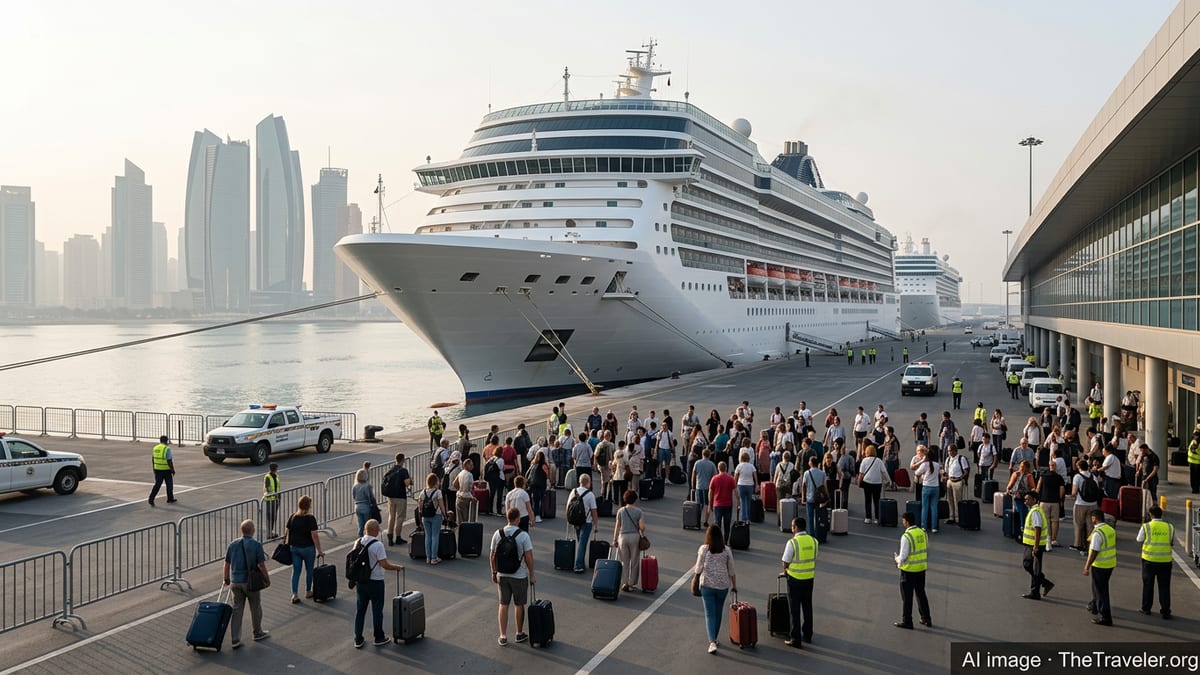
Images and descriptions from Sihanoukville’s port show passengers wheeling suitcases down the gangway and gathering near the terminal as they tried to organize flights, short term accommodation and storage for belongings that had been meant to stay in their cabins for years. Several travelers have said publicly that they did not have immediate plans for housing on land because they had structured their lives around remaining on board.
Company statements cited in coverage explain the halt as a response to rapidly rising operating costs, particularly fuel expenses tied to recent geopolitical disruptions, and to financial strain on the operator. At the same time, residents have voiced frustration over the timing and manner of the announcement, raising questions over whether warning signs about the cruise’s viability were communicated early enough.
Despite those frustrations, multiple passengers quoted in articles have gone out of their way to emphasize positive aspects of the experience. They recall months of shared dinners, friendships formed on deck and a sense of calm that came from waking up each day to a new horizon, even as the long term security of the project quietly eroded.
Echoes of Earlier Long Term Cruise Troubles
The collapse of the Odyssey’s never ending style program is not occurring in isolation. Over the past three years, several high profile attempts to launch multi year or open ended residential cruises have struggled or failed before or during operations, highlighting the fragility of this emerging segment.
One widely covered case involved the Life at Sea Cruises project, which had advertised a three year, 1,095 day global voyage with hundreds of port calls, targeting remote workers with rates starting around 30,000 dollars per year. According to reporting from major newspapers and broadcasters, that cruise was canceled in late 2023 shortly before departure after organizers acknowledged they did not have a suitable ship, leaving passengers seeking refunds and scrambling for housing after some had sold homes or ended leases.
Other concepts, including proposed fifteen year residential voyages and long term stay packages on converted cruise ships, have also faced delays, ship procurement issues and legal disputes over refunds. Consumer advocates point out that while traditional cruises are well established, the regulatory and financial frameworks around effectively turning a cruise ship into a condominium at sea are still evolving.
Industry commentators note that the Odyssey’s experience reinforces concerns raised during earlier projects. The business case for a ship that rarely pauses operations for more than brief maintenance windows is challenging, particularly when fuel markets are volatile and when continuous occupancy must be sustained to cover costs. The longer the promised voyage, the more exposed residents become if plans change.
What Prospective Long Term Cruisers Should Know
For travelers drawn to the romance of a never ending cruise, the events in Cambodia underscore the importance of caution. Published terms and conditions from major cruise lines show that operators generally reserve broad rights to alter itineraries, substitute ships or end voyages early for reasons ranging from mechanical problems to cost pressures and geopolitical events.
Specialists in maritime regulation point to protections such as financial responsibility rules for passenger vessel operators that apply in key markets, intended to ensure some recourse if a scheduled voyage never operates. However, these safeguards can be more complicated when the product is marketed as a multi year residential experience rather than a standard ticketed cruise, and when companies are based or licensed in multiple jurisdictions.
Travel and financial planners often advise would be residents to scrutinize contracts, paying close attention to refund policies, escrow or trust arrangements for advance payments and what happens if a voyage is shortened or canceled entirely. Independent coverage of recent cases indicates that disputes have centered not only on refunds, but also on out of pocket costs for housing and health care when people have reorganized their lives around living at sea.
Despite the risks, interest in ocean based living remains strong, with new residential ship concepts continuing to be announced. For those who watched the Odyssey’s voyage from afar, the image of residents reluctantly rolling their suitcases down the gangway in Sihanoukville sits alongside descriptions of sunsets at sea and a close knit onboard community that many still describe as magical, even after the dream of a never ending cruise came to an unexpected stop.