

More news on this day
What began as a late‑summer escape to Norway’s fjords has turned into a costly, open‑ended ordeal for an Italian traveler marooned at Bergen Airport, after a sweeping strike by air traffic controllers canceled departures and left hundreds of passengers sleeping on terminal floors.
Get the latest news straight to your inbox!
A Sudden Halt to Summer Travel Plans
Reports from Norwegian and Italian media describe days of mounting disruption at Bergen Airport Flesland, Norway’s second‑busiest air hub, after walkouts by air traffic controllers caused widespread cancellations from the afternoon of Saturday 22 August 2026. Flights serving Italian destinations, including routes to Florence and other major hubs used for onward connections, have been among those repeatedly grounded.
Publicly available coverage indicates that dozens of Italian citizens are among the stranded, some of whom had been visiting the fjords and coastal areas around Bergen for the Ferragosto holiday period. For many, the return leg was scheduled tightly around work commitments and school calendars in Italy, leaving little flexibility once cancellations began.
According to Italian news reports, one of the affected travelers is a 37‑year‑old woman returning home after a tour of western Norway. Her flight was canceled less than an hour before departure, triggering a cascade of rebookings, hotel changes, and mounting expenses. Similar accounts from other Italians stranded at Bergen describe the same pattern of short‑notice disruption and scarce alternatives out of the country.
The situation has been particularly acute at Bergen because of its role as a gateway to the fjords. Passenger volumes are high in August, and when operations slow or stop, options to reroute via smaller Norwegian airports or by rail and ferry quickly become saturated.
Long Nights on Airport Floors
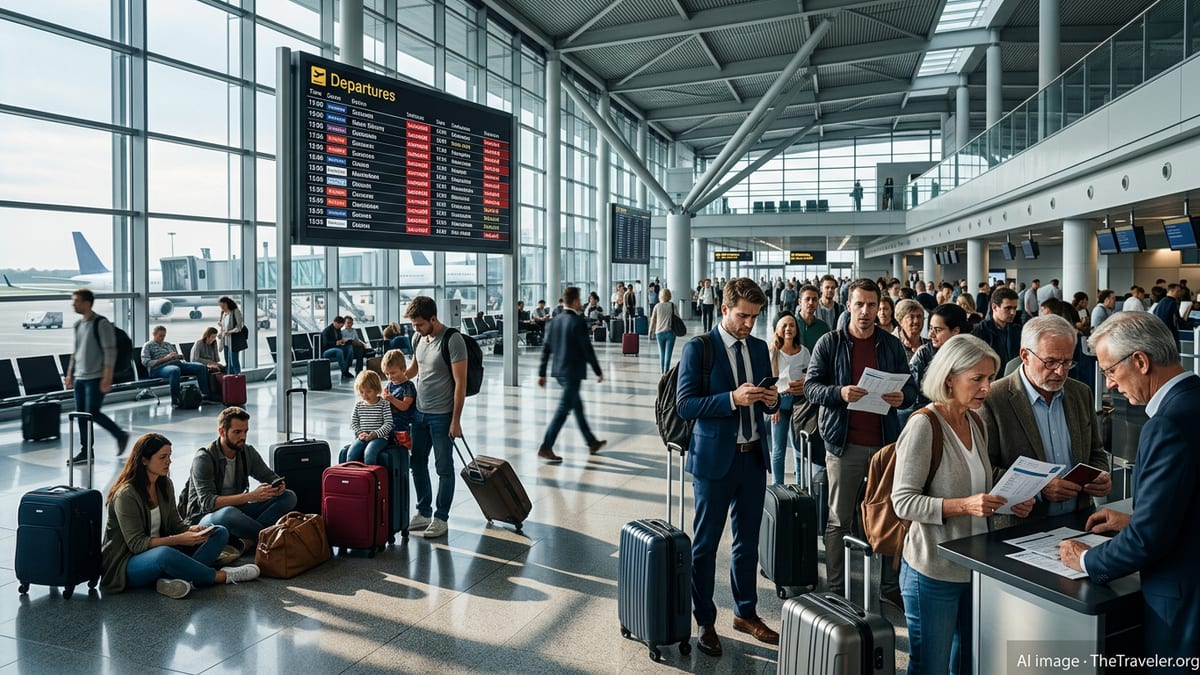
Images and testimony shared with Italian outlets show travelers lying on the floor of the departure hall at Bergen, using jackets and hand luggage as makeshift pillows. With hotels near the airport rapidly filling up during the peak season, many stranded passengers, including Italians, have reportedly opted to remain inside the terminal overnight to avoid further costs and the risk of missing a rescheduled departure.
Accounts gathered by several newsrooms indicate that basic services inside the airport have struggled to keep pace with the disruption. Passengers have described long queues for food and limited quiet areas to rest. When cancellations extend into multiple days, fatigue and uncertainty compound the stress, particularly for those traveling with children or older relatives.
Coverage from Norwegian media notes that some nearby airport hotels have been fully booked over the affected weekend, leaving late‑arriving passengers with few realistic options beyond sleeping in public areas of the terminal. For travelers unfamiliar with local transport or language, the prospect of searching for accommodation in the city center late at night can be daunting.
For the Italian traveler at the center of this ordeal, three unplanned nights in Bergen reportedly led to out‑of‑pocket expenses approaching 900 euros, including last‑minute hotel stays, meals, and local transport. Reimbursement, if any, will likely depend on the outcome of claims under European passenger‑rights regulations and the specific policies of her carrier and travel insurer.
Airlines, Strike Action and Passenger Rights
The wave of cancellations at Bergen has been linked in local coverage to industrial action among staff associated with air traffic management in Norway. Information published by airport operator Avinor urges passengers to monitor their airline’s updates closely in the event of a strike and to arrive with ample time for check‑in and security when flights do operate.
Airlines serving Bergen have responded differently to the disruption. Reports from Italian and Norwegian outlets note that some carriers have offered rebookings on later dates or alternative routings via Oslo or other hubs, while others have struggled to provide clear timelines, leaving travelers to refresh mobile apps and departure boards in search of news. In several cases highlighted by Italian media, passengers reported no meal vouchers or clear guidance on accommodation despite repeated cancellations.
Under EU Regulation 261/2004, passengers departing from a European Union or European Economic Area airport generally have rights to care in the case of long delays and to refunds or re‑routing after cancellations, along with possible compensation when the airline is responsible. However, whether industrial action by air traffic controllers qualifies as an extraordinary circumstance that exempts carriers from paying compensation can be complex and may depend on specific legal interpretations.
Italian consumer organizations and travel advisers commonly encourage affected travelers to keep all receipts for unexpected expenses, document cancellations in writing, and file formal claims with both the airline and any travel insurance provider. For visitors stranded abroad, consular websites also point to general guidance on alternative routes home by train, bus, or ferry where feasible, although such options are limited from western Norway.
Bergen’s Role in Norway’s Tourism Boom
Bergen’s position as a major tourism gateway has amplified the impact of the strike on international visitors. Official travel information describes Bergen Airport Flesland as a key entry point to the fjords, handling several million passengers a year and connecting cruise departures, scenic rail journeys, and popular fjord excursions.
During August, the city’s hotels, guesthouses, and short‑term rentals are often close to capacity as cruise passengers, hiking enthusiasts, and city‑break travelers converge. When outbound flights are canceled without warning, the pressure on local accommodation can quickly escalate, as stranded passengers compete for the same beds as new arrivals beginning their holidays.
Travel forums and recent visitor reports have long noted that Norway’s high season around Bergen can be unforgiving when plans change at short notice. The current strike has magnified those challenges: travelers arriving with prebooked itineraries suddenly find themselves extending stays in one of the country’s most expensive destinations, often without the cost protections they expected.
For Italian tourists used to more densely connected air networks in southern Europe, the reality of limited alternative routes from western Norway can come as a surprise. Once seats on the few remaining flights out of Bergen and Oslo sell out, options such as long‑distance buses, ferries, or multi‑day rail journeys across Scandinavia become the only paths home.
Lessons for Future Travelers
The ordeal of being stranded in Bergen has prompted many travelers to re‑evaluate how they plan trips to remote or high‑demand destinations. Travel advisers and online communities increasingly recommend building buffer days into itineraries that rely on a single key flight home, particularly during periods known for industrial disputes or extreme weather.
Recent events have also underscored the value of scrutinizing fare conditions and travel insurance policies. Not all tickets provide the same flexibility for rebooking in the event of cancellations, and some low‑cost fares may require passengers to shoulder accommodation and subsistence costs themselves when disruptions are deemed outside the airline’s control.
For visitors heading to places like Bergen, where tourism numbers are high but infrastructure is finite, guidance shared on official tourism portals and traveler forums emphasizes booking critical segments and accommodation well in advance, while remaining prepared for rapid changes. Carrying a financial cushion, maintaining open communication with employers back home, and having contingency plans for extended stays are increasingly seen as prudent steps rather than worst‑case thinking.
For the Italian traveler still waiting in Bergen for a confirmed seat home, the memories of Norway’s dramatic landscapes are likely to be overshadowed, at least for now, by the frustrations of nights on a terminal floor and unexpected costs. Yet her experience is also becoming a cautionary tale that may inform how others prepare for journeys to Europe’s most scenic, but sometimes logistically fragile, corners.